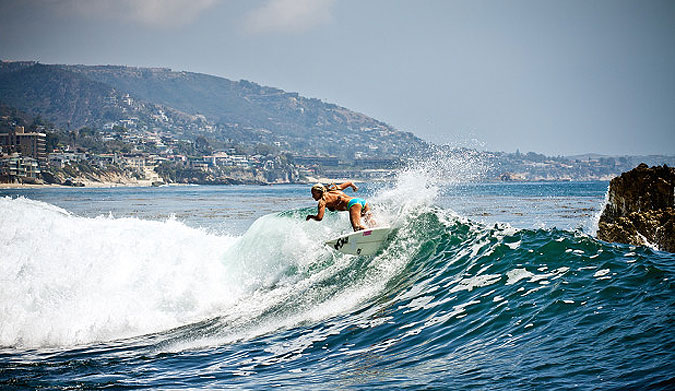
Taylor, backhand and at home.

MS: When did becoming a Political Science major first sound like a good idea?
TP: It’s been a little tricky navigating a big school like UCLA, but I’ve always been really passionate about the environment and business. I think it’s fascinating how much business has changed over the last decade to reflect our more eco-conscious society, and I’m excited to see how it evolves in the future. There’s no undergraduate business program at UCLA, so Political Science is a common major for students going into the working world. I’ve tried to tailor my Poli Sci and Environmental Systems and Society classes to address the relationship between the environment and business.
MS: Would I be wrong to imagine that you may have a JD in your future?
TP: Unlike most of my Poli Sci classmates, I will not be pursuing a JD in the future, but I’m hoping to go back to school for an MBA in the next couple years.
MS: Was UCLA your first choice?
TP: UCLA was my first choice, but I almost ended up going to Stanford. Now as a senior, I couldn’t be any happier to be a Bruin.
MS: Are you a Bruin fan, or, as a surfer, is school spirit lost on you?
TP: School spirit is definitely not lost on me. Just you wait until football season gets started!
MS: An excerpt from your contributor’s profile on The Inertia reads, “I loved competing, but when it came time to graduate high school, I decided not to try the WQS.” You’ll still be young enough to compete at an elite level after you collect your degree(s); so, do you think you’ll ever slog it out on the QS for a shot at surfing on theWomen’s World Tour?
TP: At this point in my life, I’m not really considering grinding it out on the QS. It’s fun to compete every once in a while, and I’m still absolutely in love with surfing and traveling, but there’s still much I want to explore beyond the contest scene. While traveling around the world surfing is appealing, if I were to try the QS I would want to be 100% committed to competitive surfing. Right now at least, I just don’t think I’m there. There are so many other things I want to be besides a professional surfer.
MS: In your mind, how has women’s surfing (professional or otherwise) changed the most since you started surfing as a 10-year-old?
TP: I think women’s surfing has changed a lot in two major ways: bigger airs and smaller bikinis.
MS: The most powerful marketer in surfing right now is a young woman by the name of Alana Blanchard. Much has been said and written about Alana’s social media prowess—Current Women’s World Champion, Carissa Moore even wrote about it. What are your thoughts on surfing and social media?
TP: I hope that as women’s surfing continues to progress, athletes are able to market themselves as they want. If girls want to wear small bikinis and model, and that’s genuinely a part of their personality, that’s totally great. If girls are passionate about music, art or other things, I think that’s incredible too. I just hope that as women’s surfing becomes increasingly popular and commercialized girls aren’t pressured into presenting an image that isn’t true to themselves. Surfing celebrates the individual, and I hope it remains that way for the next generation of female surfers.
MS: When did you first write about surfing?
TP: The first time I wrote about surfing was in my sixth grade language arts class. I wrote about the history of surfing. Since then, I don’t think I’ve ever stopped writing about surfing.
MS: What most informs your journalistic decisions? Do you simply write about whatever it is that interests you in the moment? Does virality ever influence your topic selections?
TP: I was an editorial intern at The Inertia this year, and I absolutely loved my time there. The company has such a fresh energy to it, and the guys who run it are brilliant. I was really fortunate that I got to publish a couple pieces I was really passionate about like “Higher Education: Maluhia Kinimaka is Going to Stanford,” “The First Time a Woman Surfed Mavericks,” and “The 5 Medical Applications of Surfing.” That being said, I was also an intern; so, I picked up some additional pieces the team needed me to cover as well.
MS: When you’ve taken your education as far as you wish to take it, will you come back to live in Laguna? If not, where would you most like to make a living?
TP: I’m not sure where I will end up, but I’m at a really exciting point in my life. I’m almost finishing my time at UCLA, and have so much of my future still undecided. I’d love to work abroad at some point, but I think I will always come back to Laguna. I just can’t imagine settling down anywhere else.
MS: Thanks, Taylor. All of Laguna will be cheering you on and will welcome home with open arms.
This interview was first published on LagunaBeach.com.

