
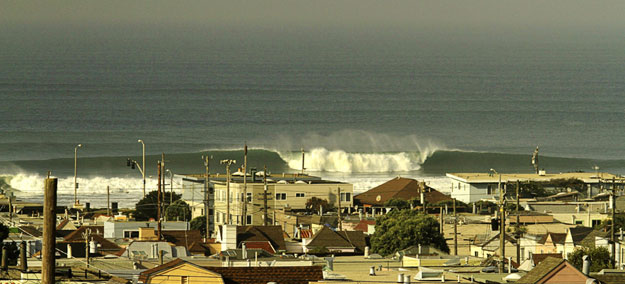
Classic Ocean Beach, nearly double overhead. Don’t even try and paddle out without finding a rip. Image: Ferraris

My father used to take us to Huntington Beach in the summer time. I still remember the first time I saw him body surf. He went flying by with a big smile on his face. I also remember the first time I got into deep water and my feet came off the ocean floor. I was a good swimmer with lots of confidence so I put my head down and swam like crazy. After a bit, I looked up and discovered I was still right next to my dad. With all that swimming I hadn’t moved from where he was standing. I lost some of my confidence and reached out and grabbed my dad.
My father laughed and said, “you are in a riptide. When you are in a riptide you should swim laterally to the rip and shore until you get out of it. Then swim in.” My father was teaching me a lesson that applies to much of life: Sometimes it does no good to fight against the current. Sometimes, you just have to go with the flow.
As waves crash to shore, the water eventually looks for a way back out to sea. A riptide is the long shore current flowing toward the deepest part of the sand bar to escape. Surfers get into the riptide in order to get out to the surf. It is like an escalator to the waves. On a big day at Ocean Beach, my home break in San Francisco, if you can’t find a riptide, you don’t even try to travel out.
The revelation that in surfing and life you just have to go with the flow opens a deeper lesson still: there is a flow to life. Dualistic thinking begins to break up. Life is not just a competition for me to subdue, a series of unrelated objects placed for me to exploit on the way to my goal. Danger and chaos here, and safety and order there. Sometimes, what is a problem in one situation is a gift in another. Chaos in one place becomes beautiful play in another.
To understand this thought better, let’s look at where the ocean waves that we surf or panic in come from. It helps to picture throwing a rock into a small frog pond. At the point of impact, there is a big splash with drops of water and waves of multiple shapes and sizes. But as the initial splash settles down and the waves move outward, they begin to stretch out and clean up. Soon you see no sign of the rock but the rings of waves moving across smooth water.
The Pacific is the frog pond, but instead of a rock, God throws wind through the dance, the give and take of high and low pressure. The friction of the wind on the water creates ripples which join together to create waves. Small waves join to form big waves and big waves join to form swell. Surfers want to be at a beach or point far enough from the storm, say 2,000 miles, that the different length and size of waves separate and clean up, but close enough that the swell still has size. Still, different size and length waves break differently at different locations.
Each reef and beach has its own personality and prefers a particular swell height, period and directions to others, and does different things on different local winds and tides. So, depending on the swell (long distance wind), the direction it is coming from, its height and period, and the local tide, local wind, contour of the land, family and work schedule, the experienced surfer decides where and when he or she may catch the biggest, most organized and cleanest surf possible.
Not long after that first lesson in the riptide, I became infatuated with surfing as after watching an amazing athletic display from the pier in Huntington Beach, California. In Huntington Beach, the competition for lifeguard is so great that virtually all good candidates are college swimmers. One day, my father and I were on the Huntington Beach pier watching the tryouts. Contestants had to swim through the surf, out to the end of the pier and back again. I was in awe of these guys. I wanted to be one of them. They were tall, lean and tan and all wearing red trunks and carrying a strap with a float tube. They raced at once into the sea, skipping and doing butterfly strokes to get into deep water. As they reached the surf line, some of them began to flounder, and I could see the look of fear on their face as wave after wave rolled toward them. The instructor yelled orders. Meanwhile, a group of surfers was out beyond the surf line waiting for waves. A young hot shot took off on a wave, did a few carves and had to jump off to avoid running over the lifeguards. Meanwhile, the guards in the lifeguard tower on the pier yelled on the loud speaker, “Surfers stay 100 yards north of the pier.” Just then the biggest set of waves we had seen all day came in. Way outside, a veteran surfer sat in perfect position, turned and stroked into the biggest wave. Meanwhile, the lifeguards-to-be on the inside looked panicked as they saw the monster wave bearing down and the veteran surfer screaming along the wave face. But the surfer had amazing control, bobbing and weaving through the string of terrified college swim team prize winners right underneath me to slash his way through the pier pilings and to the other side. It was one of the coolest athletic feats I had ever seen.
But what I didn’t know when I was a kid standing on the pier was that the surfer wasn’t a stronger, more gifted athlete and swimmer, but the guy who best knew his surroundings. When experienced surfers are talking with each other, what really makes their mouths water is not the description of human acrobatics or competition, but casting a vision of the alignment and flow of global forces.
Translated into a theological question: How did you read life around you to find the most joyous and powerful way to live today? How do you place yourself on the wave of your life? What wave do you find to ride? Despite the promoted few competitive surfers and their contests, unlike most other sports, surfing is more about the wave than the athlete or the competition. It is more about a relationship with the ocean than standing on a board and doing tricks. The wave itself is God’s trick, and the surfer just wants to be a part of it, to dare, to dance and to play with it. Who stands around after a game in awe of the basketball court? One court is the same as another, static boundaries within which humans display talent and compete against one another. Surf is God’s dynamic creation–beautiful, always changing, frightening and luring us.

