
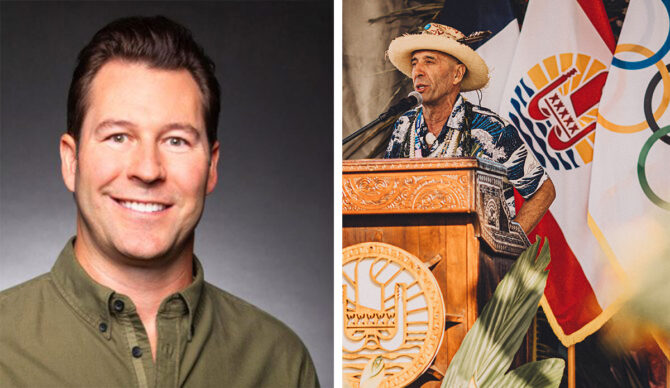
The WSL is urging for amendments to be made to the new LA 2028 qualification system. Photo: Linkedin//Pablo Franco//ISA

The World Surf League’s CEO Ryan Crosby said he’s disappointed by the lack of communication from the International Surfing Association in creating the updated qualification system for the LA 2028 Olympics. In a statement provided to The Inertia, Crosby said the ISA dodged meetings and emails, releasing the new system without the WSL’s input.
Here is the full statement from Crosby:
“The WSL supports our athletes and, together with the surfers’ representative body, World Professional Surfers (WPS), rejects the new qualification process put forward by the ISA. We believe that surfing’s success on the Olympic stage relies on the participation of the world’s elite surfers, and this new system compromises that goal.”
“We are deeply disappointed in the ISA and their complete lack of consultation throughout this process. They ignored our attempts at a reasonable partnership, canceling meetings and failing to respond to emails, while simultaneously pursuing back-channel discussions regarding qualification.”
“We want the world’s best surfers to represent their countries at the Games and we had a good system in place that delivered this in 2020 and 2024. The previous qualification process, which included a full season of Championship Tour competition, has been scrapped by the ISA without good cause.”
“WSL, and our athletes, are asking that the qualification process be corrected to ensure that the top-ranked surfers have a place at the Games, consistent with Tokyo and Paris. We hope to resolve this and move forward with what’s best for the sport.”
Why the CT surfers object
The ISA released the new system on Friday, immediately receiving a barrage of negative Instagram comments from WSL Championship Tour surfers. Those who voiced their opinions included reigning world champ Yago Dora, Filipe Toledo, Caity Simmers, Lakey Peterson, Leo Fioravanti, Luana Silva, Erin Brooks, Joao Chumbo, Tyler Wright, and Tya Zebrowski.
The crux of the CT surfers’ complaints is that the new system reduces the number of surfers who qualify directly on the tour. Previously, 10 men and eight women qualified via the pro tour, with a limit of two per country, while the new system limits the CT to five men and five women, with a limit of one per country. They also disagree that the CT rankings to decide who qualifies will be pulled from the first four to five events of the 2028 season (June 15 cutoff) instead of the cumulative, final rankings of the 2027 season. (Read our coverage of the system to understand all the major changes.)
Dora told Reuters that CT surfers had given feedback on a draft of the proposed system, but were subsequently excluded from the process.
“We don’t want an easier pathway to qualify than the rest of the surfers,” Dora said. “We just wanted it to be fair, and we want to make sure that all the best surfers are representing their nations in the Olympics.”
“If they are giving out those five spots, they should give it the most fair way possible — that would be counting the full year of 2027,” he added.
View this post on Instagram
The ISA’s counterpunch
However, the CT surfers’ points were not met without opposition. The ISA, a world champion, and Olympic surfers supported the new system. They underlined how the new system creates more opportunities and requires the CT surfers to fully participate in the World Surf Games instead of losing on purpose, or skipping it altogether.
In the same Reuters article, ISA Executive Director Robert Fasulo highlighted how the new system actually creates more qualification opportunities for CT surfers, given they can compete in their continental championships or the next three editions of the World Surfing Games.
“There are more pathways with the new system,” said Fasulo. “Let’s not forget that the men’s 2024 Olympic champion and bronze medallist both qualified through the ISA World Surfing Games.”
Sofia Mulanovich, the 2004 WSL world champion, Tokyo 2020 Olympian, and two-time ISA gold Medalist, defended the system on the merits that the Olympics are not designed to mimic a professional tour.
“(The Olympics) are about giving real and fair opportunities to qualify, especially for surfers who don’t have the financial means to travel and compete in the full (championship) tour,” she wrote in an Instagram comment. “The fact that the ISA now has more spots, and that there are more spots overall, makes this a true win-win: more opportunities and a stronger, fairer competition.”
Chile’s Manuel Selman, a Tokyo 2020 Olympian, also wrote a lengthy post in favor of the new system.
“Yes, CT surfers are the best in the world,” he wrote on Instagram. “No debate there, but being the best doesn’t automatically entitle you to redesign the Olympic system. If you want the spot, go win the ISA event. That’s how Olympic qualification works in almost every other sport on Earth.”
“Surfing can’t demand to be treated like a global Olympic sport while insisting its private professional tour should dominate the pathway,” he concluded.
As the debate continues to rage on social media, all indications thus far point to the system being finalized in its current form, despite the WSL’s calls for amendments.

