
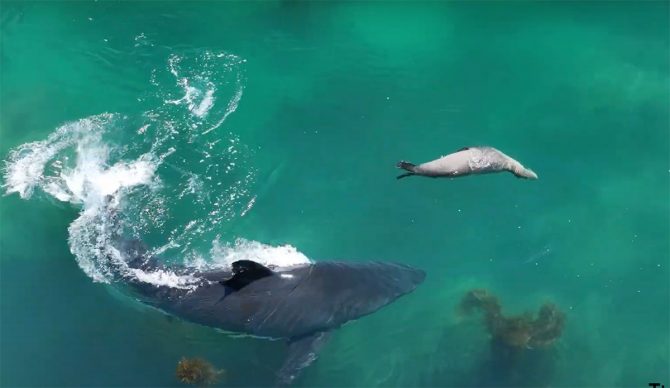
After five great whites passed up an easy meal, the sea lion ended up washing ashore. Photo: YouTube//Screenshot

The circle of life can be a tough thing to watch. Unless you’re completely heartless, even the most avid hunter will tell you that killing an animal can weigh heavy on the heart. We’re lucky as humans. For the most part, we get our meat while being able to ignore where it came from. But it certainly is important to understand that a steak isn’t just a steak — it was an animal that lived and breathed. In nature, predators need prey, and in general, know exactly where their meals come from. In Carlos Gauna’s latest YouTube video, he films five great white sharks surrounding a sick sea lion.
Gauna spends much of his time flying a drone above the sea looking for great whites for his YouTube channel, The Malibu Artist. He finds plenty of incredibly interesting things to film that aren’t great whites, but the great white is generally what he’s focused on. California’s coast is his main stomping grounds, and there’s no shortage of sea lions there.
“California is home to one of — if not the largest — populations of sea lions in the world,” Gauna says. “Because there are so many, it is no surprise that predators that feed on them can be found nearby. Perhaps no creature is better known as the foe of the sea lion than the great white shark.”
The sea lion seen in the video here is likely suffering from domoic acid poisoning, which has caused the deaths of many sea lions in recent months.
“Domoic acid (DA) is a neurotoxin produced by the microscopic marine algae, Pseudo-nitzschia,” Channel Islands Marine & Wildlife Institute explains. “This phytoplankton grows when our coastal ecosystem provides favorable conditions, such as when upwelling of water causes the nutrients from deeper water to rise to the surface where sunlight is present which proliferates algal growth. This typically occurs during transitional periods in the spring and fall.”
As is generally the case in nature, the weak, young, or sick are weeded out first. “Observing the scene,” Gauna continued, “you undoubtedly know why the sharks are there. White sharks, like most predators, are animals of opportunity. But this encounter was a surprise, and it ended in a way that was not at all what he expected.
After the sharks passed on the easy meal, Gauna theorized that the sharks might have known the risk was higher than the reward.

