
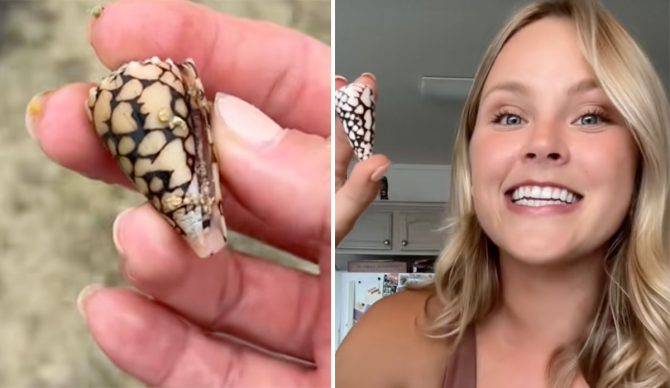
If you see a shell in a tide pool and it’s got a creature in it, it’s best to just leave it alone. Photos: TikTok//Screenshot

A TikToker has an important message after she inadvertently handled a type of snail that no one should handle: don’t handle shells if you don’t know what they are.
On June 11, Becky Lee Rawls posted a video of the day she was on a beach in Okinawa, Japan, looking for pretty little shells. When she spotted one that fit the bill, she grabbed the small, innocuous looking thing, a mottled off-white struck through with a dark brown pattern. What lurked inside that pretty shell, however, was one of the world’s most deadly creatures.
The cone snail is a weird little thing. Although it’s a snail, it’s a predator. Humans aren’t on their list of things they prey on, but they’ll give you a hell of a notice that we’re lucky we aren’t.
“The handful of humans that are stung by a cone snail is often subject to a venom potent enough to immediately paralyze and eventually kill its prey,” the National Library of Medicine wrote. “The venom from one cone snail has a hypothesized potential of killing up to 700 people.”
Rawls, who collects shells, had no idea what she was holding onto until afterwards. “When I first saw the shell, I was just focused on how beautiful it was,” she told Newsweek. “I’ve picked up so many shells while at the beach before without hesitancy. I didn’t even realize it was alive at first.”
@beckyleeinoki Received a ton of questions on my last video so this addresses the top concerns! ? #conesnail #oceansafety #seashells #beachcombing #shelling ♬ original sound – beckylee?
When she got home, though, she did a quick Google search and quickly realized how lucky she had just been. “That’s when I realized I was playing with the most venomous creature in the ocean that can lead to full paralysis or even fatality,” she said in a follow-up video.
If you are stung by a cone snail, you’re going to know it, and Rawls clearly wasn’t. Her video of the almost-bad situation went viral, though, garnering over 25 million views in the following days, mostly from people who had no idea that cone snails existed.
“It really showed me how little known this danger is, which made me feel like sharing it was the right thing,” Rawls continued in Newsweek. “I still love the ocean, and this won’t scare me away, but I’m way more cautious now. I treat anything unfamiliar with respect and distance. I’m grateful for whatever reason the snail did not sting me and to have this second chance.”

