
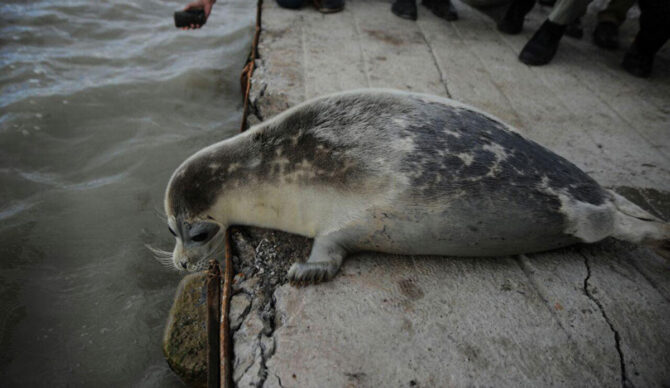
Caspian seals are listed as endangered, so losing 500 of them is a massive blow. Photo: Wikimedia Commons

Caspian seals are in a bad way. They are classified as endangered on the IUCN red list of species threatened with extinction, and their already dwindling numbers were recently dealt a severe blow when almost 500 of them washed up dead on the coast of Russia’s Caspian Sea.
“So far, 484 seal carcasses have been found washed ashore,” Dagestan’s natural resources ministry said in a telegram message to the press. Dagestan is a Russian republic situated along the Caspian Sea.
Although the cause of the deaths hasn’t been confirmed at the time of this writing, officials are working to determine what killed them. But there is a working theory.
“We ask journalists and bloggers not to jump to conclusions and to await the expert opinion,” the telegram message continued. “The death of Caspian seals during migration is a tragic but annual natural phenomenon throughout the Caspian Sea, including the coasts of Dagestan, Kalmykia, and Kazakhstan. Scientific research over the past several years, including virological analysis, has never confirmed the theory of mass infectious diseases. Scientists believe the main cause is asphyxiation (suffocation) of animals passing through zones of powerful natural gas emissions (methane, hydrogen sulfide) from the seabed associated with seismic activity. The Ministry of Natural Resources of the Republic of Dagestan will monitor the situation and inform the public about the results of the surveys and laboratory tests.”
Environmental groups are skeptical of that theory, though, and many of them say that the authorities are likely passing the buck away from human causes. The Moscow Times wrote that, “Independent outlets have reported concerns that industrial trawl nets may be suffocating the animals without leaving visible injuries, a suspicion raised during previous die-offs.”
This is far from the first time mass seal deaths have been reported in the area, the worst of which came in 2022 when over 2,500 carcasses were discovered strewn across miles of coastline. Since the beginning of the 20th century, Caspian seal numbers have plummeted by more than 90 percent, and those numbers are still dropping about 3-4 percent every year. The widely accepted reasons for the seals’ discouraging numbers are hunting and pollution.

