
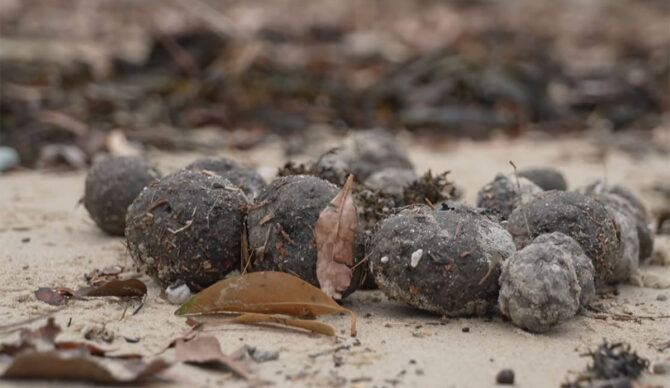
Forbidden energy balls, courtesy of the Malabar System’s fatberg. Photo: YouTube//Screenshot

If you spend much time tromping in the sand at various beaches around the world, you may be familiar with those little balls of tar that get stuck to your feet. But if you’ve been tromping around on a various beach in the Sydney area, they might not have been tar balls. They might’ve been poo balls. Poo balls from a fatberg.
It all started back in 2024, when beaches across Sydney, including Coogee, Clovelly, Maroubra, Bondi, Bronte, Congong, Frenchmans, Little Bay, Malabar, and Tamarama beaches, began to be inundated by little dark balls. But a quick sniff made it fairly apparent that those little dark balls were not, in fact, tar. After authorities took samples and did an analysis, they found that the balls contained all sorts of stuff.
“The balls contained traces of cooking oil, soap scum, hair, human fecal matter, veterinary drugs, blood pressure medication, PFAS (aka “forever chemicals”), and the psychoactive substances THC and methamphetamine,” wrote IFLScience.
Now, a few years after it all began, the cause of the balls of poop and drugs and oil has been discovered: the Malabar System, a wastewater management system that captures wastewater from the Parramatta River in the north to Botany Bay in the south and west to Leppington and south to Campbelltown. That area has a lot of people, and all those people are pooping and throwing things down the drain.
“They smell absolutely disgusting,” Professor Jon Beves told 9News. “They smell worse than anything you’ve ever smelled.”
The Malabar System did its job just fine for a long time. Around two million people got to ignore where their poop and drugs and wet wipes and bacon grease were going, but then something went wrong. The system, possibly overloaded, developed an enormous “fatberg,” the likes of which became famous after the world learned about the horror that was the London Fatberg, also known as the Whitechapel Fatberg. Fatbergs are made of congealed fats, oils, grease, and items like wet wipes, diapers, and sanitary products that are flushed down drains every day. They form huge, solid globs that are difficult and disgusting to remove and dispose of. The London Fatberg was 820 feet long and weighed around 130 tons, so you can imagine what that would do to a sewer system.
Anyway, the Malabar System got its very own fatberg, and according to reports, it is HUGE. It’s about the size of a Boeing 737, and when it rained harder than usual, chunks of it were dislodged and spat out to sea, where they clumped together and washed ashore for people to step on.
According to The Guardian, “Sydney Water is now regularly cleaning an accessible part of the system, which is ‘an extremely risky operation.’ In April 2025, it removed 53 tonnes of accumulated FOG [fat, oil, and grease] including debris balls.”
But still, the issue remains. The fatberg, while smaller, is still there, and the people, as people are wont to do, are still pooping relentlessly. What does one do in a situation like this? Well, authorities are spending $3 billion AUD (about $2 billion USD) on a plan that they hope will solve the pesky little issue in about a decade. It’s an upgrade to the system by the New South Wales government, and it aims to reduce the amount of wastewater going through the system while also teaching people how to get rid of things like fats, oils, and grease.
“Sydney is a rapidly growing city and no one wants to see debris balls washing up on our beautiful beaches again – but the truth is our wastewater system needs an upgrade to keep pace with the population,” said Minister for Water Rose Jackson in a release. “For too long, a lack of investment in essential infrastructure in Western Sydney has been a handbrake on our housing goals. We can’t undo that overnight, but we’re getting on with the job of clearing this backlog.”
With any luck, the Malabar System’s constipation issue will be solved by a $3-billion influx of Metamucil, but only time will tell. In the meantime, if you’re on a Sydney Beach… watch where you step.

