
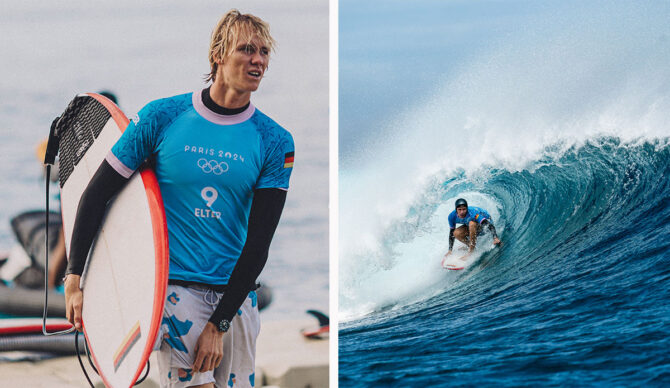
Tim Elter has mixed feelings about reports that big changes are coming to surfing’s Olympic qualification system. Photo: Pablo Franco//Pablo Jimenez//ISA

News broke last week of an overhaul coming to surfing’s Olympic qualification system. AOS Midia, a Brazilian surf outlet, received alleged details of the changes that would alter how surfers qualify for the sport’s third Olympic appearance at LA 2028.
In summary, the new system would add more weight to the ISA World Surfing Games and less to the World Surf League Championship Tour. Only five men and five women would qualify through the CT — one surfer per country — as opposed to 10 men and eight women, two surfers per country, which had been the standard through the first two editions of the Olympics. The rest would earn their slots at the World Surfing Games.
When reached for comment, the International Surfing Association didn’t deny the details of the report, only confirming that a version of the qualification system had been submitted to the IOC for approval.
We reached out to several Olympic surfers for their perspective, but most understandably didn’t comment, given that the system isn’t finalized. However, we spoke with 22-year-old German Olympian Tim Elter. Having honed his skills in the Canary Islands, Elter represented Germany at the 2024 Games in Tahiti.
Elter said he has “mixed feelings” about the reported qualification system for 2028.
He stressed how hard the system already is for surfers from dominant surfing nations due to the limit of two surfers per gender per country (with a bonus third slot introduced in 2024). The new system would intensify this bottleneck, he said.
“You basically need to be final five to qualify (on the CT), which makes it really hard,” said Elter “If there’s years where there’s a really dominant nation, it could leave top CT guys out of the draw.”
The new system opens opportunities for more countries, Elter explained, which mathematically favors surfers from less dominant surfing countries, like himself, compared to the previous system.
“More smaller surfing countries would bring more diversity, which I think is great,” Elter said. “In the end, the Olympics are all about diversity. It’s been really hard to get smaller surfing countries into it, so it could be an opportunity.”

Elter earned an equal 17th at the Paris 2024 Games in Tahiti. Photo: Pablo Jimenez//ISA
While there would be more slots open to surfers not on the CT, in theory, the new system would also increase the competition at the World Surfing Games, making it harder to qualify than in the past. He acknowledges that this could be frustrating for CT surfers who are accustomed to getting their slots via the yearlong tour.
“It’s not going to make any distortion in the results, which was a big drama in the last (ISA) qualifiers in Puerto Rico, or even in the qualifiers for Tokyo 2020,” said Elter, referencing how in the past, CT athletes had dodged their World Surfing Games duties, or not tried their hardest when their qualification was already secured via the CT. “If you have a heat with three CT guys, and two of them are just going to give up, you’ll (automatically move on), where someone else has to battle it out with three hungry guys.”
“I remember on the girls’ side in the qualifiers in Puerto Rico, there were three girl heats where two CT-qualified women just gave up, and one girl moved on without doing anything really,” he added. “So I think that’s the fact, that the CT guys will have to earn their spots – not just participate in good faith, but really show what they have. I think that makes it more fair for everyone.”
Elter also looks at the broader Olympic movement and surfing’s somewhat unique position in using a blend of international federation results and a private professional tour to qualify Olympians. Other sports, such as golf and skateboarding, also partner with private tours. But some sports, such as swimming, solely use international federation rankings.
“Maybe it’s easy for me to say, since I’m only surfing ISA at the moment, but I think it’s cool,” said Elter. “I like to see the ISA get more weight and more relevance, to be honest.”
Regardless of the qualification system, Elter believes that the field of athletes for surfing needs to expand. The ISA had requested 12 additional shortboard slots for each gender, as well as new longboard divisions, but that was denied by the IOC last year.
“Surfing has a really narrow field,” said Elter. “It’s really hard to qualify as a surfer. Whereas, for example, let’s say biathlon in the Winter Games (210 athletes, 29 countries), there’s way more diversity. You see guys from countries that are not really known for the sport, and they’re representing and raising their flag.”
“In the end, the passion of the Games is exactly that – these underdog stories,” Elter concluded. “If you keep the field narrow, there’s not much room for these stories. Of course, the qualifying has got to be demanding, but it would be good if they could even expand it, more athletes from different countries.”

