
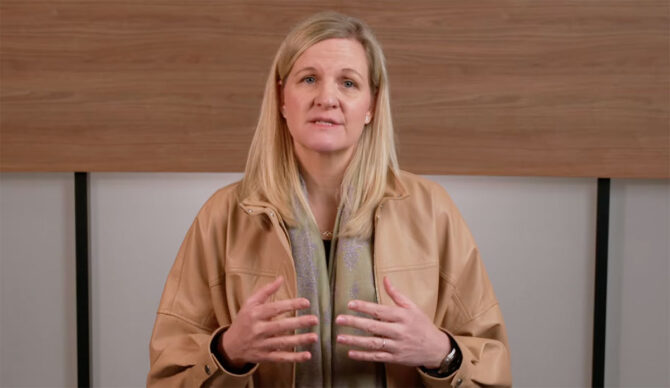
Kirsty Coventry, IOC president, explaining the decision to ban transgender athletes from women’s events in the Olympics. Photo: IOC//Screenshot

The International Olympic Committee (IOC) has ruled that transgender athletes are not allowed to compete in women’s events at the Olympics.
“Eligibility for any female category event at the Olympic Games or any other IOC event, including individual and team sports,” the International Olympic Committee said, “is now limited to biological females.”
Athlete eligibility will be determined by a mandatory gene test that looks for the SRY gene, a part of DNA that is found on the Y chromosome that “initiates male sex development in utero and indicates the presence of testes/testicles.”
There aren’t many examples of transgender women competing in women’s events — aside from Laurel Hubbard, a New Zealand weightlifter who didn’t medal at the 2020 Tokyo Games — but the policy lines up with President Donald Trump’s executive order, titled “Keeping Men Out of Women’s Sports” that pertains to the 2028 Los Angeles Games.
According to reports, the new policy will apply from the Los Angeles Olympics in July, 2028. “It is not retroactive and does not apply to any grassroots or recreational sports programs,” the IOC said.
The eligibility policy “protects fairness, safety and integrity in the female category,” the IOC said. Kirsty Coventry, IOC president, gave the reasoning for the committee’s decision in a statement.
“At the Olympic Games, even the smallest margins can be the difference between victory and defeat,” she said. “So, it is absolutely clear that it would not be fair for biological males to compete in the female category.”
While gender and sex — and the differences between them — have been a point of contention, especially in the last few years, it’s not a black and white issue. The majority of humans have 46 chromosomes in each cell. Men generally have one X and one Y, while females have two X chromosomes. But every now and then, a person can have an extra Y chromosome. According to the National Institutes of Health, XYY syndrome occurs in 1 out of every 1,000 boys.
That, of course, is not the norm, but it can happen, which could make the genetic testing a little tricky. Before the Paris Games in 2024, three sports excluded transgender women from competing if they had been through male puberty. Testosterone levels can fluctuate, too. Take, for example, two-time Olympic champion runner Caster Semenya. She has a condition called DSD, which gives her more testosterone than most females. She has a male-typical XY chromosome pattern, but also has physical traits that females have. DSD is more commonly known as intersex.
In the surfing world, there aren’t many examples, either. Sasha Jane Lowerson was at the center of a dispute when she became the first openly transgender female to win a surfing competition.
The IOC released a document that showed its research into whether being born with an XY chromosome pattern does give physical advantages. According to the document, males have a performance advantage over women that is “10-12 percent in most running and swimming events,” and at least 20 percent in “most throwing and jumping events,” but “can be greater than 100 percent” for explosive power events, like boxing.
“Males experience three significant testosterone peaks: In utero, in mini-puberty of infancy and beginning in adolescent puberty through adulthood,” the document said. This give males “individual sex-based performance advantages in sports and events that rely on strength, power and/or endurance.”
It’s a complicated issue, but the IOC is confident its research was thorough and that it has come to the right decision. The research used “in-depth individual interviews with impacted athletes from around the world,” and the IOC says that the gene test is “the most accurate and least intrusive method currently available.”
In 2022, the ISA released its policy around transgendered people competing. It required that a transgender woman have “serum testosterone concentration (of) less than five nmol/L (nanomoles per liter) continuously for a period of the previous 12 months.” An ISA contact said that it was too soon to say whether the IOC’s decision will affect the ISA’s policy.

