
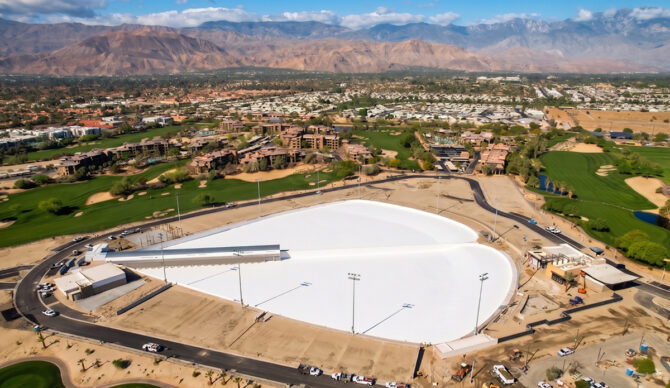
The Wavegarden pool under construction at DSRT SURF in Palm Springs, California. Photo: Wavegarden

It feels like a lifetime ago that Kelly Slater unveiled his clandestine wave pool project in the Central California farmland. It’s been a little over a decade since that watershed moment, and a lot has transpired in the wave pool space since then: dozens of pools have been constructed, early adopter surf parks have closed, world tour events have been held in pools, former pro surfers have entered the fray, and technology companies have engaged in legal battles over patents.
More recently, Germany’s first pool, SURFTOWN MUC, announced it is partnering with car manufacturer, Citroën, suggesting that there are still large, untapped commercial opportunities for pools beyond solely selling tickets to customers. It made me ponder: how much money are these proliferating wave pools actually making? Are they on track for long-term financial success?
To get a pulse of the industry’s finances, we tapped wave pool expert Bryan Dickerson, the founder and editor of Wave Pool Mag. Dickerson, who has traveled the world surfing and reporting on new parks and wave technologies, gave us his thoughts on the business side of surfing in pools.
We have a decade or so of data on publicly operated surf parks. From your point of view, what is the financial state of the industry? Are they making good money, breaking even, struggling?
Well, no one is open about their books. So what I see from here, and what interests me in the context of Wave Pool Mag, is that we can look at how each operator of a surf park is fine-tuning their customer journey, their wave settings, and their operations to suit their clientele, whether it’s local or international, new surfers or experienced surfers. There are so many layers to operating a surf park. And every park is operating differently than they had when they first opened. Before COVID, there was this halcyon view that someone would come up with a plan, there’d be a cookie-cutter approach, and they’d do it to all their surf parks. They’ll have 10 parks in 10 years or five in five years — whatever they put on the press release.
But we’ve learned post-COVID, with higher operating expenses and construction costs, that a lot of the models have been adjusted, and in that adjustment, the best way to make sure you recoup your costs is how you operate your wave pool. Everyone seems to be fine-tuning that, and there’s not a whole lot of data. As far as how much they’re making, I don’t know. There’s money to pay back investors, and there’s operating costs.
The only signs you have that it’s not going well are parks that have closed, N-Land and Surf Snowdonia, which, in both cases, the failures were more technology-based. But since then, technology has evolved to deliver what people need in a wave park: throughput — other than the Kelly Slater wave technology, which has one wave every four minutes. But because it’s Kelly Slater, they were able to pump money into a foil track system and then market it as very exclusive, which has worked wonderfully. And you can only really do that if you have a brand name like Slater. Everyone else in the technology space has gone towards more wave settings, more throughput for users and the lagoon, and more fine-tuning waves, which works best for the operators, because they can tweak it.
Five years back, there was a huge proliferation of parks around the world. Do you think the demand for surf parks was correctly forecasted?
I think it was over-forecasted, because if you look at our wave pool map, we have more than 100 projects on there, and a lot of those were pie in the sky, high projections. Still, people love to surf, and any way you can bottle that, which is often wave pools, they’re going to get behind it and often invest money to get the idea off the ground. I think five years ago, you had a lot more of what we call “dreamers,” and these are people like, “I really want to do a surf park,” and that hadn’t really met with the cold, hard cash aspect of it.
So in the next five years, are you expecting the growth percentage of surf parks to slow down?
Yeah. You’ll see fewer projects announced than you did in the halcyon days, around COVID. But the ones that are announced will be more solid, because people have experience, they know what it takes to build a surf park now.
Is there anyone getting rich off surf parks? Or is it still mostly people of passion who do it because they like surfing?
The Surf Ranch in Lemoore is probably making the most money, I would guess, due to a $30-million wave pool and what they charge for people to visit. But other parks are doing extremely well. The O2 SURFTOWN in Munich is doing well. URBNSURF Sydney is doing well, and there are a few others, but those are the first three that come to mind.
Do you think those parks nailed the local market in offering clientele what they want?
Well, if you look at Munich, it’s like it was made in a laboratory to have a successful surf park. You have an ocean-less, dedicated core surf community that depends on a river wave. And as far as Europe goes, the German economy is strong. So people have disposable income. The whole club, coaching, and improving your surfing mentality is pretty ingrained when Germans take up a new sport. So I think it’s been really well received.
View this post on Instagram
The Munich pool announced a new car partnership. Is sponsorship a wave-pool revenue source that maybe we didn’t factor in eight, 10 years ago?
What’s happening is, in certain park operations, there are so many layers to it that having corporate sponsors is not like a windfall or a cash cow. In some cases, it can be, if it’s a very large agreement. But on the smaller level, if you’re talking about surf brands, car makers, watch makers, every little bit helps, but I don’t think there’ll ever be a point where it’s like, “Oh, let’s open the surf park, it doesn’t matter how we operate it, as long as we get the advertising revenue.”
Has anything surprised you about the way surf park business models are adapting — something you didn’t foresee?
I’m amazed at the surf brands taking so long to show interest. For example, Endless Surf gave a speech at a SIMA (Surf Industry Members Association) summit, and no one had been to a wave pool, except for a handful of people. So now they’re scrambling, going, “Oh, you know, that’s good for the surf industry because there are more surfers.” My inbox is filling up with surf brands that have questions. But before that, there were brands like Sun Bum, Rip Curl, FireWire, that really worked hard to make sure that when a surf park opens, they’re represented. So it’s been a mixed bag. Some surf brands were ahead of the curve, getting into wave-pool surf shops. And now there seems to be a big push from the generic surf industry to want a piece of wave pools.
Are there any other creative revenue sources that you’ve seen wave pools tapping into?
One of the coolest things is something like Flowstate, where you can purchase videos of your session afterwards. The business was born in Melbourne at URBNSURF. It’s very much a tech company that is now at several pools around the world, including Palm Springs and Waco. They’ve now gone to the beach, where they figured out how to use similar technology with phones so they can record surf clubs, and they’re doing snowsports, really expanding. I think it might be the only company that started in a wave pool and then expanded to more traditional action sports, locations, and venues.
Twenty years from now, do you think there’ll be a wave pool technology or business model that prevails as the winner among those that we see now?
It’ll be similar to what we see now. You won’t see a “Top Golf” format — everyone uses that comparison — where it’s the same at every location. The coolest thing about the wave pool space is that each pool that opens is very much unique and endemic to its community, its surroundings. The cookie-cutter approach doesn’t really work. So there’s not going to be a big franchise.
But I think you will see more residential developments where they put a wave pool in the middle, and then the property values go up. You’ll see more developments like Cabo San Lucas, which should be open in September, and developers like that because it’s cut and dry. You build it, and then you sell it.
What are the biggest challenges and opportunities that the industry faces?
The biggest challenge is technology companies calling each other out, because when they do that, investors think the space is a little too erratic or unsophisticated for them to pump millions of dollars into. So that’s a threat. There needs to be more support within the surf park developer and technology companies, technology makers, wave makers — more cooperation, because the biggest threat is that everyone goes their own way and acts like they’re an island and don’t cooperate or don’t work with one another.
The biggest opportunity would be for wave pools that can identify a community in need of something like surfing, like what Munich did. If there are projects around that identify an area like, “We have this enthusiastic base, we can put a wave pool here, and work with the community and get something going.” That’s the biggest opportunity culturally, because that builds like a whole surf scene, which is really neat to have your own spot, your own group that gravitates towards this one place. You can see a culture being born and hyper-accelerated. It’s not evolving over the years like Malibu or something like that.
The biggest opportunity commercially, I think, will be for those brands — endemic and non-endemic to surfing — that really take the time to work with a surf park operator and understand who their customers are, and tailor their partnerships and marketing toward that developing community. James Miles at URBNSURF has done a great job with partnerships. Some of the stuff you see coming out of SURFTOWN Munich has done really well. I was just in Switzerland, and Alaia Bay has some great partnerships going as well. And they’re all commercial partnerships that came from hard work and really understanding who is going to the wave park, rather than just saying, “We’ll get you 100 towels and put up our banner.”

