
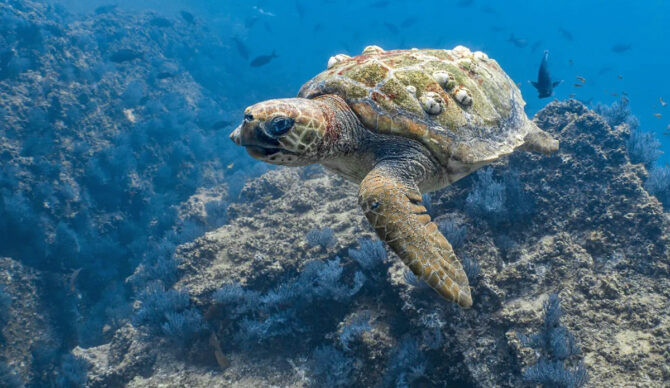
Conservationists expect sea turtles to flock to California during the incoming El Niño, and they’re urging the government to prepare for it. Photo: Baja Underwater Expeditions//Facebook

A conservation group is demanding that the National Oceanic and Atmospheric Administration implement new fishing regulations ahead of a powerful El Niño event that could attract droves of loggerhead sea turtles. The Center for Biological Diversity says they’ll sue if NOAA doesn’t act by June 1.
Loggerhead turtles, an endangered species known for their long migrations, typically aren’t found in California waters. But during years with unusually warm ocean temperatures — conditions expected to develop as El Niño strengthens later this year — the turtles have been known to migrate north. During the last strong El Niño in 2015, one study estimated that roughly 70,000 loggerheads moved into Southern California waters.
The conservation group is asking NOAA to temporarily ban the use of “swordfish drift gillnets,” a mile-long mesh net left submerged in the water for 12 to 14 hours at a time to catch thresher sharks, swordfish, and other large fish. The nets, however, pose a threat to turtles and other marine animals.
The swordfish drift gillnet fishery spans from the Mexican border to Oregon, and is open from May 1 to January 31, with defined rules about how close to shore the nets can be used during specific timeframes.
In 2024, NOAA temporarily banned the use of the nets in Southern California for three months due to El Niño conditions that could have drawn in turtles. They also implemented the closure in 2014, 2015, and 2016. The extreme conditions expected to occur during this upcoming El Niño would be even more reason for them to close it again. NOAA itself lists gillnets as a threat to the turtles.
“Drift gillnets always wreak havoc on ocean life, but it’s especially critical they be pulled from California’s water before endangered loggerheads arrive this summer,” Catherine Kilduff, a senior attorney at the Center for Biological Diversity, said in a press release. “Thankfully loggerheads have a built-in regulatory protection from these mile-long nets when ocean conditions bring the sea turtles to southern California to feed. Federal officials just need to establish the loggerheads’ conservation area, and they should do that immediately.”
Loggerhead habitat ranges across the Pacific, Atlantic, and Indian Oceans. The Pacific populations nest in Japan and Australia, traveling across the ocean to Baja California, Peru, and Chile to feed before returning to the beaches where they were hatched. According to NOAA, the species has suffered a decline of 50 to 90 percent over the past 60 years due to bycatch in fishing gear, harvest of turtles and eggs, loss of habitat, pollution, vessel strikes, and changing environmental conditions.

