
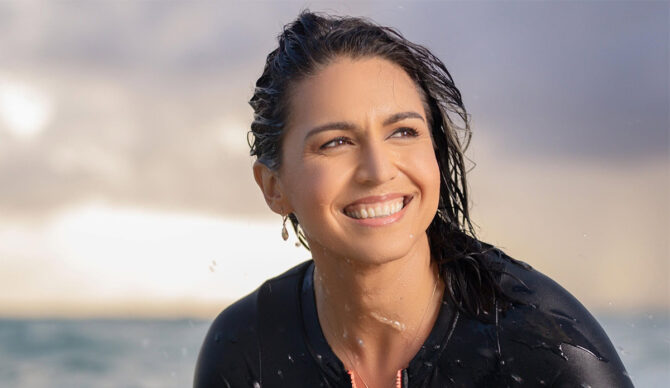
Tulsi Gabbard has strayed a long way from her political ideals that once made her popular in the surfing community. Photo: Tulsi Gabbard//Facebook

It appears Tulsi Gabbard, the former progressive congresswoman, surfer, and ex-member of President Donald Trump’s cabinet, might have more skeletons in her closet than any of her constituents realized. Few politicians have undergone the ideological transformation Gabbard has, and a new report in The Washington Post alleges that she was heavily influenced by a divisive religious leader whose network used fake social media accounts to shape public narratives around the Hawaiian politician.
The article, published June 21, draws on tens of thousands of files and communications provided by a former member of a Hare Krishna-affiliated religious group led by Chris Butler – known as the Science of Identity Foundation. Former members have alleged the group functioned as a cult, claiming Butler exerted control over followers’ major life decisions while maintaining a deep interest in political influence. The SIF mixes yoga with aspects of another religious movement, Gaudiya Vaishnavism. It asks members to practice vegetarianism, refrain from alcohol use, and is also known to be anti-homosexual and anti-Islamic.
According to the report, both of Gabbard’s parents held senior positions in Butler’s group, and Gabbard herself had called Butler her guru. Some former members claim her unprecedented rise in politics as a 21-year-old elected to Hawaii’s House of Representatives — and then U.S. Congress — is a direct result of Butler’s influence.
The files and communications obtained by the Post reveal the extent of the influence an anonymous figure — whom the evidence suggests was Butler — allegedly wielded over Gabbard. Thousands of emails, Skype messages, and meeting transcripts between Gabbard, the anonymous figure, and members of the religious group show how directives attributed to him often became reality. According to former members, Butler did not use a computer; instead, delivering instructions verbally during meetings that were later transcribed and circulated. Gabbard introduced legislation that originated in those communications. She repeated talking points from the messages — sometimes verbatim — in television appearances.
The files also indicate that both the anonymous figure and Gabbard instructed members of the group to use fake social media profiles — some of which remain active — to influence how she was portrayed on social apps and in news coverage.
“Why didn’t we get our talkers to comment?” Gabbard wrote in a communication referring to an online article that labeled her as having “loony foreign policy positions.”
Butler’s aide, Sunil Khemaney, denied the claims and later said that he was behind the anonymous messages, despite some of those messages referencing him in the third person. A spokesperson for Gabbard told The Inertia that the story was “false” and “a blatant example of anti-Hindu bigotry,” but did not provide any evidence to rebut the claims made in The Washington Post story.
This outside influence could explain Gabbard’s political transformation from Bernie Sanders supporter to conspiracy theory peddling, MAGA bootlicker. During her rise, she became popular among progressive leftists, especially surfers, for her aloha messaging, environmental protection stances, and non-interventionist approach to international relations. She even flirted with a 2020 presidential run, and apologized for past anti-LGBTQ beliefs.
Gabbard was a keynote speaker at The Inertia’s first EVOLVE Summit, advocating for inclusiveness, climate action, and anti-war policies. She stunned many of her early supporters by endorsing Donald Trump and accepting a position as director of national intelligence in his administration, whose policies clashed with hers, including opening new swaths of ocean for drilling and starting new wars abroad. She stepped down from the post last month, citing her husband’s bone cancer diagnosis.
Gabbard’s spokesperson did not answer questions about why the Hawaiian politician’s political identity shifted so dramatically, ultimately aligning herself with Trump despite contradicting many of her previous positions. For many who admired her as surfing’s environmental champion, the investigation raises questions: How much of that public persona was ever real, or just a ploy to dupe voters?

