
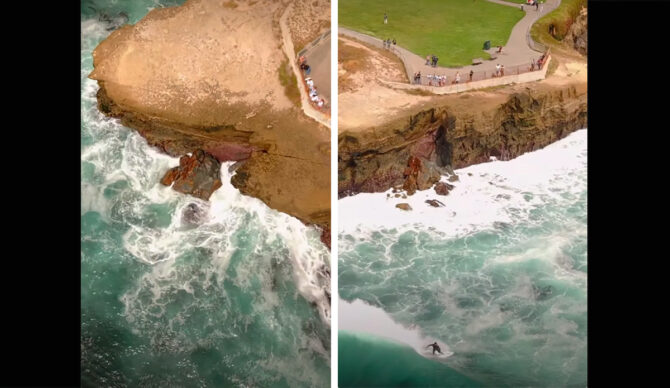
Surfers riding close to the cliff may need to watch out for rocks both underwater and falling from above. Photo: @wetfeetphoto//Instagram

Chunks of the cliffs at Santa Cruz’s premier surf spot, Steamer Lane, have been tumbling into the ocean for years. When the tide is low, surfers need to keep an eye out for stubborn rocks protruding above the surface. However, on Monday, June 22, a massive piece of the cliff collapsed, leaving a fresh pile of rubble in the lineup.
The new obstacles added to Steamer Lane have sparked conversations around how the wave could change, if at all. According to Santa Cruz surfer and communications coordinator at the non-profit Save the Waves Coalition, Emmett Balassone, the impact appears to be negligible on surf conditions.
Balassone, who has surfed Steamer Lane for two decades, said he paddled out a few hours after the most recent collapse on a two-to-four-foot south swell with a low-to-medium tide, and the new rocks did not change how one surfs at “the Slot,” the portion of Steamer Lane that breaks along the cliff.
After a long run of big south swells that likely sped up erosion, the cliff gave way. It was the biggest cliff collapse since similarly large chunks detached in 2023 and 2024, Balassone said.
“We will see how things settle, but at the moment, the new chunk of rock fell in the hole created by the last collapse, so the footprint of the debris field hasn’t increased much,” Balassone told The Inertia in an email.
Videos of the rockfall show that more precarious cracks remain on the cliff. Balassone warns that a strong swell or an earthquake could result in another large rockfall.
“I can’t speak for everyone, but I have certainly been cautious about sitting under the cliff on high tides since the first big chunk broke off,” he said.
He warns surfers not to sit too close to the cliff and to avoid using the handholds some rely on to climb this section when getting in and out of the water.
Save the Waves added Santa Cruz, including Steamer Lane, as one of its “World Surfing Reserves” in 2011. The organization released a report last year that found surfing contributes $194 million annually to the local economy.
Erosion has been wreaking havoc on the cliffs surrounding Steamer Lane and adjacent Its Beach, inching closer to the city’s iconic lighthouse. Balassone notes that the city has updated its Local Coastal Program — a requirement for cities under the Coastal Act — to prioritize surf break protection. In practical terms, he says that means carefully analyzing any proposed changes to the coastline.
“Coastal management is a highly complex, multi-year process,” he said. “(The city) can further fund studies to evaluate how adaptation scenarios like seawalls, managed retreat, hybrid solutions, or pilot projects will impact wave quality.”

