
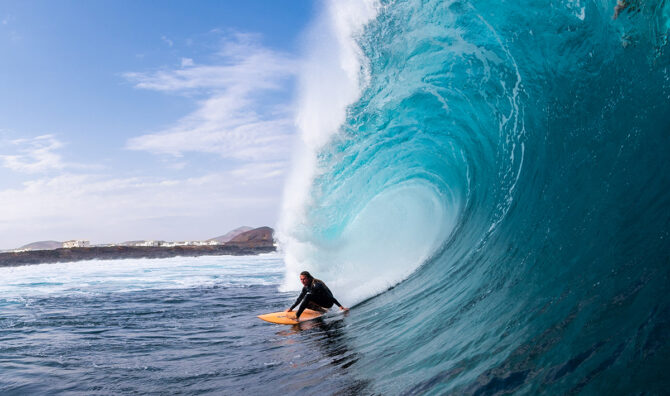
Mr. Robertson certainly feels comfortable in heaving barrels. Photo: German Abreu//Courtesy DR

“Lenny Smith was worried about surfing the boards,” Dylan Robertson told The Inertia. “But I said, ‘They were painted to be ridden, it’s dynamic artwork. I want them to reflect your connection with the ocean and the land around you. And with 17,000 years of cultural significance under your feet, it’s not a bad conversation starter.’”
Robertson is a 44-year-old hard-charging slab rider and artist who grew up near Wollongong, on the NSW South Coast. Smith, 21, lives about 50 miles south at Shellharbour, and is one of Australia’s best emerging surfing talents.
He’d grown up watching Robertson pack the various bombies and slabs near his home, and was on hand earlier in the year, when Robertson had been a standout and local guide when Lucas Chianca and Lucas Fink had rocked up to surf the historic run of swell in April. Despite the caliber of the posse, Dylan managed to score a few sets of the day at Cape Solander, down in South Oz and at a rare big-wave reef on the South Coast.
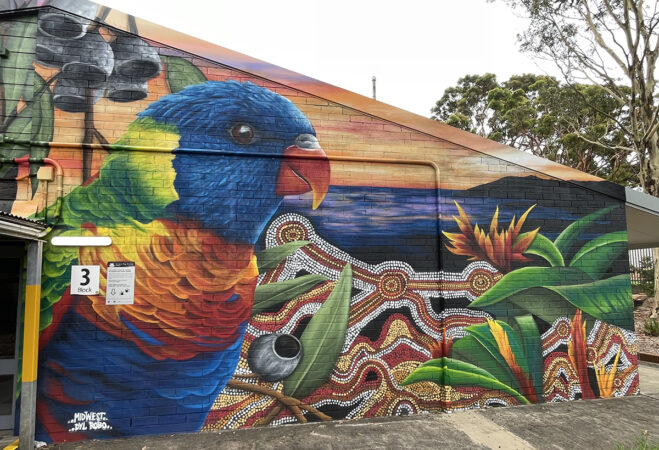
A mural painted by Robertson. Photo: Courtesy DR
“That was one of the biggest days I’ve probably ever seen at the left, which is just near Lenny’s house,” said Robertson. “I usually paddle my 8’6” Byrne out there, but that day it was pretty much tow only. It was inspiring to see Chumbo’s approach and the lines he drew. But we’ve been surfing those types of waves for most of our lives. I call it 25 years at the school of hard knocks.”
Robertson was 18 when he discovered his great grandfather was an indigenous Australian. However, as part of the stolen generation, where children were forcibly removed from their families and communities by Australian government agencies and church missions, Dylan and the family had little knowledge his relatives’ customs and history. He started exploring that side of his background, and quickly developed a deep connection. His love of surfing and nature helped, as did being surrounded by historic sites where he lived in Dharawal Country – more than 1,100 square kilometers of traditional lands in New South Wales. In the escarpment which borders the coast and provides the backdrop to many of its heaviest slabs, you can view rock art drawings, stencils, and historic axe-grinding grooves that date back 17,000 years.
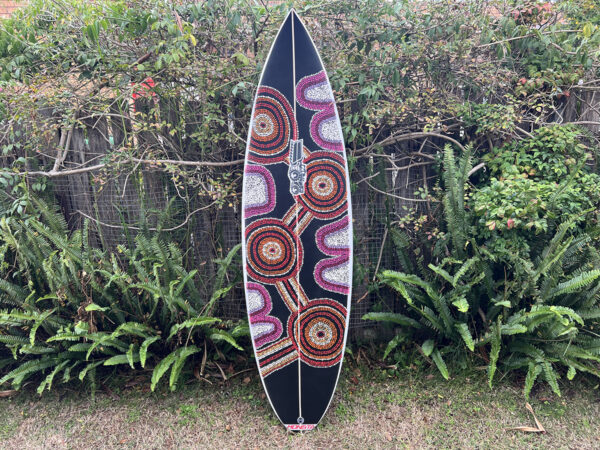
More stellar work from Robertson. Photo: Courtesy DR
“It was the art, though, where my fascination really took hold,” he said. “All the different artwork all over the country, and every piece had so much meaning. If you go even more granular, each individual dot tells such a story.”
So when Smith asked him to paint his boards, it was the story that Dylan wanted to put front and center. As with all his projects, be it surfboards, wall canvases or murals, he started by talking to local elders to get the history of the land and its people.
One board illustrates the connection between the ocean and the mountains for the local Wodi Wodi people. It has the songlines, the invisible pathways that crisscross the Australian continent and trace the journeys from the Dreamtime – from the ocean, then inland through the middle of the mountain ranges. Along this track, the saltwater people would travel from Bass Point to Macquarie Rivulet, looking for shelter and food during the colder seasons.
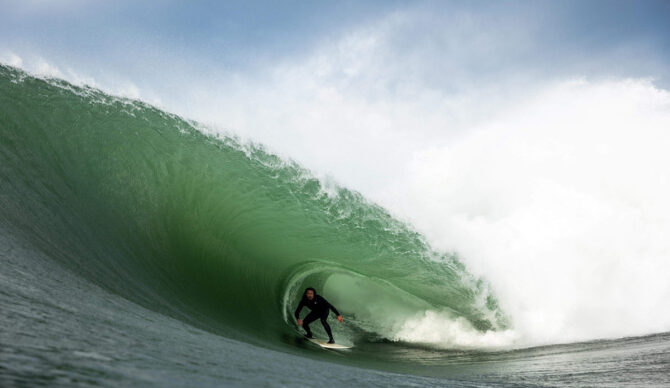
Cylinders like this feel like home to Robertson. Photo: Courtesy DR
On another board, the songlines show the locations where they camped, hunted, fished, as well as the gathering grounds, burial sites and story places. They also depict the fish and whale migration patterns on which their lives were based.
“Like surfing, art is a real passion, but I do it mainly to start a conversation,” he said. “If someone like Lenny is going surfing or walking around with that board, that’s an immediate talking point. And a conversation helps spread the culture and the history, and that builds connection. And we all need more of that.”

