
Image: Copernicus Marine Service Information//Mercator Ocean

For quite some time now, scientists around the world have been shouting into the void about what’s happening to our planet. The climate is warming, the weather is getting wilder, and the oceans are acidifying and heating up. According to two European Union Earth monitoring systems, the Copernicus Climate Change Service and the Copernicus Marine Service, we’re in real hot water.
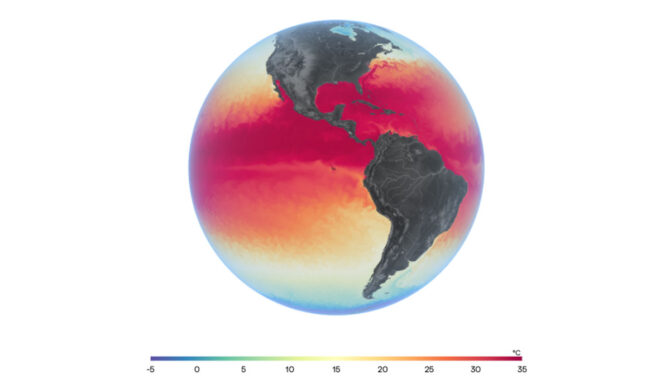
Scientific American reported that the average temperature of the oceans around the world broke all sorts of records in June. On the 21st, the overall average temperature was nearly 70 degrees Fahrenheit, which sets a frightening new record.
“Over the past three years,” reads a study from the European Commission, “the global ocean outside the polar regions (between the 60°N and 60°S latitude) has been between 0.35º C – 0.73º C warmer than the longterm average, and in June these anomalies have now reached record-high levels for the time of year.”
This isn’t great news for the climate in general. Our warming oceans are wreaking havoc on sea life, which is fairly important to the survival of all things on Earth, whether they’re wet or dry. As the world is moving into an El Niño event that’s almost surely going to simultaneously set some parts of the world ablaze and see others inundated by Biblical rainfall, researchers are warning that we ought to batten down the hatches and get ready for what’s to come.
“It usually ends up being a double whammy,” said NOAA oceanographer and high-tide flooding expert William Sweet, Ph.D. “The first punch is decades of sea level rise, which has waters close to the brim in many coastal communities. And now with this second punch – a strong El Niño – coastal communities face more frequent, deeper and widespread high-tide flooding along both the West and East Coasts.”
Experts also expect that more heat records will be broken, and they’ll be broken soon.
“With ocean temperatures at these levels and El Niño on the horizon, we are likely to see more temperature records fall in the coming months,” said Carlo Buontempo, the director of the Copernicus Climate Change Service, in a statement. “Current conditions could indicate the beginning of a new phase, leading, once more, to uncharted territory.”

