
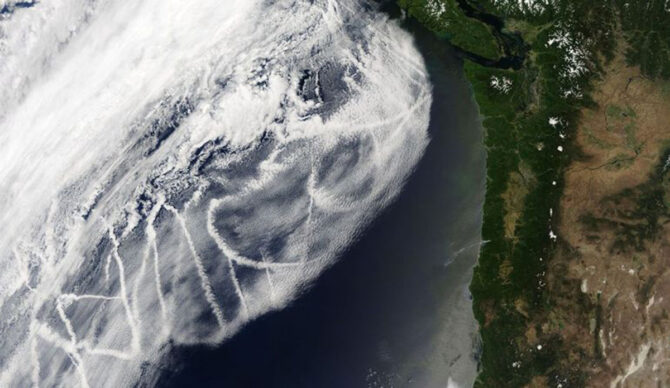
articulate emissions from ships produce bright tracks in clouds over the Pacific Ocean. Photo: Dept. of Atmospheric and Climate Science

There’s a “super” El Niño brewing, and it’s looking like we ought to batten down the hatches. Major organizations from around the world are warning of its implications, and all sorts of patches are being mulled over. One of the most worrisome patches is geoengineering, a human manipulation of the Earth’s climate system. Worrisome because messing with the climate is something that would have global implications, and we don’t have a real way to test it out on a global scale.
“An attempted real-world field test could lead to disastrous unintended consequences but the ‘Black Summer’ bushfires that scorched Australia in 2019 and 2020 served as a ‘natural experiment,'” wrote Scripps researchers in a paper about the possible use of geoengineering as a way to quell the heat. “The smoke that wafted into the atmosphere was filled with reflective, cloud interacting aerosols akin to those used in a geoengineering method called marine cloud brightening.”
In short, the smoke emitted from the bushfires had tiny reflective particles in it that brightened the clouds. That increased the amount of solar radiation that bounced back into space instead of entering our atmosphere.
The study, which was led by UC San Diego’s Scripps Institution of Oceanography, looks to find out whether we actually could use marine cloud brightening as a way to dampen the severity of floods, extreme heat, and massive storms that come along with a powerful El Niño event.
One of the co-authors of the study had already done quite a bit of research into what clouds brightened by smoke in the southeastern Pacific Ocean had done and found that they likely played a starring role in creating global La Niña-like weather patterns.
“The effect was compelling enough that the team, led by Scripps Oceanography researchers Kate Ricke and Jessica Wan, used a seasonal forecasting model to investigate what would have happened if a similar event had occurred before a ‘super El Niño’ instead,” the paper explained. The results were interesting: they suggest that this particular scenario could be a very good candidate for geoengineering.
“As long-term anthropogenic warming and short-term natural variability often compound to produce extreme weather events, our findings suggest it may be worth considering interventions which target natural variability, rather than the forced response to greenhouse gases,” said the authors in the study released on July 8 in the journal Science Advances. “Such an approach could result in similar physical risk reduction with shorter duration interventions that carry less sociotechnical risk than a sustained deployment.”
Geoengineering is always a touchy subject. As mentioned, the potential ramifications could be world-altering. If things don’t go as expected — and they very well might not, given the vastness of the testing grounds — things could get worse. Just how much worse is impossible to know, but at least one researchers who is generally opposed to throwing caution to the wind says this case is extraordinary.
“Kate Ricke, a climate scientist with appointments at Scripps Oceanography and UC San Diego’s School of Global Policy and Strategy, is usually firmly in the camp of scientists who urge caution, saying much more research needs to be done to make an adequate risk/reward analysis,” a Scripps article reads. “This case is not ordinary, she said. Applied to El Niños like the one forming now, geoengineering could be used temporarily as a tool to help society mitigate specific events nearly guaranteed to produce significant damage. Economic analyses have shown that recent large El Niños cost society trillions of dollars in damage, the authors note.”
It should be mentioned that, as of this writing, there are no proposals to actually test cloud brightening on a large scale, but as researchers learn more about it, it’s more and more likely that it could happen in the near future. One of the issues that the general public often has with it is that it’s thought that once we start, we’ll have to continue doing it. But some researchers now believe that we could potentially use it for short periods of time.
“It’s a different way of thinking about geoengineering,” Ricke said. “We need to understand a lot more, but if there is a way to use this in addition to the risk-reduction tools to mitigate El Niños, why wouldn’t we consider it?”

