
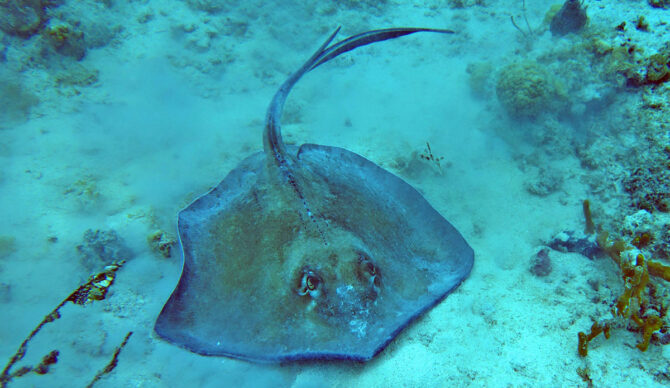
Everyone do the stingray shuffle. Seriously. Photo: Unsplash

If you have been unfortunate enough to feel the unyielding pain of a stingray’s sting, you know it is not pleasant. If you have been unfortunate enough to step on two back-to-back… well, I’m sorry. Stingrays like to lay around in the sand in shallow, warm water, and this year the water off the coast of Southern California is warmer than usual. Which means that there are both more people and more stingrays in the same area. Which also means that incidents of stingray stings are up, too. Way, way up.
According to a report from the Associated Press, Bolsa Chica and Huntington State Beaches have already reported more than 3,100 incidents this year. That’s double the number for the entirety of 2025, and we’ve got a ways yet before the calendar year clicks over.
If you have been lucky enough to avoid feeling the pain of a stingray, count your blessings. I have broken many bones. I’ve been hit by scorpions. Been electrocuted badly enough to lose fingernails. Honestly, it’s tough to describe getting stung by one — it feels, I imagine, like being hit in the foot with an electrified sledge hammer. Luckily, scalding hot water and time leaves you feeling fairly normal in a day or so, but there’s a fair chance that you’re going to get an infection a few days later, depending on whether you got all the pieces of the barb out, how well you cleaned the area, and what the water was like when you were stung.
They’re fairly common in places like Huntington Beach and farther south. In San Diego, nearly 1,000 stings were recorded by lifeguards so far in 2026. That’s more than any six months in the last five years.
“We’re definitely seeing an increase,” Bryan R. Etnyre, state park superintendent in northern Orange County, told reporters. “A lot of it is due to warming ocean temperatures that are consistently staying in the 60s. I don’t think there was a week all winter where we dropped below 60 this year.”
Not only is the water warmer, but over the last few years, population numbers of the animals that often prey on rays have dwindled. Sharks, sea lions, and giant sea bass aren’t eating as many rays as usual, so the rays are enjoying a bit of a baby boom.
“They’re really a subtropical species that is thriving at the end of its range because of climate change,” said Chris Lowe, a professor of marine biology and director of the Shark Lab at California State University, Long Beach.
It should be mentioned here that rays don’t want to sting you. They just don’t want to be stepped on, which is why the stingray shuffle came to be. If you do stomp on one, their instinct is to flick their tail up towards the danger. At the end of that tail is a venomous barb that injects a whack of toxin into your flesh.
With El Nino warming the waters, stingrays are everywhere right now.
“There can be so many that they actually carpet the bottom, like you can’t see sand,” Lowe said. “During El Niños, we get more of them up from the south, and they come closer to shore. So this year, we’re expecting record numbers.”

