
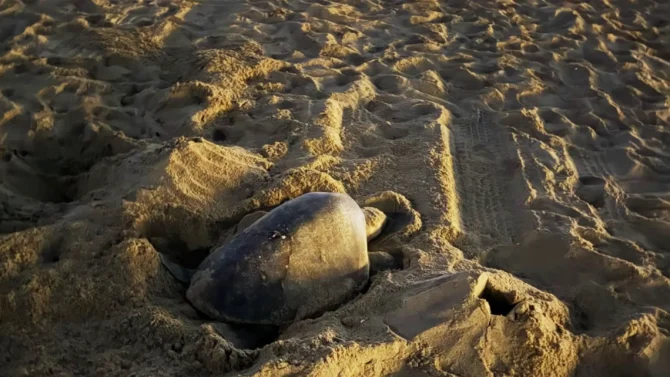
You don’t see this every day (or ever) on a California beach. Photo: NOAA//Facebook

Southern California beachgoers witnessed an unusual occurrence last week. For the first time in recorded history, a sea turtle climbed ashore in Seal Beach on September 16 and laid eggs.
NOAA Fisheries West Coast documented and identified the turtle as an olive ridley, which is on the endangered species list. Three days later, another turtle came ashore to nest near the pier in Huntington Beach, but it’s unclear whether it was the same olive ridley mother.
While it’s not uncommon to spot sea turtles in Southern California waters, they aren’t known to nest on the U.S. West Coast. Olive ridley turtles tend to nest in warm, tropical waters throughout the Pacific, Indian, and Atlantic Oceans. In the Pacific, the nesting grounds stretch from Mexico to Panama. NOAA said this is the first documented sea turtle nest of any species on the West Coast.
“While occasionally seen in Southern California following warm currents, this species has never been documented to nest in the United States,” NOAA said in a social media post. “Our team of local, state, and federal partners will monitor the nesting sites throughout the incubation period, which typically lasts 45-60 days. Both areas are fenced, protected, and have interpretive signage. We urge beachgoers to steer clear and not disturb the sites.”
Olive ridley turtles have experienced a 30 to 36 percent reduction in population size over the past century. They are omnivores that eat algae, crustaceans, tunicates, and mollusks, and have a lifespan of 30 to 50 years.
It’s probably no coincidence that the first recorded turtle nest on California beaches comes amid an historic El Niño phenomenon that has scorched ocean temperatures in the Eastern Pacific basin. Ocean temperatures along Baja California are as much as five degrees Celsius higher than averages. Southern California’s waters have also been unseasonably warm, with temperatures around the low to mid 70s Fahrenheit.
The warm waters have attracted other tropical creatures north to California. Venomous sea snakes were spotted in Orange County, and anglers have reported seeing devil rays, swordfish, seahorses, and hammerhead sharks.

