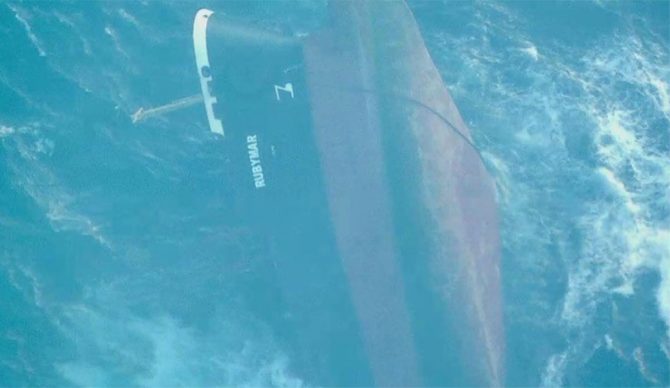
The Rubymar has a whole lot of fertilizer in it, and that’s not a good thing for the Red Sea. Photo: US Central Command//Press release
After a cargo ship laden with an enormous amount of fertilizer sank off the coast of Yemen, officials are warning that an environmental crisis in the Red Sea is on the horizon.
The vessel, called the Rubymar, was a cargo ship that was carrying around 21,000 metric tons of ammonium phosphate sulfate fertilizer.
“On March 2 at approximately 2:15 a.m. (Sanaa time), Rubymar, a Belize-flagged, UK-owned bulk carrier, sank in the Red Sea after being struck by an Iranian-backed Houthi terrorist anti-ship ballistic missile on Feb. 18,” reads a press release from U.S. Central Command. “The ship had been slowly taking on water since the unprovoked attack.”
According to U.S. Central Command, ‘The Iran-backed Houthis pose a heightened threat to global maritime activities.”
It’s not just the fertilizer that poses an environmental risk — although that amount certainly isn’t good to have floating around out there — but the leaking oil and fuel from the ship, too.
“Without immediate action, this situation could escalate into a major environmental crisis,” Julien Jreissati, Program Director at Greenpeace Middle East and North Africa, said in a statement. “As well as any further leaks of fuel oil from the engines, the sinking of the vessel could further breach the hull, allowing water to contact with the thousands of tonnes of fertilizer, which could then be released into the Red Sea and disrupt the balance of the marine ecosystems, triggering cascading effects throughout the food web.”
Fertilizer can be pretty disastrous for the environment, despite the fact that it’s generally used to make things grow better. But in places like the Gulf of Mexico, agricultural runoff has created a dead zone about 9,000 square miles in size. In short, the fertilizer-laden runoff from vast cattle ranches in that particular part of the world inevitably makes its way into the waterways and, eventually, into the Gulf. Once there, the fertilizer continues to do what it does: fertilize. Only now, it fertilizes algal blooms, which occur naturally. When algae are given a massive dose of nitrogen and phosphorus, however, it flourishes.
From there, the phytoplankton have a feeding frenzy and their populations explode. Then, since there are so many of them, huge portions die off, sink to the bottom, and the even tinier creatures that break them down use up way more dissolved oxygen than they should. And there you have a dead zone, an area of ocean that is so starved of oxygen there’s almost nothing that can live there.
Clean up efforts in the Red Sea are likely to be tricky, considering the conflict in the region. The Houthis are currently fighting with Saudi Arabia over control of Yemen, and in response to the turmoil in Gaza, Houthi forces are attacking Israeli-linked ships in the Red Sea.
“This disruption could have far-reaching consequences, affecting various species that depend on these ecosystems and, in turn, potentially impacting the very livelihoods of coastal communities,” Jreissati said. “Immediate access to the shipwreck site is imperative for an expert response team to assess the situation and swiftly devise and implement an emergency plan.”


