
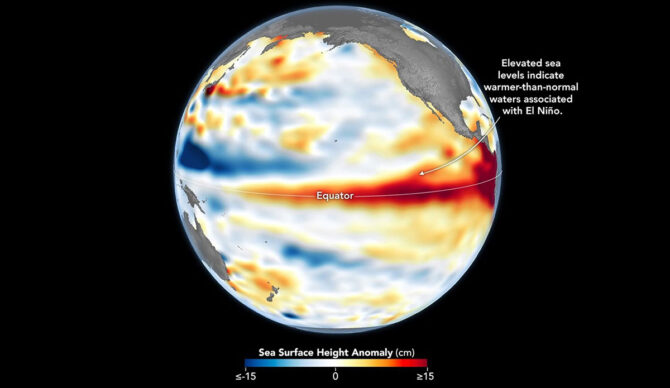
Higher-than-normal sea surfaces (red) are visible in the central and eastern Pacific on June 8, 2026, a few days before El Niño was declared. Image: NASA Earth Observatory//Lauren Dauphin

El Niño has made quite splash this year. That’s because it’s shaping up to be something pretty powerful, and when El Niño gathers its strength, it can have global effects. And in June, the Sentinel-6 Michael Freilich satellite made some observations from space that show it is indeed still gathering strength.
El Niño, for those uninformed, is a weather phenomenon that reoccurs every few years. It brings wetter than normal conditions to the American southwest and drought to places like Indonesia and Australia. It happens when the regular wind and current patterns in the Pacific break down, which allows warmer water from the equatorial region to move east. It’s a huge redistribution of the ocean’s heat, which in turn affects atmospheric circulation for the whole of the planet.
On June 11, after a few months of speculation from scientists monitoring this kind of thing, it was officially announced that El Niño had arrived, and it was likely to be a real doozy.
“It usually ends up being a double whammy,” said NOAA oceanographer and high-tide flooding expert William Sweet, Ph.D. “The first punch is decades of sea level rise, which has waters close to the brim in many coastal communities. And now with this second punch – a strong El Niño – coastal communities face more frequent, deeper and widespread high-tide flooding along both the West and East Coasts.”
Because of the strength of this year’s El Niño, NASA scientists have been keeping a close eye on it in a few interesting ways.
“When ocean water warms, it expands in volume and causes the sea surface to rise — making the water’s height a reliable indicator of ocean temperatures,” Phys.org explained. “Warmer-than-normal temperatures, and hence higher sea surface heights, in parts of the equatorial Pacific Ocean are associated with El Niño.”
The map that came from the Sentinel-6 Michael Freilich satellite shows some serious sea surface height changes all across the central and eastern Pacific Ocean. Red, as you’d imagine, means higher-than-average sea levels, while normal sea temps are white. Lower-than-normal are shown in blue.
The satellite has been in orbut since 2020, thanks to a partnership between NASA and the ESA (European Space Agency). The data it gathered was parsed by the smart people at NASA’s Jet Propulsion Laboratory (JPL).
“Earlier in spring 2026, the satellite started to detect precursor signs of El Niño as swells of warm water hundreds of miles wide, known as Kelvin waves, moved from the western Pacific to the eastern Pacific,” Phys.org continued. “That happens when trade winds in the western equatorial Pacific weaken and then temporarily reverse to blow from the west. Warm water piles up in the east, deepening the warm surface layer, lowering the thermocline and suppressing the upwelling that usually keeps waters along the Pacific coasts of the Americas cooler.”
That heat that’s building up under the surface is what the observations show. It’s not just the sea surface temperatures, either, because depending on how shallow the heat is, it might not have much effect on the climate. But when a whole whack of warm water is way down deep, that’s when things get a little hairy. Like they did back in 1997.
“According to JPL sea level researcher Severine Fournier, deputy project scientist for Sentinel-6 Michael Freilich, conditions in the western Pacific on June 8 looked similar to those from the same time in 1997, a year when an exceptionally strong El Niño emerged,” Phys.org wrote. “Warm conditions in the eastern Pacific in 2026 have lagged behind, however, with fewer Kelvin waves built up by the same date.”
Whether or not this year’s El Niño becomes as strong as 1997’s, only time will tell.
“For now,” Fournier said, “it looks like it’s going to be a big one — more so than I would have said last week — but we still need more observations to know what’s going to happen.”

