
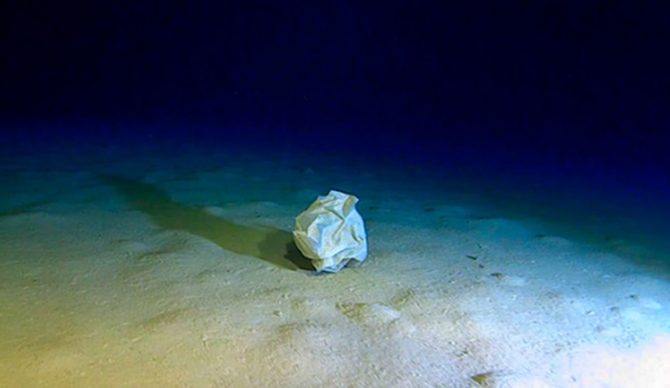
Trash found at 16,000 feet deep at the bottom of the Mediterranean Sea that shouldn’t be there. Photo: University of Barcelona

We humans are pretty terrible at dealing with the immense amount of trash we create. We throw it in the ocean, bury it in landfills, burn it, and generally just kind of pretend it isn’t a massive, global problem. But every now and then, we’re reminded that we have done an amazing job at cramming our garbage into Earth’s every orifice. Recently, the deepest point of the Mediterranean Sea was found to look like a bit of a dump, which is surprising because we don’t spend very much time down there.
Researchers aboard a two-man submersible called the Limiting Factor — a vessel that has reached the deepest point of all five oceans — surveyed an area known as Calypso Deep, located in the Hellenic Trench of the Mediterranean. They did it for a study published in March, 2025 on how litter is affecting even the most remote areas of the planet.
In February of 2020, a millionaire explorer (he’s a guy straight out of a Clive Cussler novel) named Victor Vescovo piloted the Limiting Factor to the bottom of the Calypso Deep and calculated its depth at a staggering 16,762 feet. That is, one would hope, deep enough to avoid litter, but as we learned from the 36,000-foot deep Mariana Trench, we’re super good at littering.
Anyway, scientists found 167 pieces of trash at the bottom of Calypso Deep while they were down there. While 19 of them weren’t confirmed to be litter, the rest were. Plastic made up 88 percent of it, but glass, metal, and even paper was found, as well. To be specific, they saw plastic bags, drink cans, glass bottles, plastic ropes, and plastic cups.
Since Calypso Deep is a vast area, the researchers weren’t able to count every single piece of garbage. Using the area surveyed, however, they were able to estimate that there could be up to 26,715 pieces of trash per square kilometer, which would make it “one of the highest concentrations of litter ever recorded in a deep-sea environment.”
There are a few reasons why so much garbage has accumulated down there — the obvious one is that we’re terrible at making sure it doesn’t — and one of them is that Calypso Deep a natural basin. It has a relatively flat bottom surrounded by steep slopes on all sides, so it acts as a bit of a trash pit to anything that might be floating around its edges.
“It is a closed depression, which favors the accumulation of debris inside it,” said Miquel Canals, study author and a professor at the University of Barcelona’s Faculty of Earth Sciences. “The weak currents in the trench […] also facilitate the deposition of light debris at the bottom.”
The scientists involved in the study, as always, are hopeful that their findings will be a bit of an alarm for policymakers, manufacturers, and the general public. But if history is any indicator, the study will make a small splash and then be ignored.
“The ocean floor is still largely unknown to society as a whole, which makes it difficult to raise social and political awareness about the conservation of these spaces,” Canals explained. “It is necessary to make a joint effort between scientists, communicators, journalists, the media, influencers and other people with social impact. The problem is there, and it has an enormous scope, even if it is not directly visible. We should not forget about it.”

