
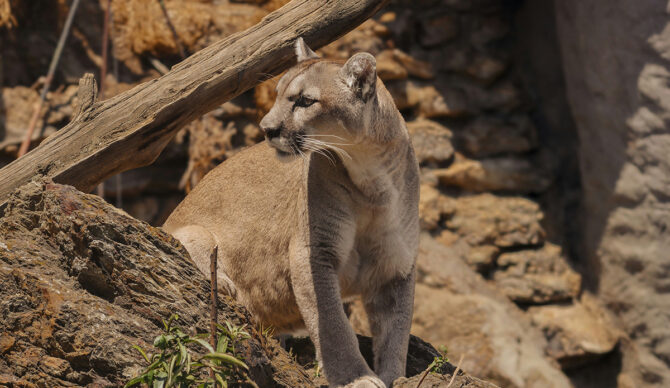
New research could help better understand how humans and mountain lions can share space. Photo: Richard Callupe//Unsplash

Growing up in the Santa Cruz Mountains in California, I learned an adage along the lines of, “If you see a mountain lion, it’s not hunting you.” Pumas are stealth experts and, even though I had never seen one, the chances are that one had seen me. New research published in Current Biology supports that notion: mountain lions are aware of human activity and generally avoid it.
Researchers compared six years of GPS data from 36 mountain lions in the Santa Cruz Mountains — stretching from Santa Cruz County to San Francisco — and compared their movement against trail data from the fitness app Strava. They found that trail density and traffic directly influence mountain lion movement, as the cats rarely come within 100 feet of busy trails. Additionally, when the animals are near trafficked trails, they tend to move faster and more directly.
UC Santa Cruz says the findings are consistent with previous research that shows mountain lions fear humans and keep their distance.
The data also showed that some mountain lions were more tolerant of human activity than others. However, there was no evidence that mountain lions that remained closer to humans were any more likely to be involved in “human-puma conflicts,” which include sightings, attacks on pets or livestock, aggressive behavior, or rare attacks on humans.
“The long assumption here in the U.S. and beyond has been that habituation equals dangerous, with the result that wildlife agencies generally kill any carnivore they think is becoming habituated,” Mark Elbroch, a coauthor of the study, said. “This research suggests that habituation shouldn’t be viewed as black and white, at least, and there may be a spectrum of habituation that is in fact supporting peaceful coexistence between people and these amazing animals.”
Research suggests that California has anywhere between 3,200 and 4,500 mountain lions.
Earlier this year, Santa Cruz County’s mountain lions were listed as threatened under the California Endangered Species Act. Researchers in the study say understanding their movements is important to creating a habitat in which they can thrive.
“Mountain lions in the Santa Cruz Mountains are at increased risk of extinction, due to a lack of genetic diversity and habitat connectivity,” John Morgan, lead author of the study, said. “So how can we continue to provide recreation opportunities while also protecting habitat in a way that’s safe for people and mountain lions?”

