
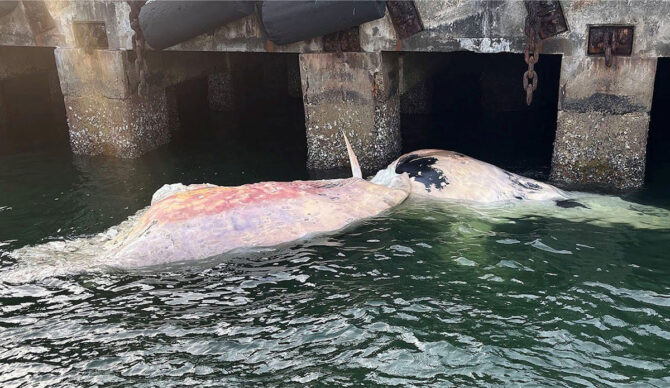
Carcass of an Omura’s whale at Tanjong Pagar on 6 September 2025. Photo: Marcus A. H. Chua//Nature in Singapore

Back in 2003, scientists discovered something pretty incredible: a whole new species of whale. For something as big as a whale, the Omura’s whale is incredibly elusive. We know next to nothing about how they live, and everything we do know comes from dead ones. Sadly for the whale but happily for researchers, an old Omura’s whale carcass washed up off the coast of Singapore eight months ago, in the early fall of 2025.
Omura’s whales, for a long time, were thought to be a sort of tiny Bryde’s whale. In 2003, however, three Japanese scientists were able to prove that it was its own species after finding DNA from nine different Omura’s whales — eight of which had been caught in the late ’70s and one that washed up on a Japanese beach in 1998. When they analyzed that DNA, they found that Omura’s whales were indeed their own species. Surprisingly, due to their relatively small size, they’re thought to be related most closely to the world’s biggest animal, the blue whale.
Since its discovery, Omura’s whales have been filmed in the wild only a handful of times, and they are a stunning animal.
The most recent Omura’s whale to be found last fall was in poor shape. Measuring in at a little under 16 feet in length, it was in an advanced stage of decomposition.
“The floating carcass of a rorqual whale was seen stranded along the pilings of a wharf at Tanjong Pagar Terminal, wrote the researchers in a paper published in Nature in Singapore. The observers detected a strong odor, and noted that the carcass was in an advanced stage of decomposition. Most of the skin had sloughed off, and the posterior part of the body was missing.”
On September 12, 2025, six days after it was found, the whale’s carcass was taken to the Lee Kong Chian Natural History Museum for a thorough examination in hopes to learn more about this rare and elusive animal. Despite the state of it, researchers were able to use its DNA and its skull to prove it was an Omura’s whale.
Sadly, after a necropsy, it appears that the whale likely died from a ship strike, an occurrence that is all too common. The whale wasn’t fully grown, as mature ones grow to about 30 feet at maturity.
“Preliminary investigations from the damage to the skeleton — broken bones and hemorrhage — are consistent with ship strike injuries,” the paper reads. “The near-coastal habits of the Omura’s whale may place the species at higher risk of impacts from human activities and incidents of marine vessel injuries or entanglement.”

