
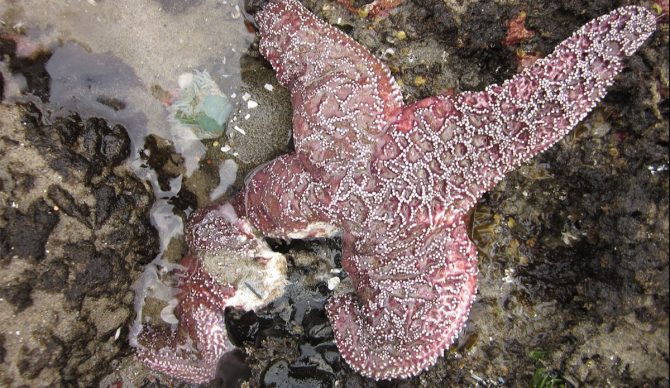
The leg of this Pisaster ochraceus sea star in Oregon is disintegrating as a result of sea star wasting syndrome. Photo: Elizabeth Cerny-Chipman, courtesy of Oregon State University//CC BY-SA 2.0

For about a decade now, sea stars have been dying at extraordinary rates. They’re being killed by something aptly dubbed “sea star wasting disease” because they quite literally waste away into a goo-like substance. For years, scientists have been searching for what’s killing the sea stars, and now, they finally have an answer.
Turns out, it’s a strain of bacteria called Vibrio pectenicida, a pathogenic bacterium that has been known to attack scallop larvae. Over the years, over five billion (yes, with a B) have died as the bacteria sweeps through their populations. Back in 2013, it was first noticed in the waters from Mexico to Alaska. While over 20 different species of starfish have been decimated, the sunflower sea star has seen the worst of it. Some 90 percent of its population was lost in the first five years, and they are still barely clinging on.
“It’s really quite gruesome,” said marine disease ecologist Alyssa Gehman at the Hakai Institute in British Columbia, Canada.
While a healthy starfish has, as Gehman put it, “puffy arms sticking straight out,” sea star wasting disease causes gaping lesions on the arms until eventually they fall off. After an exhaustive four-year study, researchers published their findings in the journal Nature Ecology and Evolution. They used the DNA of microbes that were in infected starfish, then compared them to healthy ones. They were able to find abnormally high levels of Vibrio pectenicida in the starfish’s coelomic fluid, which can be thought of as its blood.
“When we looked at the coelomic fluid between exposed and healthy sea stars, there was basically one thing different: Vibrio,” said Gehman in a statement. “We all had chills. We thought, ‘That’s it. We have it. That’s what causes wasting.'”
Starfish are essential to the marine ecosystem. They mostly feed on sea urchins, which has the effect of stopping the sea urchins from eating too much kelp. As sea stars die, urchin populations explode, and kelp forests, which provide food and shelter for thousands of species, decline.
“When we lose billions of sea stars, that really shifts the ecological dynamics,” study author Melanie Prentice, an evolutionary ecologist at the Hakai Institute and UBC, said in the statement. “Losing a sea star goes far beyond the loss of that single species.”
Now that researchers know what’s causing the disease, they’re working on figuring out why it happened so they can figure out what can be done to slow it down.
“Understanding what led to the loss of the sunflower sea star is a key step in recovering this species and all the benefits that kelp forest ecosystems provide,” said Jono Wilson, the director of ocean science at the California chapter of The Nature Conservancy.

