
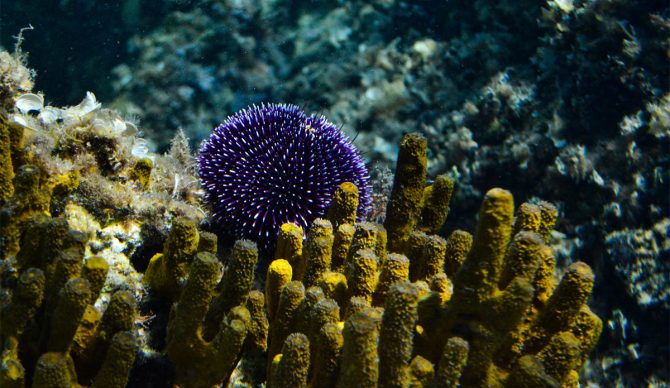
Overfishing is driving sea urchin populations through the roof in Hawaii, and that’s killing reefs. Photo: Unsplash

Coral reefs around the world are in dire straits due to a lot of things. The seas are warming, causing coral bleaching events on an unprecedented scale. Pollution is rampant and the seas are rising. But there’s one more thing on the list of hazards: sea urchin populations are skyrocketing, which is threatening some reefs in Hawaii to the breaking point.
According to new research from scientists working out of the North Carolina State University Center, overfishing is the driving force behind the numbers of sea urchins. Scientists looking at Hawaii’s Honaunau Bay found that without the fish, sea urchins are thriving. While that’s good for sea urchins, it’s bad for the reefs they feed off of.
“Fishing in these areas has greatly reduced the number of fishes that feed on these urchins, and so urchin populations have grown significantly,” said Kelly van Woesik, Ph.D student in the North Carolina State University Centre for Geospatial Analytics and lead author of the study. “We are seeing areas where you have about 51 urchins per square meter, which is among the highest population density for sea urchins anywhere in the world.”
According to Oceanographic, the growth of a reef is measured by how much carbonate it produces. Back in the 1980s, reefs in Hawaii grew about 33 pounds per 10 square feet each year. That amount signals what scientists think of as a healthy reef. But the reef in Honaunau Bay only grew about one pound per 10 square feet, indicating that that particular reef is struggling mightily.
Reefs like the ones in Honaunau Bay are incredibly important to the local ecosystem. They protect the coast from erosion by absorbing over 95 percent of the energy from incoming waves and they play host to any number of creatures that live among them.
“The reefs cannot keep up with erosion without the help of those natural predators, and these reefs are essential to protecting the islands they surround,” said van Woesik. “Without action taken now, we risk allowing these reefs to erode past the point of no return.”

