
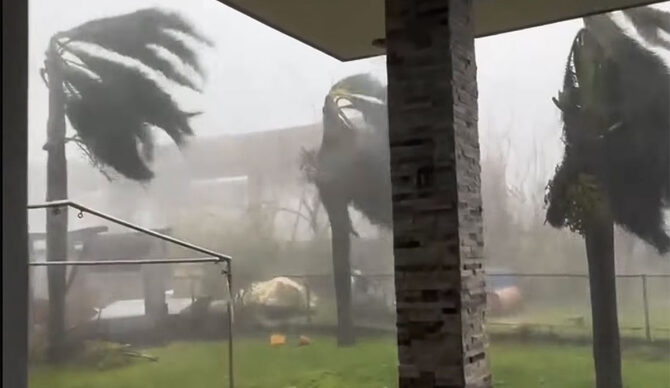
Winds were in excess of 150 mph when Sinlaku hit the Northern Mariana Islands. Photo: Screenshot

Super typhoon Sinlaku absolutely hammered the remote Northern Mariana Islands, a self-governing territory of the United States comprised of 14 islands. Some of the worst hit were the islands of Tinian and Saipan, home to around 50,000 people.
Sinlaku is a huge storm. On Monday, it became the most powerful storm on the planet, creating wind gusts in excess of 190 miles per hour. While typhoons do generally ease in strength when they hit land, Sinlaku’s energy was so much that even after diminishing, it wreaked serious havoc. When it made landfall, winds were still gusting at 150 mph. Cars flipped, roofs were torn off buildings, and trees were uprooted in the face of its howling winds.
“I’m guessing anything that was made of wood and tin did not survive this,” Glen Hunter, a resident of Saipan, told The Associated Press. “It was a losing battle because the rain was coming through everywhere. Every house is just flooded with water, no matter what type of structure you’re in.”
As of this writing, thankfully, there haven’t been any reported deaths. Mayor Ramon “RB” Jose Blas Camacho was out in the community assessing the damage as soon as it was safe to do so. “It’s hitting us hard,” he said late on Tuesday evening. “It’s so difficult for us to respond with this heavy rain, heavy wind to rescue people. Objects are just flying left and right.”
The storm also led to torrential rain and flash flooding in nearby Guam, where some 170,000 people live. Guam is a U.S. territory with a handful of military installations. According to the American Red Cross, more than 1,000 people are sheltering in temporary stations across Guam and the Northern Marians. The region was the site of some of the most fierce fighting in the Pacific during World War II.
As the day wears on, Sinlaku is still expected to produce winds well over 100 mph. The eye of the storm is moving northwest, and residents are likely to be unable to safely go outside for at least a day-and-a-half.

