
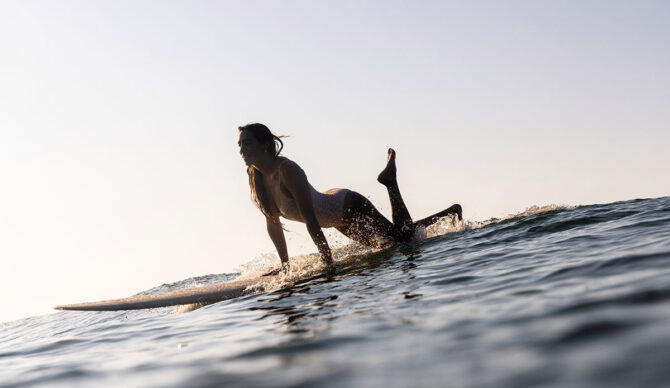
Photo: Sarah Lee

We all remember our firsts: the first time we saw a surfer, the first time we imagined ourselves in the water, the first time we tried to stand on a board and felt the ocean stir something inside us. But those beginnings are never universal. Every surfer enters the culture through a different doorway, carrying their own geography, identity, and sense of belonging into the lineup. For Lex Weinstein, that doorway was anything but obvious.
Growing up in Virginia Beach as a brown girl in a predominantly white and deeply localized surf scene, surfing didn’t feel like something that belonged in her world. The culture surrounding it often seemed closed off, shaped by a narrow image of who a surfer was supposed to be. Before there could ever be a first wave, first there was the question of whether there was even room for someone like her in the story at all.
“Surf culture in Virginia Beach is super weird,” Weinstein says. “I was a really late bloomer. It actually kind of kept me from surfing. I didn’t start until I was 16 or 17.”
Lex comes from a deeply layered family history. Her mother’s family emigrated from Cuba through Operation Pedro Pan, what she calls the “Peter Pan flight,” part of the wave of Cuban children sent to the United States by families hoping to build safer, more stable lives. Her mother was one of six children. The first four were sent ahead. It took four years for her grandparents and mother to follow.
“My grandmother literally had to go pick up her remaining kids all over the U.S.,” Weinstein says. “Family has just always been like the root, the core, the heart of everything in my life because of what my grandparents and my mom and my aunties and uncles had to go through.”
Her father, a man from Brooklyn, met Lex’s mother through her grandfather, two men who worked in the same hospital and became tennis partners. He came to dinner for seven years before he asked her mother out.
“My dad is from Brooklyn, New York, through and through,” she says, laughing. “My mom is this Latina Catholic Cuban. But somehow they saw so much more overlap in the love of family, food, tradition, and culture.”
Lex grew up inside that intersection, navigating the world as part of a mixed-race family in a place where she often stood out. In surfing, a culture that has historically projected a narrow image of who belongs in the water, that navigation became even more complicated.
“I faced a lot of racism, a lot of bullying, a lot of othering,” she says. “I was a neurodivergent queer kid with an immigrant mom and a Jewish last name in Virginia Beach. I just really desperately wanted to fit in.”
The story of how she actually got into surfing, how she first found a space where she felt free from judgment, both her own and everyone else’s, emerged only after some hesitation. It was a story she had never told anyone until now.
She was 16, working as a hostess at an Italian restaurant, when a neighbor called the police on her and a co-worker after dropping her off after a shift. The responding officer didn’t believe she lived in the house. She didn’t have an ID on her. She tried to prove it, showed him she knew the garage code, but when she pulled away from his grip and told him not to touch her, he said she was resisting arrest. He handcuffed her, walked her to the front door, and rang the doorbell.
Her white father answered.
“The cop immediately changed his whole persona,” Weinstein says.
She ended up in court over a curfew violation. As community service, her mother paired her with their youth minister, a surfer named Jeff.
“He was like, ‘This is bullshit,’ Weinstein remembers. “‘Let’s file these papers and I’ll take you surfing.'”
He took her to the Outer Banks. She cried on the beach at Hatteras more than once, terrified. She paddled out anyway.
“Putting on a wetsuit and learning how to paddle out into the ocean, just the quiet,” she says. “I felt like I found home. It was the one place I actually felt I belonged.”
It wasn’t until nearly 20 years later, during the national reckoning that followed George Floyd’s murder, that Weinstein began to understand what had happened that night as racial profiling.
“Why he didn’t believe I lived at that nice house; why he changed his whole demeanor when my dad answered the door. That’s what that was,” she says. “It was a reawakening.”
She got a job lifeguarding at Sandbridge, a stretch of beach near the North Carolina border that has always existed slightly outside the main Virginia Beach current: quieter, less crowded, wild horses running the beaches to the south if you drove far enough and had a vehicle that could handle the sand. Six to eight hours a day she sat above it all, watching. The way the water changed with the wind direction. The birds. The shifting moods.
“I fell in love with the ocean in a way that was so much more about a relationship,” she says. “Watching her moods, her different expressions, what it looked like with offshore winds versus onshore versus sideshore, seeing all the different personalities come out. I was hooked.”
The older guys she worked with put her on longboards and taught her technique, told her stories, gave her a framework for something she was already starting to feel. She was a teenager who had spent years not quite fitting anywhere, queer and not yet out, Latina and Jewish in a town that made her feel neither identity was fully accepted, neurodivergent in a school system that had no language for any of it. The water, it turned out, didn’t ask any of those questions. The water didn’t care about her last name or what she looked like or whether she fit the category.
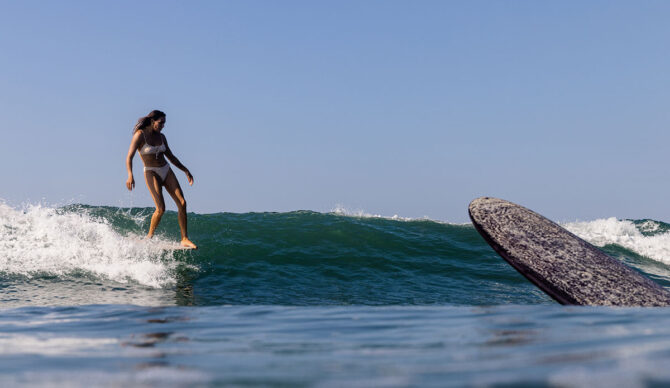
Photo: Sarah Lee
The board that started it all was a 7’0″ WRV fun shape, a rounded-nose, wide-tailed thruster built for exactly the kind of beginner who doesn’t yet know they’re not supposed to love a fun shape. When Weinstein talks about her first surfboard, her face changes. She nearly spits out her coffee laughing at the memory.
“Nobody’s ever asked me that,” she says. “It was a WRV fun shape. Rounded nose, thruster. Such a perfect first surfboard.”
Her older brother helped her pick it out. She kept it for over a decade, taking it to Puerto Rico and riding it on reef breaks that she says it handled beautifully.
“People hate on fun shapes,” she says, grinning. “But it was genuinely just so fun in all conditions.”
Surfing stories are often polished smooth by nostalgia and repetition. Weinstein’s story feels different. It is deeply personal, unexpected, and honest in a way that cuts through the usual narratives surrounding who finds surfing and how they arrive there.
As surfers, we are always searching for something. Sometimes it’s waves. Sometimes it’s solitude, memory, movement, or the feeling of disappearing into a place long enough to understand it. For Weinstein, part of that search led her to Kauai, where she spent time farming and living close to the land. After long days working in the dirt, she would rinse off in the ocean.
“I called my friend and said, ‘I have figured it out. I found the medicine, it’s the sea and the soil. It’s the combination of the two, going back and forth,'” she says. “He was like, ‘Sea and Soil, hang on to that. There’s something to that.'”
She sat on it for nearly four years.
That experience eventually became the foundation for Sea + Soil Collective. More than a project or a brand, it grew out of a desire to recreate that feeling of connection for other people. In 2019, she texted about 15 friends and asked if anyone wanted to volunteer at the Ecology Center in Encinitas, California one Saturday morning and then go surf.
Every single one said yes.
“Each month I would do it,” she says, “and each time the group just grew and grew.”
Sea + Soil began simply: gardening, volunteering, surfing, and gathering people together around shared work and shared care. But almost immediately, something deeper started forming around it. People gravitated toward the experience because it offered more than activity. It created a sense of connection and community and belonging that many people had been missing.
When COVID hit, the group had started growing food in a friend’s backyard in Cardiff, what became the Cardiff Tiny Farm, and suddenly 30 to 40 people were showing up on Tuesday mornings, donating around 60 pounds of produce a week to a local food bank serving mostly immigrant families.
“People felt like they were taking care of their bodies by getting outside and sweating and getting their hands in the soil,” Weinstein says. “But also caring for community members who were less privileged; people who were really in a dire situation.”
Sea + Soil became an official nonprofit in 2021.
For several years, Sea + Soil sustained itself largely through grants and nonprofit partnerships. But as the political climate shifted after the 2024 election, many funding streams tied to environmental justice, equity, and community programming became less stable. Weinstein realized the organization would need to evolve in order to survive without compromising its mission.
Andrea Poveda came into the picture through the World Surf League’s PURE grant program, where she was managing sustainability and social impact initiatives. When Sea + Soil applied for a grant to fund habitat restoration projects in North San Diego County and South Orange County, Poveda was the point of contact.
“I was extremely compelled by Sea + Soil and by Lex’s mission,” Poveda says. “It really creates the perfect bridge for people who love the ocean and who feel like they also have an obligation to take care of the land that’s connected to the ocean they surf in every single day.”
Poveda grew up in South Florida. Her father is Cuban, born in Puerto Rico and raised partly in Venezuela, where his love of surfing began. Her mother is Mexican. She spent nearly a decade in Boston before moving to California and landing at the WSL.
She and Weinstein connected quickly. Both identify as queer, neurodivergent, and Latina. Both share Cuban heritage. And both carry a particular kind of grief around that heritage.
“We’re sort of mourning the fact that we can’t really have a deep relationship with Cuba and with the land where half of our family grew up, because of the situation there right now,” Poveda says. “Because of that lack of physical connection, I think we feel very passionately about creating community, about building bridges between groups of people, and for people that maybe feel like they don’t really have a place to belong.”
When Poveda left the WSL, Weinstein knew she wanted to find a way to work together again. Toward the end of 2025, Weinstein flew to Miami to pitch her an idea.
The Sea + Soil Impact Travel Program was born.
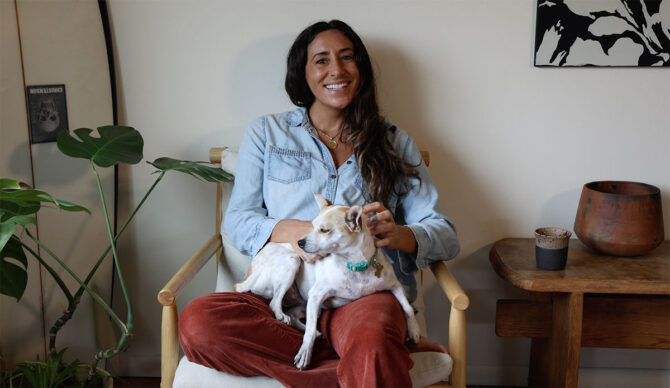
Photo: Nicole Grodesky
They are calling them regenerative retreats — immersive, small-group travel experiences combining surfing, land stewardship, and nature-based wellness. Their first trips are scheduled for July 2026, hosted at a private home in Playa Negra, Costa Rica, steps from the water, with access to waves that range from a reeling point break to playful beachbreak A-frames.
But the surf is only part of it.
Through a local connection, they found Ruben, the school bus driver who also runs a landscaping company and whose family has owned a nearby farm, Finca Linda Flor, named for his late mother, for generations. His dream is to develop it into an outdoor classroom preserving traditional ecological knowledge: edible and medicinal gardens, a fruit forest, native species conservation, workshops for local kids he drives to school each day.
A portion of every retreat’s proceeds will go directly toward making that happen.
“We aim to travel in relationship with the place we’re visiting,” Poveda says. “We directly support community-identified priorities and existing initiatives that are already rooted in the land and in the community that’s welcoming us.”
The model is a deliberate rejection of what both women see as the extractive default of the surf and wellness travel industries, trips where surfers arrive, consume, and leave, with little given back to the communities that provide so much.
“A lot of surfers and people that travel just come into these communities and exist in their own bubble,” Poveda says. “We were really hoping to create something more intentional, and that also created a space for people who aren’t necessarily reflected in the traditional surf and wellness industries.”
That distinction, between individual healing and something larger, runs through everything Sea + Soil does.
“The wellness industry has this really heavy emphasis on personal wellness and personal healing,” Poveda says. “But for us, true well-being extends beyond the individual. It includes the land we move through and the communities that hold it.”
Weinstein puts it plainly: “Collective wellness, that’s the medicine.”
She envisions the retreats as spaces for people who wake up, as she describes it, with a sense of dread and a creeping feeling that the actions available to them are never quite enough.
“Sometimes the answer is actually pausing,” she says. “Allowing for rest, allowing for play, allowing for joy, but not bypassing the grief. Coming together in a community that’s willing to touch grief, to really tap into the awareness of what’s going on in the world, and actually talk about how to co-create the world we want to live in.”
The retreats will include surfing at all levels, volunteer time on Ruben’s farm, cooking classes with a local grandmother who specializes in traditional Guanacaste food, and what Weinstein describes as spiritual ecology workshops, helping participants connect what they’re learning in the water to how they move through the world on land.
There will also be Spanish. Poveda is fluent. Weinstein is close. The choice to make the program bilingual is intentional.
“If you’re wanting to practice your Spanish, to go to another country and actually feel like you’re a part of the local community and not just a tourist, this is the trip for you,” Weinstein says.
Poveda, who moved back to South Florida about six months ago, has since launched a South Florida chapter of Sea + Soil, partnering with local organizations focused on conservation and restoration in a state she describes as “biodiverse and special” and in need of serious care.
Weinstein, meanwhile, is rebuilding locally: monthly volunteer days in the canyons, a weekly gardening cohort, and plans for a summer series of free programming at the Cardiff Tiny Farm, the plot where the whole thing started. Chef friends want to cook Sunday morning meals. Others want to lead seed-saving workshops, watercolor sessions, mushroom cultivation classes.
“We’re really trying to create spaces that remind us what it is to be human,” Weinstein says. “To turn our phones off and connect with ourselves, our community, and our local environment.”
Poveda, asked to describe Weinstein in a few words, doesn’t hesitate.
“The word that comes to mind is nurturing,” she says. “Not only in her personal relationships, as a caretaker, as a parent, as a friend, but she extends that nurture to her community, to the earth, to the sea. Everything she touches. And I think that’s what has really allowed for everything she’s done to bloom, because she approaches everything with such care and intentionality.”
For Weinstein, the journey from that Virginia Beach porch to this moment has never moved in a straight line. There were years of playing a certain game, of leaning into the parts of herself the industry recognized while setting other parts aside. That changed.
“I really reflected on my experiences throughout my life and the choices I’d made,” she says. “What does it mean if I actually don’t do that anymore? How do I identify as a Latina surfer, a Latina Jewish surfer? How do I feel stepping into my surf identity with the culture I was raised with, versus having to separate that from who I am just to be recognized?”
Photo: Sarah Lee
She thinks about the younger surfers who are finding their way now, and what she hopes they never have to feel othered.
“Meeting up with queer surfers, other folks who, when we’re together, are just in this little bubble rooting for each other and cheering for each other,” she says. “It’s a whole other world, really stepping into your identity versus feeling like you have to set it to the side in order to participate or feel a sense of belonging.”
Sea + Soil is, in many ways, the physical form of that belief. A community, a nonprofit, a farm, a retreat program, built from soil and saltwater, from grief and joy, from the quiet certainty that healing, real healing, doesn’t happen alone.
“The branches can only grow as tall as the roots are deep,” Weinstein says.
She’s been tending the roots for years.

