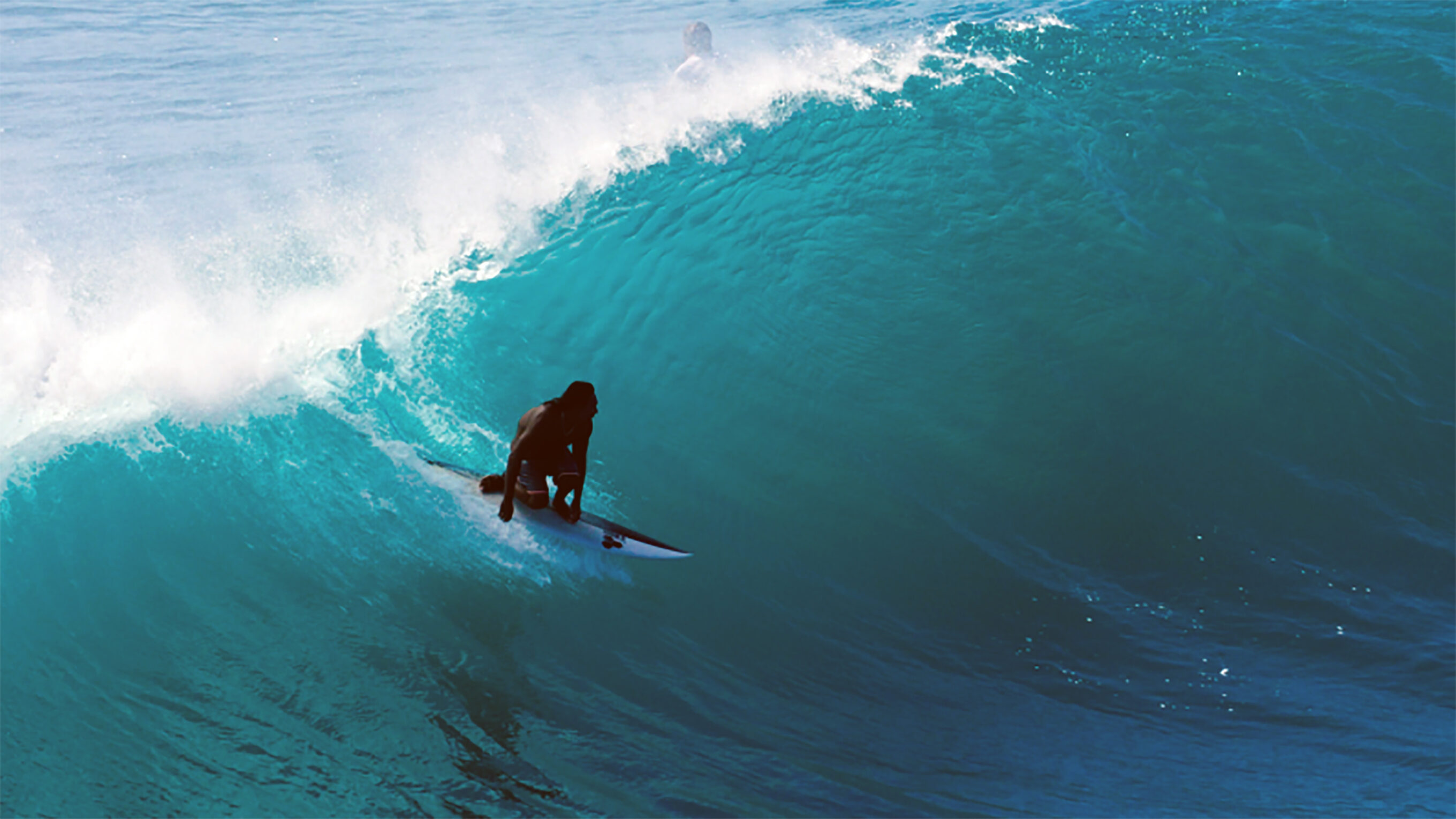
“I’d only been gone about three months, and I drove up past Bingin and to Uluwatu yesterday, and I was tripping,” said filmmaker Max DeSantis. “It’s actually looking a bit like a city now. Even in such a short time, you could see the change. ”
Nestled in the back of Max’s car was his six-week-old son. He’d been born in Germany, and Max and his partner Libby were bringing him home to Ulus. Max had undertaken a similar journey when he was around six months old in 2000. He was born in Hawaii, but his parents quickly returned to Bali, where they had started a clothing company after falling for the island in the early ’90s. “I was one of the first “bule” (the Balinese equivalent term for Haole) kids to grow up here at Ulus,” he says. “I was friends with all the locals and my whole life was surfing. I surfed Uluwatu every day; it was an incredible place to grow up.”
And yet in Max’s 27 years on Earth, few places have undergone such rapid tourist-led development as Bali. DeSantis has tackled that transformation through Magic Island, his debut documentary, a 58-minute portrait of Uluwatu’s journey from a quiet, remote fishing village to one of the world’s great surf and tourism destinations. Surf writer and podcaster Jed Smith called it “a cutting-edge, multimedia, visual masterpiece rooted in Balinese culture and mythology that captures a cosmic battle between capitalist greed, neo-colonial foreigner kooks and local surfing culture.”
“I want the Indonesian people in Bali to develop and thrive, obviously. They deserve to, like everywhere else in the world,” said DeSantis. “But everyone knows Balinese people are so loving and welcoming, and some people are just taking advantage of that generosity and doing it purely for profit. They’re not here because they love Uluwatu or have a history with it. It’s just, ‘how can I make money off this place and change it for my own personal gain?’”
Rather than narrate the film himself, DeSantis handed it to 12 influential locals, surfers, activists and cultural figures. Surfing pioneer Jim Banks recalls an energy he had never felt before on his first wave at Uluwatu. Author Matt George describes the 80-meter cliffs, the temple above the waves and the sense of the Earth “extending into the infinite.” Rizal Tandjung calls it “the mecca of surfing,” comparing a session there to going to a temple to pray and receive a blessing. Rio Waida, Made Lana, Mega Semadhi and Gerry Lopez also appear.
“I wanted to learn what people were thinking around here, and I thought the best way to tell the story was through people with a genuine, solid influence in Bali,” DeSantis says. “People who are local, from the island, and affected by the changes. It was a way for me to connect with Uluwatu as it’s changing, but also to try to preserve its key parts.”
The film is not only about big abstractions. Restaurateur Ibu Yeye describes struggling to compete with what she calls “Instagram restaurants,” where small portions and high prices matter less than being able to say you ate there. The documentary also examines the pressure on Bali’s water supply, a crisis visitors tend to underestimate (an issue we covered here). DeSantis points to another strain: “Right now there’s a fuel crisis, with local people waiting all day in line for a tank of gas, and the government isn’t helping. Meanwhile tourists are complaining about the size of their smoothie bowls.”
He believes the island cannot absorb much more. “I genuinely don’t think Bali’s resources can sustain much more development. Eventually I think everything will get bought up, everybody starts a business, there’s no more trees, no more land. Then maybe it’ll chill out, because there’s nothing left to develop. That’s happened all over the world.”
For him, the more serious damage is cultural. “There’s this incredible divide of wealth, and it has created an incredible divide in culture. It’s become very transactional between the locals and the bules. Travelers see the locals as staff. If that mindset changed, it would change a lot.”
DeSantis came to filmmaking sideways. At 13 he broke his leg and couldn’t surf for eight months, so he watched the waves out in front of the Temple and surf movies on repeat. Modern Collective was the movie he rinsed the most. “I was almost more into the creative side than the surfing,” he says. “The visualisation of a story, or a surf trip, or a feeling, and trying to bring that to an audience.” He picked up his mum’s old Canon Rebel and started filming and cutting edits, and soon people were asking for help with their businesses. A production degree at Sydney University followed, then Duck House Films, the company behind Magic Island, which has just become legally established in Indonesia.
Telling a story that is still unfolding brought its own problem. “Most documentaries are about an event or a place and have a beginning, middle and end, but we had to come up with an ending,” he says. He found one in Bali’s continuity. “Balinese culture has stayed quite similar through history even though the world around it has changed. They still have the same belief system and the same rituals they had thousands of years ago.” One pivotal scene recreates wayang kulit, the ancient shadow-puppet theater, with puppets the crew made themselves.
Still, like within the film, he finds reasons for hope. “If you look towards the ocean, it’s still insane. It’s so beautiful.” Like him, several friends he grew up with have just had children. “In a world where a lot of people are scared about the future, having a child is the ultimate sign of resilience and love for the planet, and belief in the future,” he said.
And surfing remains a key thread. “This isn’t a surf movie, but surfing is basically the biggest catalyst to everything that’s happened here. It’s also the last thing that still connects visitors to the nature and beauty of this place. It’s not the infinity pool, the villa, the gym or the club. Surfing makes you engage with the place in a real way. My surfing here is the same as ever, just surfing with the boys I grew up with, the real local Uluwatu guys. I’m so lucky to be part of that.”
His hope for viewers of the film is more modest. “I’d love people to go to Bali and try some local food they’ve never eaten, go to a temple, see a kecak show, something more Bali-focused than just the facade. If visitors can be more interested in Bali for its culture, then the film has made a positive impact.”
Magic Island is streaming on Prime Video and Apple TV, with wider availability promised.