
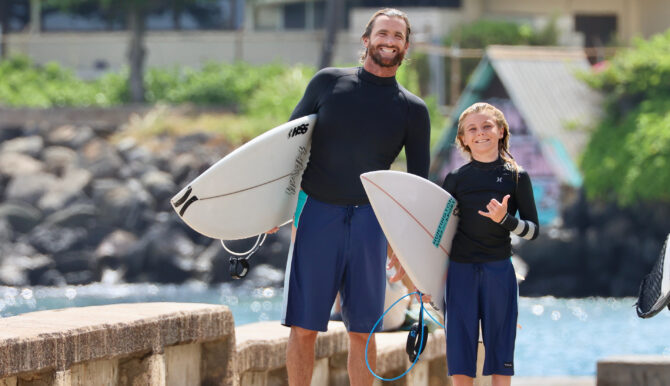
Brett Simpson and his best surf partner, son Kobe.

Brett Simpson has played the professional surfing game long enough to know this as a certainty: things will always change. And Brett seems to be on the side of positive change these days. He’s deep in the heart of the Olympic cycle, as Americans look to qualify and defend their home soil when the Olympic surfing event for LA 2028 will be hosted at Trestles. Instead of grinding away at heats himself, he’s turned his attention to helping young surfers do that. He’s also done his part to help one of surfing’s most iconic brands revitalize itself. We spoke with the Huntington Beach native about all of it.
Give us a quick life update.
I’m still doing Hurley sports marketing, athletes and events. I love that part of this realm. I have a couple of young kids that are coming up surfing, still living in Huntington Beach, and I still sit on the board for USA Surfing, the national governing body for the Olympics. We’ve got that coming up fast so it’s a lot of exciting stuff.
Are your kids into competitive surfing?
My son is 10 and my daughter is 12. They both surf. We’re usually here in the summer on the north side (of the pier). The little guy is starting to surf competitively. My daughter does competitive flag football. Son is figuring it out. You know how kids are, you wanna give them knowledge, but they’re kind of learning and figuring it out on their own. They ask questions, I’m here for it. You can only lead the horse to water.
So with USA Surfing, how big was it for the organization to officially be named the governing body again after the threat of a U.S. Ski and Snowboard takeover?
It was humongous. I feel like a lot of the people in the organization have worked tooth and nail to get there. I feel like we’re credible enough to represent our best surfers. All we really wanted was to keep surfing in surfing. I think it’s going to be great, the opportunity we have here (hosting at Trestles) is big and we’re taking it very serious. Getting our best athletes, they have to qualify through the WSL or ISA. It’s about giving the athletes those outlets to achieve that and make the Olympics, and only a limited number can get there. We’ re just trying to fill those opportunities for our best surfers.
So the Utah wave pool was named the training base for USA Surfing. Why Utah?
Resin Services and Kamaka Solutions have heavily invested in our sport and USA Surfing and I think there’s a possibility they’re a part of that. I don’t think it really mattered where it was, obviously it’d be killer to be right here, but everything in California is unaffordable anyways. Utah, right now is the base for our camps. Maybe it’s not ideal for the fact we’re not by the ocean, but there are a lot of positives. Our best young athletes want to practice airs, and I think that’s what the pools are great for.
What do you make of the ISA vs. WSL standoff? With the WSL adding an event in the Philippines that coincided with an ISA Olympic qualifier?
Fernando Aguerre worked his butt off to get surfing in the Olympics. The WSL obviously has the best surfers. But the Olympics is a different beast. The rules have changed some. The WSL athletes didn’t like the (ISA’s) initial qualifying rules. They thought they should have more (athletes) but it’s dammed if you do, dammed if you don’t. But the opportunity is still the same. You can go qualify at the ISAs, there’s the PanAm Games. I feel the WSL surfers on the Championship Tour are the best but that doesn’t mean there aren’t another 100 really good surfers from all these nations, and that’s the Olympics. The ISA wanted to diversify. I think there are nine nations on the CT, the ISA wanted 20 nations plus and I think that’s how the Olympics traditionally were, and always kinda will be. And that’s what Fernando envisions, more nations among surfing.
The Brazils, Americas, Australias, they’re gonna be dominant but it’s not like they’re going to have an overwhelming representation. They’ll have their two to maybe three athletes per, the rest you’ll have South America, places like Argentina. It’s going to be a more diverse number of nations. I feel like we all agree that the Championship Tour is the cream of the crop but the Olympics, there’s a different qualification process and you gotta go by those rules, and it is what it is.
View this post on Instagram
There’s been sports before like the NHL that have run Olympic qualifiers while the professional and amateur governing bodies weren’t on the same page. Do you think the ISA and the WSL can reconcile?
I think so, Fernando and the WSL, when you have these big decisions there’s clashes like that. Maybe there has already been handshakes in between. I’m hopeful there will be (if there haven’t) because I think they both go hand-in-hand with each other. You want the best at the Olympics, you don’t want them (the WSL surfers) bummed out, and everyone understands how important the Olympics are these days. I think in anything you can kiss and make up.
So with Hurley, it seems like there was a little wavering from the core there with the licensing going on pool toys and different products. Now it seems like the brand is returning to the source a bit. Do you agree?
For sure, obviously our current management are not, like, core surfers. They own a blanket business brand of different stuff. Look, that’s kind of my role, to step in and (share) how I felt with athletes and events – it’s a big role getting them to understand how important the surf world is. Surfing seems small but it’s a billion-dollar-plus industry with a lot of brands, there’s a lot of investment there. I can only do so much. I don’t control every budget. I don’t control every decision but I do my best in the part of taking care of athletes and supporting them in the surf realm, and it’s been a great five-plus years with Bluestar. I’ve grown to know them more and they’re very family oriented. The business structure is different than what we have normally known through Bob (Hurley), but it’s an opportunity for me to feed my family and take care of some young rising stars.

