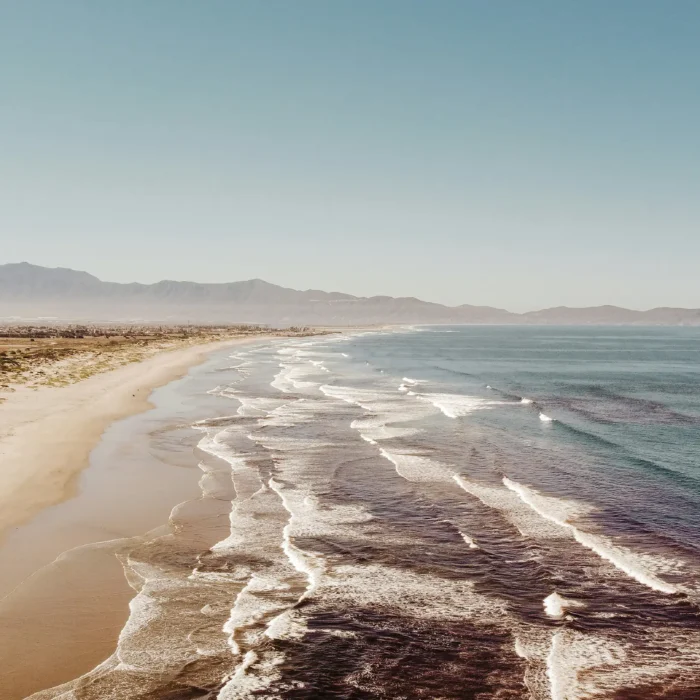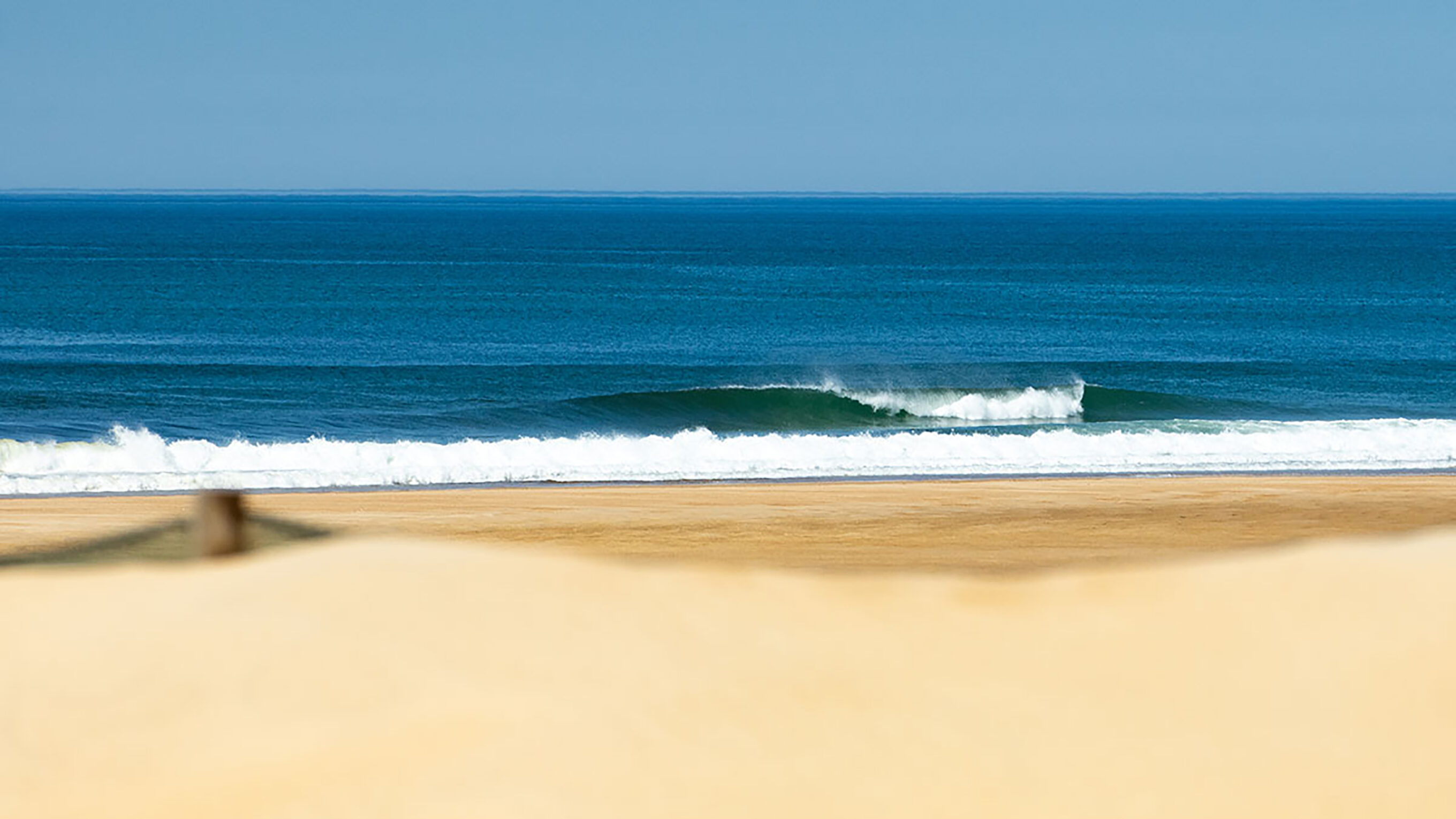
It’s late September, and I’m lying on a nearly empty beach in a small coastal village in France. I came down a path through dunes that could belong in the Sahara, if not for the vast pine forest framing them, and crossed the river where it meets the ocean, splitting the beach in two.
“On a retrouvé notre plage,” I heard locals say again and again this fall. It’s the French way of saying we found our beach again, as if they lost it. Those who could remember a time without surf camps did.
For years, residents of Moliets-Plage pushed back against more than a dozen foreign-owned surf camps and what came with them — crowded lineups, uncontrolled parties on the beach and trash left in the nature reserve. In 2022, nearly 4,000 people signed a petition calling for them to leave. Last winter, they got their wish.
When Les Cigales, the private campground that hosted most of the village’s camps, was sold to the French campsite group Capfun, nearly all of them had to pack up. A year later, Moliets has become a case study in what coastal towns globally are discovering: not all surf tourism leaves a positive trace.
Rooted or Rented?
Surf camps are a relatively new phenomenon. They market to beginners and travelers from abroad, who book a package from home and arrive ready to learn. They serve a purpose. For some travelers, a week of lessons, yoga and parties with people their own age is exactly what they want. But what they’re buying is surf culture as a package, stripped of the community that built it.
Camp operators say they bring economic opportunity to the village, attracting visitors who spend money locally and support local businesses.
For many guests, everything was taken care of: lodging, meals, lessons and parties, paid in advance to companies based in places like Munich, Tenerife and Dorset. Much of that money had already been spent before guests arrived, leaving fewer opportunities for the village to benefit from their stay.
The largest camp had operated at Les Cigales since 2012 and had more than 300 beds. Local surf schools are based in the village and hire staff in France each season. That camp, however, was run from Munich. Even the part of its operation registered in France wasn’t local. On the ground, the camp’s surf teaching was registered to a separate company more than 60 miles away in Biarritz.
The Wild West
I first heard about Moliets a decade ago in Morocco, from a German “teamer” who had spent her summers volunteering at one of its surf camps, working for food and lodging. She described an endless summer on an empty beach. A few years later, I met my husband, a Moliets local and surf instructor. He and the other local instructors had a name for the stretch of beach where the camps taught: the Wild West.
Two realities had made Moliets vulnerable to unchecked surf tourism. EU rules give businesses and workers from one member state broad rights to operate in another. And the family owned campground made the perfect home: camps could rent a plot each summer and set up a temporary operation.
When the mairie (the French term for mayor’s office) tried to step in, it found the camps out of reach. Residents say the owners skipped town hall meetings and sent managers who didn’t speak French. And the camps sat on private land, largely beyond the town’s control.
By 2022, petitioners counted 13 camps, 12 of them at Les Cigales, bringing more than 2,500 people a week into a village of just 1,299 year-round residents.
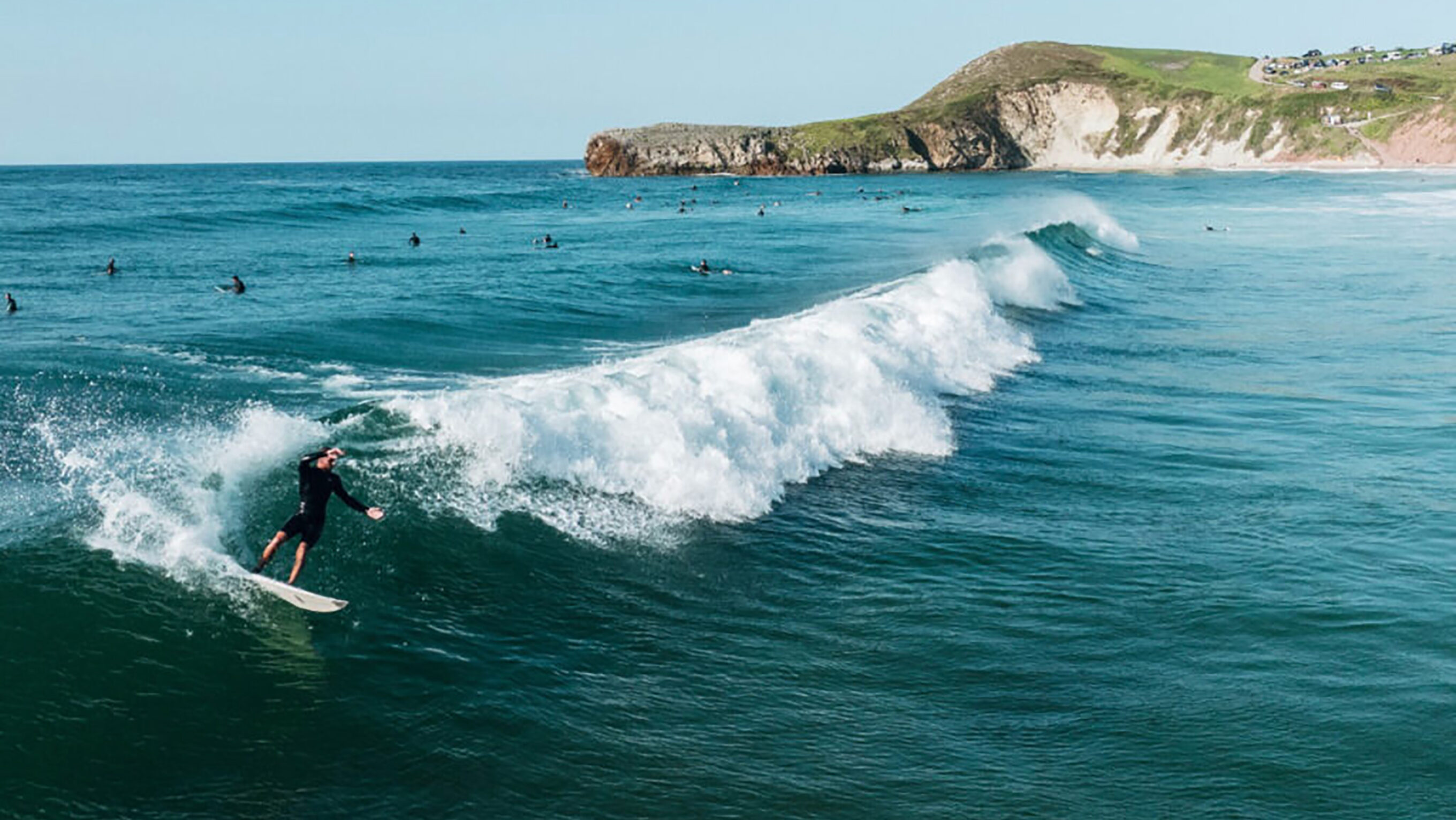
The Wild West nickname fit. On the main beach, the mairie caps how many instructors can be in the water. The camps taught north of the river mouth, outside that supervised zone, where the cap was much harder to enforce. Local surf schools said the crowds were degrading their own lessons, while the camps ran as many as they liked.
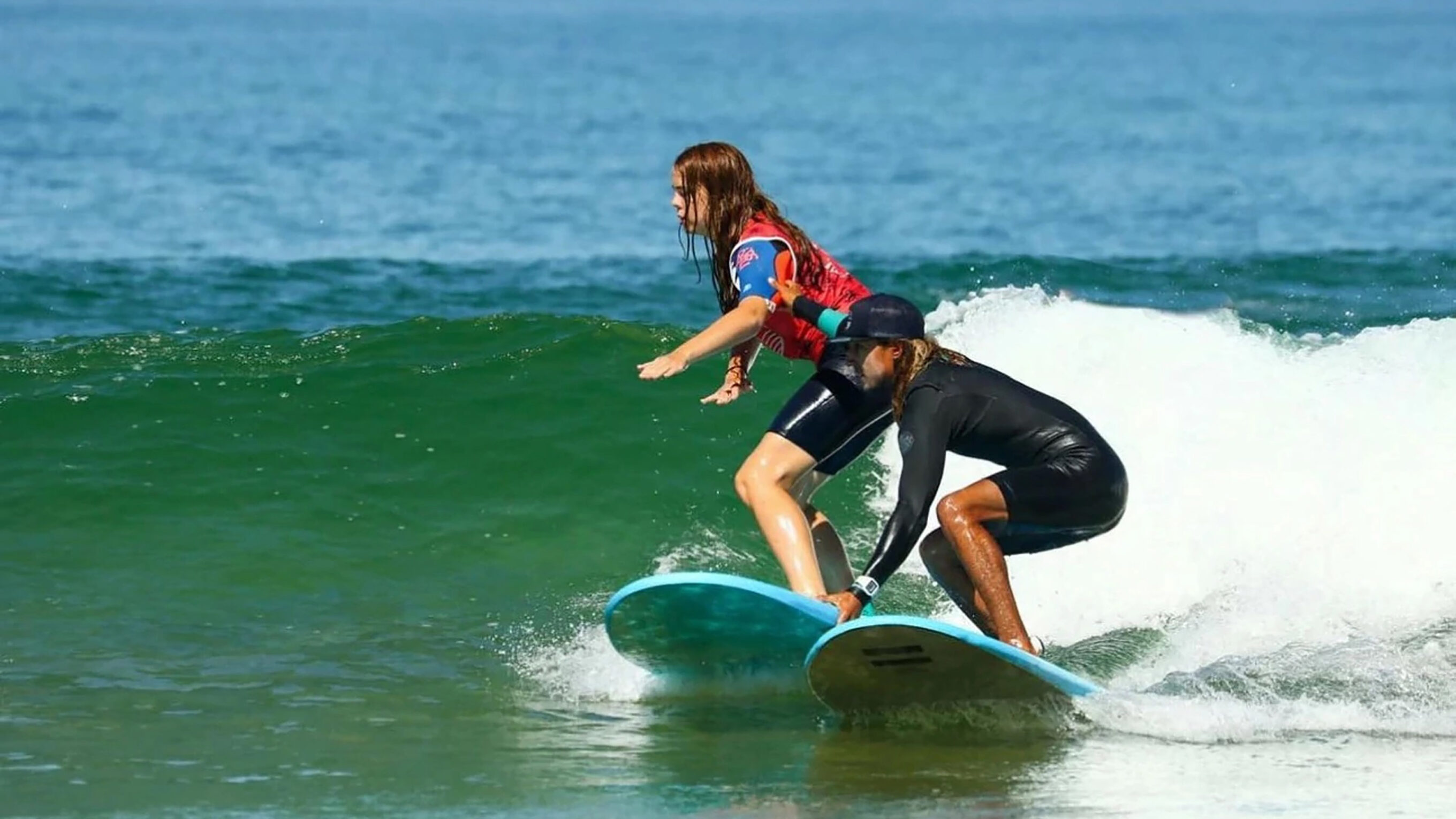
Paul Fanet has taught surfing in Moliets for five years. To do it, he had to earn France’s state diploma, with surf and swim tests and more than 1,400 hours of training. Many camp instructors, as The Inertia reported last summer, taught on a far quicker International Surfing Association certificate. Fanet said the camp staff and teachers he worked alongside in the water were “disrespecting the rules and the space, not controlling their students.”
The Lifeline
Every day, hundreds of campers crossed the river mouth to reach their beach. It belongs to the Courant d’Huchet, a national nature reserve created in 1981. It is the only river mouth in the Bay of Biscay never walled in or stabilized, and the reserve is one of France’s most important sites for the endangered European mink.
“Every morning in summer, the beaches of the Courant d’Huchet and Moliets are overrun with rubbish, left behind from unauthorized parties on the beach or inside the nature reserve,” petitioners wrote.
The Petition
The reserve was only part of it. Many camps relied on teamers working for room and board rather than local hires. One of the biggest camps’ 2025 ad for teamers in France asked for applicants who could cope with “little sleep and a lot of stress” and be on hand for guests “at any time of day.” It doesn’t mention pay.
The arrangement kept costs low, while the jobs that might otherwise have gone to local hires went to young travelers instead.
The pressure spilled off the beach. Leigh Ellis, president of the Moliets Surf Club, used to run a bar in the village. She says she had to hire security guards because camp guests would arrive in large groups, buy one drink each and crowd the space outside. She also says underage drinking among some camp guests was a significant problem, and that she raised it with the camps directly.
For several summers, “Surf camps, go home” was graffitied on the walls outside the campground. Even a major French surf outlet noted that singling out foreign camps could look distasteful, and some commenters dismissed the petition as localism. But Moliets’ locals are not a closed circle of French families. Many came from somewhere else and stayed. The village’s surf club alone counts at least six nationalities among its roughly 100 members, according to Leigh. Local surf schools have always supported the club with donations, equipment and events. According to Leigh, Vegan Surf Camp was the only surf camp to ever contribute.
The objection was never where the camps came from. It was a business model that could take from the village without ever putting down roots.
The Trade-Off
This summer, Moliets got its first look at life without the camps. Only three camps were allowed to stay, on two-year contracts covering the 2026 and 2027 seasons, according to the mairie. Among them is PURE, one of the first camps to operate in Moliets, which now runs an adults-only camp that took a maximum of 26 guests. It says the French company that runs its local operation “employs staff on French contracts and pays its taxes in France.” At the river mouth, the change was hardest to miss. Both the beach and lineup were nearly empty.
The three camps that remained now operate under the same rules as local surf schools, with authorization from the mairie. For Fanet, that made the difference.
“With the authorizations and the camps gone, I think we finally got a better and healthier balance.”
In the village, the change was quieter. Ama, who has owned Amazone Café since 2018, had feared the sale would hurt business.
“We didn’t feel the effects on our numbers like we thought we would,” she said. “It’s just different now. I used to have so many individual to-go orders for coffee and snacks, because the people in the surf camps had most of their meals provided. Now I have big families sitting down for breakfast.”
Some bars and cafés had counted camp staff among their most regular customers, especially in the slower months. At one local bar, known for its laid back vibe and DJ nights, the owner expected the camps’ departure to hurt business. It didn’t.
But the new model looks familiar. Capfun, whose parent group owns 257 campsites across Europe, announced its purchase by calling Les Cigales “a surfers’ paradise.”
Ama is waiting to see what that means for the village. “We’ll see if Capfun sends their guests out of the campsite.”
Local instructors like Fanet also have their reservations about Capfun recreating the same dynamic on the beach. “Big companies buying all the businesses in a region is never a good thing. It turns little holiday villages into Disneyland. It kills the local vibe, and I know the same will happen on the beach.”
Moliets traded foreign-owned surf camps for a French-owned enclave. But waves are finite, and with nearly 700 pitches, Capfun could fill the same stretch of beach with the same crowds. Keeping that from happening will take more than a change of ownership.
And the camps didn’t disappear. One of the biggest camps at Les Cigales registered a new site in Soulac-sur-Mer, about two hours up the coast, in January 2026. The model didn’t leave the coast. It just moved along it.
Beyond Moliets
Most of the time, this story runs in one direction. Researchers have described the global spread of surf tourism as a form of neocolonialism, with operators from the Global North setting up on coastlines in the Global South, controlling the businesses and sending the profits home.
The same camp brand that moved to Soulac now runs camps from Costa Rica and Nicaragua to Sri Lanka, Bali and Imsouane, in Morocco. At its Costa Rica camp, it says it has hosted more than 3,000 volunteers, working in exchange for accommodation.
Moliets is unusual because it happened between wealthy neighbors, inside the EU, in a country with strict regulations on everything from teaching surf to serving a drink. If the model can drain money from a French village, it raises a harder question about places where the power gap is far wider.
When I first visited Imsouane, in Morocco, 10 years ago, I didn’t see a single foreign-owned business. Then the camps arrived, and with them the crowds. The growth caught the government’s attention, and demolitions and state-backed development followed, with little regard for what drew surfers there in the first place.
Governments shape surf tourism, for better or worse. Surfers shape it too, every time they choose where to stay, who to learn from and where to eat.
Whose Beach Is It?
When the system can’t protect a coastline, the people who know it best often step in. In surfing, that’s localism. At its best, it protects the entire ecosystem of a break. At its worst, it tips into hostility, as the graffiti on the campground walls showed. But its core idea is that the people rooted in a place should have a say in what happens to it. In Moliets, they didn’t.
Portugal hasn’t escaped the model either. In Ericeira, a World Surfing Reserve, international brands like Sweden’s Lapoint and Rapture Surfcamps, which also runs camps in Bali and Costa Rica, operate alongside local schools. The difference is that Ericeira has somewhere to take that fight.
As a World Surfing Reserve, it is overseen by a council of local surf clubs, environmental groups and the municipality, which set out to limit how many surf schools its waves can carry, foreign or local. It hasn’t solved the problem, but it gives locals a seat at the table.
This year, Moliets also elected a new mayor, Dominique Graire, whose team has inherited something close to a blank slate.
The mayor’s office says the town can’t dictate which businesses a private campground hosts, but it can control what happens on its beaches. For 2027, it is drawing up a single set of rules for every surf school, covering authorizations, safety and respect for natural areas, and it plans to stop new commercial surf operators from other towns setting up on its beaches.
“In the past, some differences in how things operated created tensions, misunderstandings and a sense of inequality,” said Philip Schneider, a municipal councilor in Moliets. “Our ambition isn’t necessarily to welcome more and more people, but to make sure Moliets remains a pleasant, balanced destination that respects its environment.”
Maybe Moliets got its beach back for a season. Keeping it will take more than luck.
Editor’s Note: Meghan Maguire is an American writer based in the Landes region of France, where she lives with her husband and their one-year-old daughter.