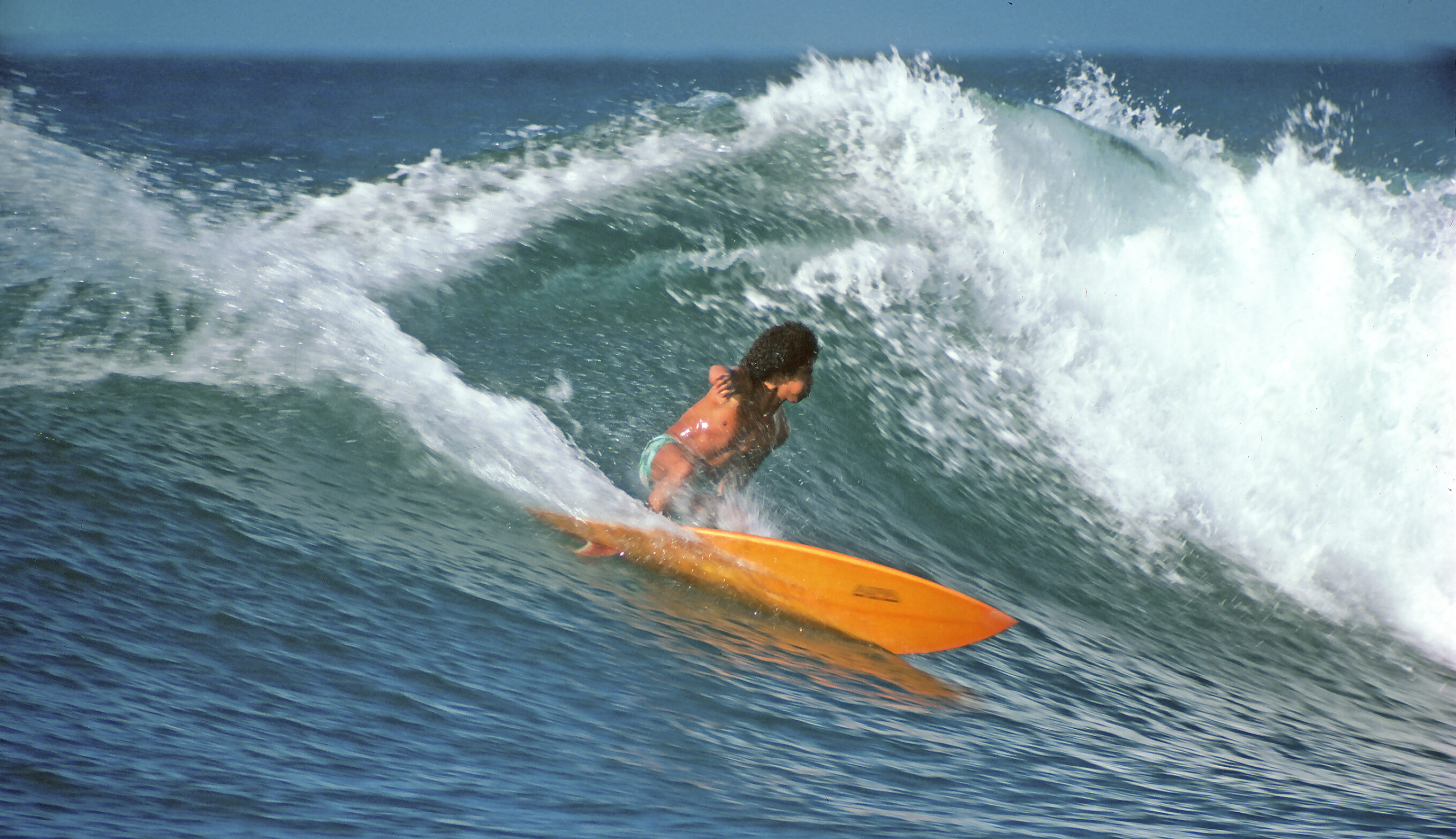
It was the second-most embarrassing thing that ever happened to me during 20-something years spent on the editorial staffs of both SURFING and SURFER magazines. This was in the mid-1990s — I was at ‘ER at the time — when arriving at work one morning I was told that Larry Bertlemann had called, wanting to talk to someone parked at the top of the masthead.
“Really?” I asked. “The “Rubberman?” My reaction was understandable at this point — Larry had been flying below the sport’s collective radar for some time. “Did he say what about?”
“He wanted us to know that we’d been spelling his name wrong.”
“What?” I said. “You gotta be kidding. How?”
“Apparently, his last name has two ‘n’s.”
Unbelievable. All these years, since way back in the early 1970s, we’d been spelling Larry’s name wrong. Larry, one of the most colorful, renowned, influential surfers in the sport’s modern history. Even worse, I’d been spelling it wrong, who certainly should’ve known better; should’ve known to at least have asked Larry at some time or another, when over the years our paths had crossed, on the page or in the water. But then again, why would I have?
It was the summer of 1970, and I was less than a month away from moving from the island of Oahu to the San Francisco Bay Area, my family temporarily put up in a Waikiki apartment, courtesy of the U.S. Navy. Along with a handful of fellow “military brats” I soaked in as much South Shore surf as I could before our respective fathers’ transfers, yet it never occurred to any of us to enter the annual Waikiki Surf Club junior event, traditionally held at Queens Surf — we were all good young surfers, yet hardly locals. But we all went down to watch, and it was there, perusing a printed event program, that I first saw the name “Larry Bertleman,” surfing in heat three of the 14-and-under division. Spelled with one “n,” mind you.
I only had to watch that third heat to realize how fortunate I was not to have entered that contest — the humiliation would’ve been too much to carry with me to frigid, windswept Ocean Beach. That “Bertleman” kid surfed like nothing my friends and I could’ve ever imagined ourselves doing: loose-limbed, almost hyperactive, turning his board anyhow and anywhere he wanted (“Stitching the wave” intoned commentator Lord “Tally Ho” Blears) all the way through the inside kindergarten section known as “Baby Queens.” He really stood out, even among other talented Island juniors like “Menehune” Mike Ho and Ewa Beach’s Robbie Husic; on the beach he was just as impressive, preternaturally confident around peers and grownups alike, seeming to know just about everyone, and be known by everyone. He was the first teenaged surf star I’d ever seen.
So that when 15-year-old Larry “Bertleman” appeared on the cover of the Dec./Jan 1971 issue of International Surfing Magazine, tucked into a tiny Kaiser’s tube, it came as no surprise to me. Nor that his name was spelled with a single “n” — it’s how it first appeared to me that summer before…as well as how I’d see it spelled for more than a quarter century.
The gregarious Honolulu street urchin would be giving the sport plenty of reasons to print his name in the years to come. Less than a year after that cover shot, Larry, along with fellow Hawaiian teen terror Michael Ho, showed up in the finals of the 1972 World Contest — from Baby Queens to the big leagues in record time. And this was no junior event: Larry would be tugging his jersey on next to genuine (and full grown) surf stars like Jeff Hakman, Terry Fitzgerald, David Nuuhiwa, Gerry Lopez and Mike Purpus. International Surfing magazine only ran seven action photos of the event. Two of those were of Larry ‘Bertleman,’ who eventually placed fourth.
Yet for all of the presence in print (between 1970 and 1978, the year both major surfing magazines began monthly publication, Gerry Lopez graced three covers, Larry’s total was seven), it was 16mm footage of Larry that really told the story; much more exciting in concert than on vinyl. In the fantastic anti-contest segment of MacGillivray-Freeman’s 1972 opus Five Summer Stories, Larry, 15 years old at the time, is featured surfing in the by-then hoary Makaha International Surfing Championships – the example being made that event organizers, pocketing the egregious $1.50 entry fees, were exploiting young competitors. No on-screen graphic appeared, so during Larry’s clip we had to accept narrator MacGillivray’s pronunciation of the name.
Didn’t matter — Larry’s surfing spoke for itself. More than any other sequence in that era-defining film, this was a first glimpse of modern surfing to come. Spontaneous motion, collapsing his legs into a deep squat, then springing into turns off the bottom, straight up into the lip or into tight, tight radius cutbacks, pivoting around his dragging front arm and bouncing off the curl; frisky cover-ups and hanging five, just for fun. More power to MacGillivray for trying to make a point about the hokey contest scene. But instead of the “Big Top” circus music with which he scored Larry’s segment with, lending his amazing performance a corny carnival aspect, had MacGillivray used a more propulsive rock tune, surfing’s high-performance trajectory might’ve leapfrogged the whole four-year, 7’4” Brewer winger-pin phase, straight to the Mark Richard twin-fin.
As it was, Larry did his best to get us there. Case in point is 1975’s Super Session, by Hal Jepson. The film’s poster said it all. It featured quotes from a number of established North Shore superstars (“It’s a cakewalk,” “Sunset jacks so much” and “Honkin’” – If you can guess which famous surfer said what, give yourself major surf historian points*). But the poster’s image was not someone in an awesome Pipeline barrel or driving through Sunset’s Inside Bowl. No, the frozen moment of the most super of all the sessions was one of Larry “Bertleman’s” flying into a fully-compressed off-the-lip on a fun-looking, four-foot sparkler. Unlike the other North Shore titans, whom we could never hope to emulate, Larry’s surfing in the film, along with his three-word manifesto — “Anything is possible” – galvanized a whole generation, both in the water, and on the pavement.**
To quell any doubts as to exactly what was possible for Larry “Bertleman,” just check a few highlights from his dossier, as laid out in the pages of the domestic and international surfing magazines throughout the 1970s and early ‘80s:
He won the junior division at the ’71 Makaha International Championships.
Placed third in the 1972 Pipeline Masters.
Winner of both Hawaiian state and U.S. national junior division titles in 1973.
Standing out at all North Shore breaks from V-Land to Haleiwa, he won the 1974 Duke Kahanamoku Invitational at Sunset Beach.
In the mid-1970s, he worked as a supremely high-function test pilot for legendary shaper Ben Aipa’s development of the “Stinger,” the sport’s first modern “high-performance” shortboard.
He placed first at the 1978 Katin Pro-Am Team Challenge, held at Huntington Beach.
Ranked #12 on 1979’s International Professional Surfing World Tour.
Pioneered the surfing billboard in the early ’80s, amassing more non-endemic sponsor stickers (including Pepsi, Toyota and United Airlines) than any professional surfer until Gabriel Medina, some 40 years later.
Featured on a 1985 SURFER magazine cover doing the first authenticated, fully-connected, well -above-the-lip aerial attempt, modestly dubbing his blast-offs “Larryials”
Yes, for a while there it seemed that Larry “Bertleman” was everywhere. But then just like that he was gone, his next 30 years marked by epic hubris, debilitating injuries and a cascade of bad choices; fading from our collective sight as if those flamboyant first 15 years had never happened. And then, on Oct 10, 2026, he truly was gone.
So rest in peace, Larry Bertlemann, who for me, at least, will always be that rambunctious 14-year-old dominating Baby Queens, so obviously destined to make a name for himself, despite the fact that we’d be misspelling it for all those years.
*Gerry Lopez, Jeff Hakman, Barry Kanaiaupuni
**Much has been said and written over the years about how Larry Bertleman, especially with his abrupt, against-the -flow, low-rotational cutbacks, applied skateboard moves to surfing (see Stacy Peralta’s Dogtown and Z-Boys for the origin of “The Bert”.) In fact, the opposite is true. Remembering that Larry was filmed doing these sorts of turns at Makaha as early as 1970, four years before the invention of the urethane wheel, it’s pretty clear that what he did was bring surfing moves to skateboarding.