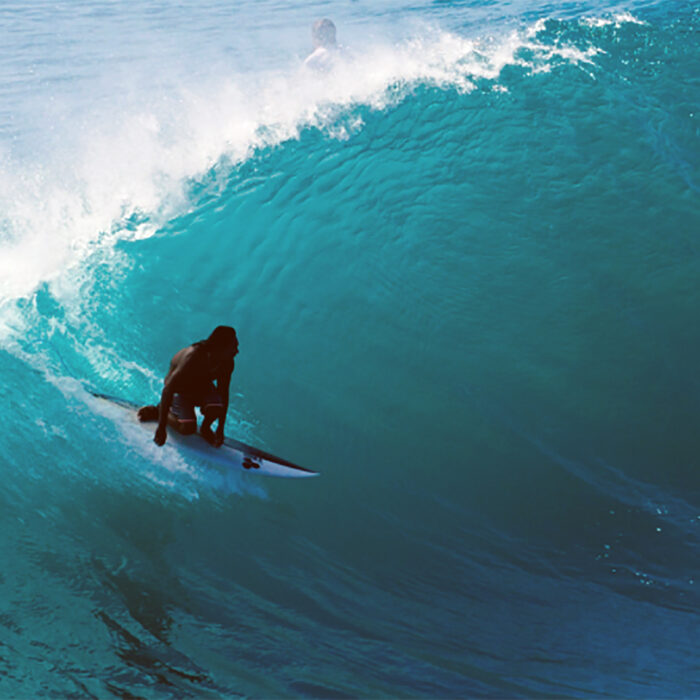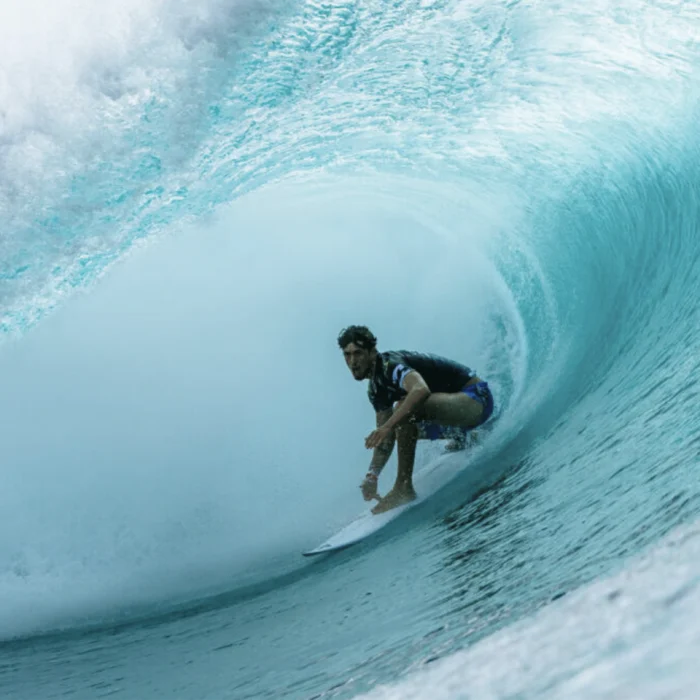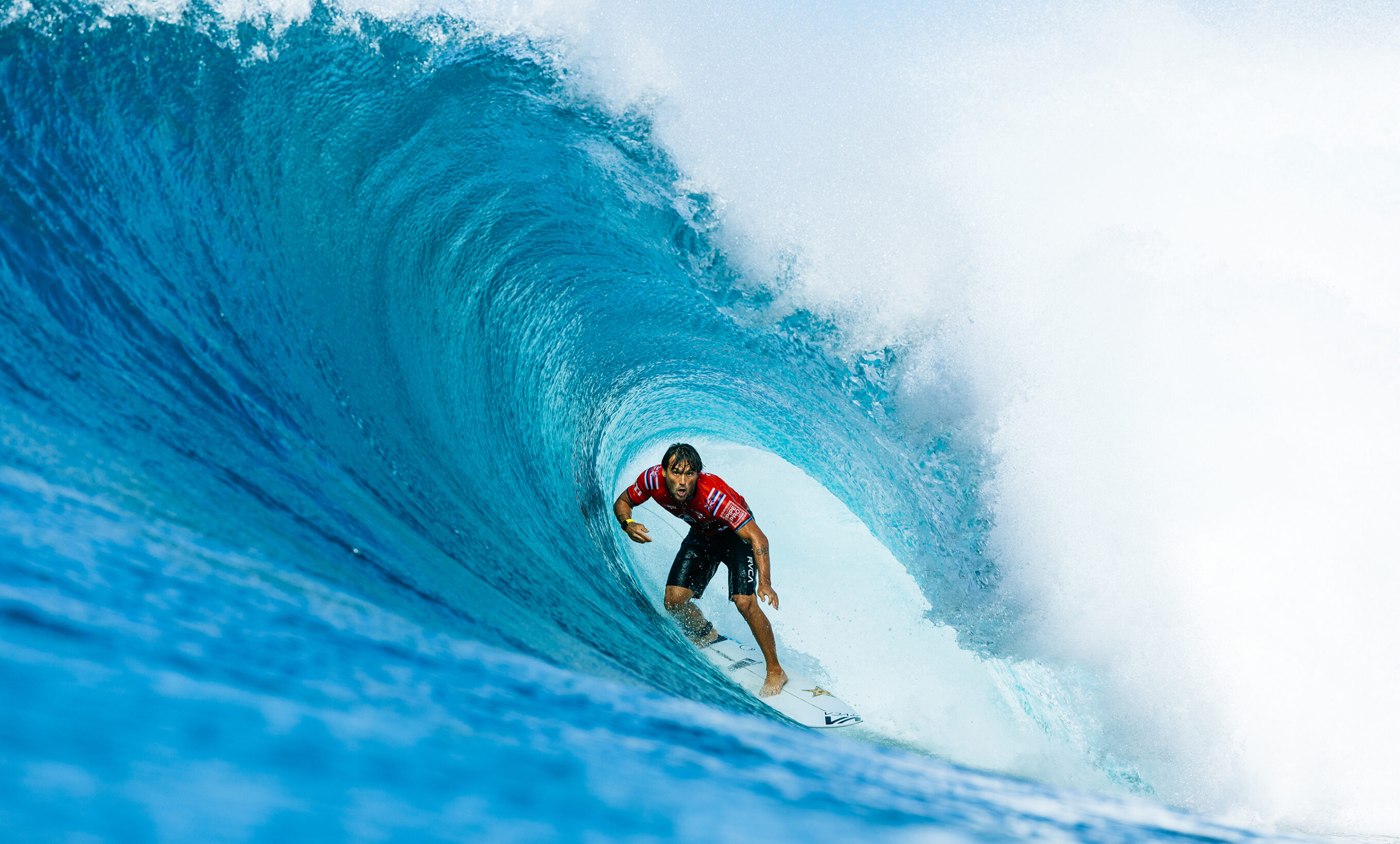
“It was super early in the morning,” says Barron Mamiya as he describes his best ride ever at Pipeline. “I try to paddle out at Pipe every morning, early in the dark, because I get a window with no one out. And this wave came in and I remember thinking to myself, fuck, this might be a close out, but it could be a crazy wave. I took off, bottom turned and the wave went so square. A tall, tall wave, and it just kept going and it spit once, and I couldn’t see anything, and I was like, I’m going to get smoked, and then I could see, and it spit again. Then I went all the way to Gums and it spit a 3rd time and let me out.”
“Did you paddle in after such an epic ride?” I ask.
“No, hell no,” says Mamiya. “I paddled back out and surfed for another four hours.”
Mamiya’s been doing this for years. With two Pipe Pro wins in a row under his belt (now the Pipe Masters thanks to the WSL acquiring the naming rights), he looks to hit the three-peat and join the company of Kelly Slater as the only surfers to dominate the event three years in a row. If it all goes his way, Baron will cement his legacy as one of the best surfers ever at Pipeline.
This year is also incredibly important for Mamiya’s requalification status. He missed the WSL’s post season in Portugal and the Philippines, and sits right under the line of 2027 qualification at 23. But Pipeline is worth 1.5 times more this season than all the other contests, so even a good showing in December will cement his qualification for the 2027 Championship Tour.
I had a chat with the Mamiya to get a glimpse into his unique mindset and relationship with the deadliest, and most beautiful wave in the world.
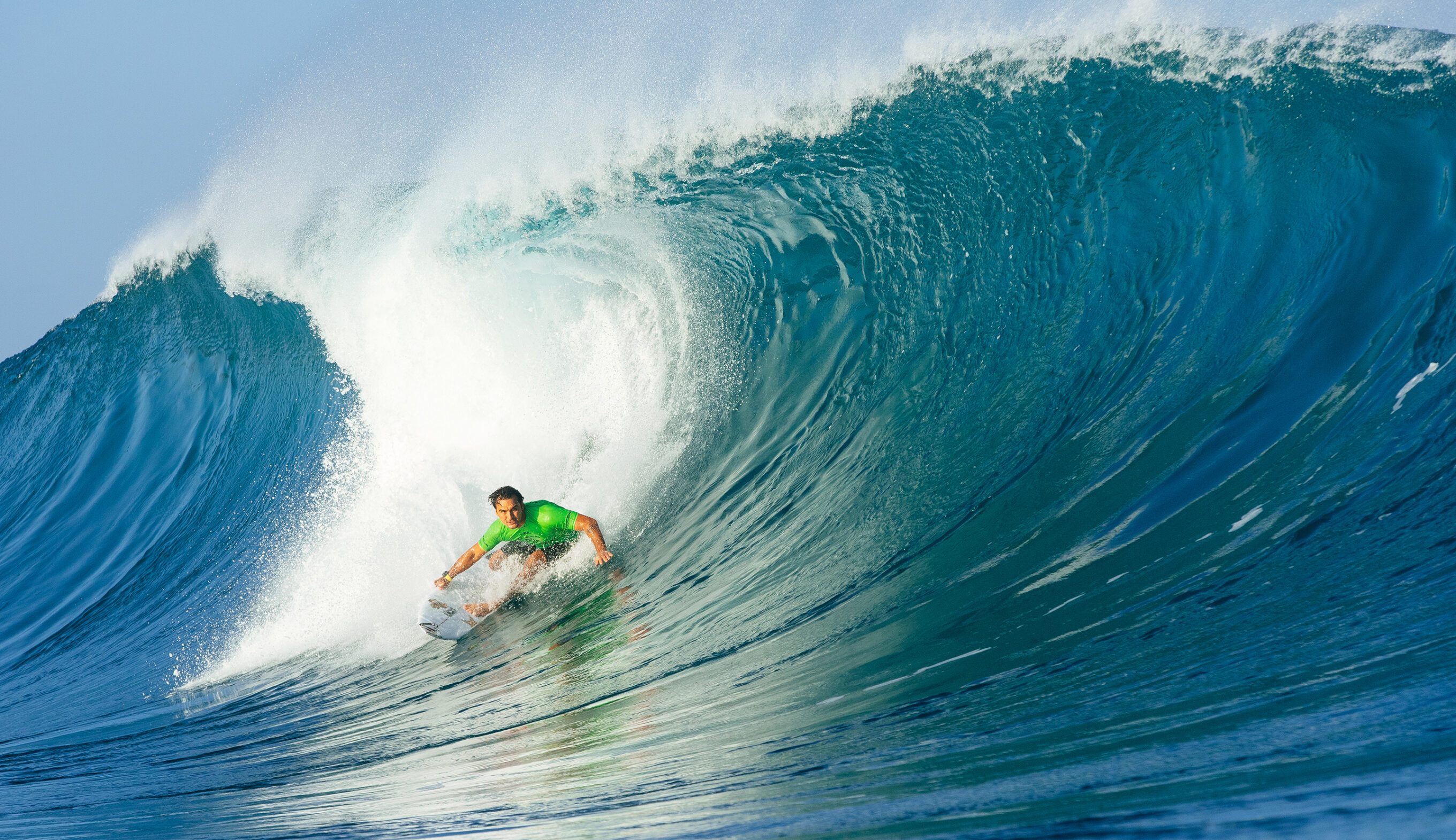
Mamiya grew up on the North Shore, surfing Hale’iwa until his family moved to the Sunset area, which is where he got his first taste of Pipe. The powerful waves shaped him, and many others, into watermen. Different conditions, all raw and heavy, create a gnarly playground that helps develop excellent surfers. As a grom, Mamiya watched the likes of John-John Florence, Kelly Slater, and Jamie O’Brien master the cavernous barrels. Mamiya studied their approach — from where they sat on the reef to mimicking their takeoff movements. Though he admits that John’s style proves too unique to copy. “I love the way John surfs, but no one else in the world is going to be able to surf like John. It’s just not possible. His technique and the way he does things is very, very different than your traditional, perfect technique like Kelly,” says Mamiya.
As for his own style, Mamiya combines balls with brains. “It’s pretty raw. I like to do certain things and I like to take calculated risks. When I was a kid, I would go all out and do whatever and hope it worked out. As you get older, you start to learn and mature as a surfer, and start to realize we’re surfing the deadliest wave in the world. I’ve watched multiple people die. I’ve seen friends, hit their head, get resuscitated on the beach. It puts it into perspective. This isn’t just like a game, you know? This is real life. You can die in a second. So, I’ve taken more calculated risk. But, you know, with that, if I think I can make a wave, and it’s a big wave, and it’s scary… I’m gonna try,” he says with a wry smile.
And that attitude and skill comes from earning his stripes. “Growing up on the North Shore, you better respect your elders quick, or else,” says Mamiya. Though he’s from the start of a new generation, where slaps on the head aren’t as common.
“I was kind of like the generation that it started to kind of die out, but you definitely had to respect your elders. When I would pull up to Pipe, I would sit in the channel out of the way just watching, you know, because you don’t want to get in the way of someone, you don’t want to get hurt, you don’t want to get someone else hurt,” says Mamiya. But people still got put in their place. “You didn’t want to be that guy that got put in check in front of everyone. That’s embarrassing. You don’t want to be known as that guy, you know, even though you’re not getting your head slapped. You don’t want to be known as the guy who got in the way of someone. So when I was growing up, I had to really respect my elders and stay out of the way.”
Mamiya was raised on leftovers, but he earned his way into the lineup the right way. “I was basically getting scraps, so I would try and paddle out when it was way too big, so the crowd thins out. I could kind of feel where to sit figure out my lines and and the positioning.” But the world’s most dangerous wave doesn’t require a permit. Anyone can get out there, whether they’ve paid their dues or not.
“Now a days there’s like 30 kids that are under the age of 18 that have been surfing pipe like once or just every couple years, and they’re sitting like out the back with people who put in their time. It’s a weird feel.” And though Mamiya isn’t the type of guy to make a scene in the lineup, he can say this: “When I was a kid, I was freaking kicking and scratching for four footers on the inside, hoping I could get something. And nowadays, kids are out the back paddling next to me on a 10 footer. I’m like, wait, what’s going on here, you know?”
You can hear the passion pour from his voice when Mamiya talks about Pipeline. It means everything to him, and the rest of the surfing world. “Pipe is heavyweight,” says Mamiya. “It’s the wave that everyone wants to perform at. It’s the proving ground. Always has been, always will be. And then when you grow up in that environment, and that’s your backyard, it carries a heavier weight.” A home kind of weight. “When I paddle out at Pipe with that jersey on, it’s when I feel the most alive. I know it’s time to put on a show.”
And it is a big show at Pipe. “It’s the most prestigious event to win,” says Mamiya. “It’s the most deadly wave in the world and you can get the wave that can single-handedly make your career, off of one single wave, or it could kill you.”
If you can’t tell from words, Mamiya is a die-hard competitor. And nothing fires him up more than surfing against the best at Pipeline. “For example, my last heat against John, there was a wave that came in the heat and I got a 10 on it, but like, the wave was so big and so scary that, you know, if it was any other guy in the water, I probably wouldn’t have looked at the wave. Based on where I was positioned and how heavy it was. I don’t think I would have went on the wave in a freesurf or in a comp if I had someone else in it. But I get so competitive at Pipe, I would have rather gone head first into the reef than missed an opportunity to get a crazy wave against one of the greatest Pipe surfers in John. I think in that moment, John brought that out of me because I knew I had to do something crazy.”
That’s the bull on parade side of Baron. But Mamiya is also a mastermind when it comes to wave selection and body positioning. “The ideal wave at Pipe would probably be one of those waves that’s maxed out first reef, and it’s almost capped at second, but it missed, and it comes in and stands up tall, like a tall 12 footer that has a nice tepee. And there’s wall all the way through Off the Wall, but then there’s a nice taper, like to Eukai. A perfect funnel. I like to take off super under it, and it’s almost like your feet are above your head when you’re taking off; you got this forward momentum and you’re under it. And, I go off of feel at that point because I’ve done it so many times. I’ve felt this before. This is recognizable. Sometimes you’ll disengage, you know, on an air drop. And then once you make the drop, you set your line and then if you’re super deep, you have to pump, but for the most part, you set your line and you just go and hope you’re not too deep.”
When Pipe is on, and Mamiya is in the water, it’s a tune-in moment for anyone in the sport. And this year’s Pipe Pro will carry even more weight for Mamiya.
The Pipe Masters runs from Dec 8-20.