
Lucas Chumbo at the contest site. Photo: Yunes Khader

For years, big-wave surfing has had everything a world championship is supposed to have: some of the best surfers on the planet, terrifying waves, international events and plenty of people willing to risk their lives chasing them.
What it hasn’t had is a world champion.
The last unified big-wave world title came in 2018, before the WSL moved away from the format and the sport was left with a collection of individual events, awards and standalone performances rather than a championship that could answer the simplest question: who is the best big-wave surfer in the world?
Gary Linden thinks that needs to change.
“If there’s no big wave champion, there’s no sport,” Linden told The Inertia. “To me, you have to have a world champion for it to be a legitimate sport.”
After years of trying to put the Big Wave Alliance together and unify big wave contests around the world, Linden is finally getting his chance. The first event designed to crown a new world champion will be held at Laje da Jagua, a remote slab about three miles off the coast of Jaguaruna, in southern Brazil.
The waiting period opened July 29 and runs through November 30, with the event set to happen on a single day when the right swell arrives. Twelve men will compete across two semifinals and a six-man final, while six women will compete in their own final. The prize purse is $25,000 for each division.
The Surfers Are Buying In
The response from the athletes has been encouraging. Linden says some of the biggest names in big-wave surfing were quick to commit when he reached out.
“Billy Kemper, like, in 45 minutes responded, ‘I’m in,’” Linden says. “Lucas Chianca, Nic Lamb, Tom Lowe… I mean, everybody except Kai Lenny, and he did respond, but he had other commitments.”
For Linden, getting Kemper on board means more than simply adding a big name to the field. He sees the former world champion as someone who understands what a new generation of big-wave surfers needs.
“He’ll be there. Billy gets it,” Linden says. “You know, he’s got – I don’t know how many kids – but he gets it that this is not for him, it’s for the next generation.”
That support matters because the Alliance is asking the surfers to accept something that doesn’t currently have universal recognition: that whoever wins in Brazil can call themselves a world champion.
Linden knows there will be questions about that – it’s part of the job.
“I’m not concerned if someone thinks it’s not a legitimate world champion,” he says. “It’s a world champion – like boxing has the IBF, WBA; it has different federations, right? Well, this is the Big Wave Alliance World Championship.”
Big-wave surfing has not had a unified world championship for years, and Linden believes having an organization willing to run one is more important than waiting for everyone in the sport to agree on who has the authority to award the title.
“I don’t think whoever gets crowned from this, wins this event, is going to decline the title,” Linden says.
And if someone eventually builds something bigger or better, Linden says he’ll welcome it.
“My feeling behind it: I am more than happy if somebody steps up and creates a better tour.”
A Different Way to Build a Tour
The Big Wave Alliance is built around existing local events rather than a traditional tour with a fixed schedule. The idea is to let organizers use their own local knowledge and infrastructure, then bring the best surfers together for a world championship.
That also allows the Alliance to wait for the kind of swell big-wave surfing actually needs.
“There’s only four heats, so you can cherry-pick a swell,” Linden says. “A big wave swell usually lasts for three hours of peaking – it comes up, it peaks, and then goes down. So I want to be able to pick that. Now, with our scientific input and local knowledge, we should be able to pick that.”
That philosophy is particularly important at the new Brazilian venue.
Why Brazil?
The event came together after Brazilian big-wave surfer and organizer Thiago “Jacaré” approached Linden.
Jacaré had already run an event at nearby Praia do Cardoso and had connections with the local community and government in Jaguaruna. He saw an opportunity to turn Laje da Jagua into the centerpiece of a bigger event.
For Linden, the local infrastructure was a major advantage.
“My part is to bring the format, and my name brings credibility with the athletes,” he says. “And for me, it’s great because Brazil is professional at running an event. They have a federation, they have judges, they have water safety – all the stuff that I used to have to bring.”
The connection is also personal. Linden first arrived in Brazil in 1972, sailing from the Canary Islands on a 30-foot boat with no motor. He stayed for six months, fell in love with the country and learned Portuguese before returning and working for another two years, with the plan of eventually moving there.
“Since ’74, I was part of the community there,” he says. “I was one of the first shapers to go to Brazil and shape. I still have my house in Saquarema, since ’74.”
That history made the choice of Brazil particularly meaningful.
“I would have taken any place to have the prize money and the organization,” Linden says. “But nothing made me happier than to have it in Brazil and be able to shock the world.”
The Wave
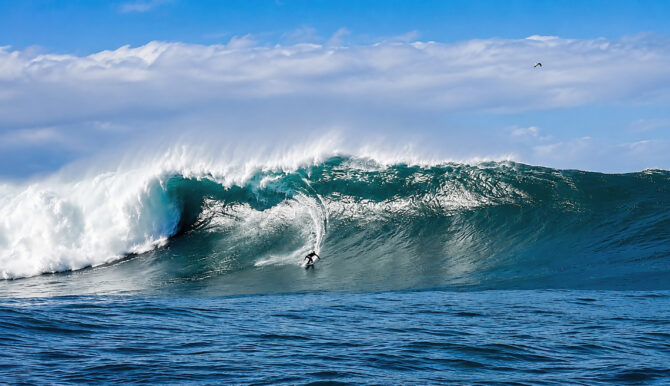
Laje da Jagua has already produced some giant sessions, although much of what has happened there has never been formally documented.
“Based on days we’ve surfed that haven’t even been officially documented yet, Jaguaruna 100 percent qualifies as the biggest wave ever seen in Brazil,” Jacaré says. “We’ve already seen waves well over 55 feet.”
The event will be paddle-in rather than tow-in, and getting the right conditions will be critical. Linden has never actually seen the wave in person.
He did, however, get a warning from Lucas Chianca recently at the Big Wave Awards.
“Man, with the currents out there, it’s going to be a challenge,” Chianca told him.
Linden sees that as part of the appeal.
“I’m tired of hearing that Brazil doesn’t have big waves. I want waves that are so big, they can’t even ride them,” he says. “It’s going to be a dogfight. It’s going to be a challenge for everybody.”
Jacaré says the forecast is already showing potential, but the event needs a very specific combination of swell and wind.
“Looking at October, there’s already a big swell coming, but the wind just hasn’t aligned yet,” he says. “You have to look at the chart and say, ‘This is the contest swell,’ you know? The slab is sensitive – it can’t have bad wind, it needs the right direction, and a good swell period.”
The surfers are watching, too. Jacaré says Justine Dupont recently messaged him asking about swell direction and whether a good swell was coming.
“I explained everything to her, and she told me, ‘Please let me know. I have a lot of commitments, but my top priority is to compete in this contest.’”
For now, that is what everyone is waiting for: the right swell to arrive at the right place at the right time.
If it does, the Big Wave Alliance will have something it has been missing since its inception – and something big-wave surfing has been missing since 2018: a world champion.

