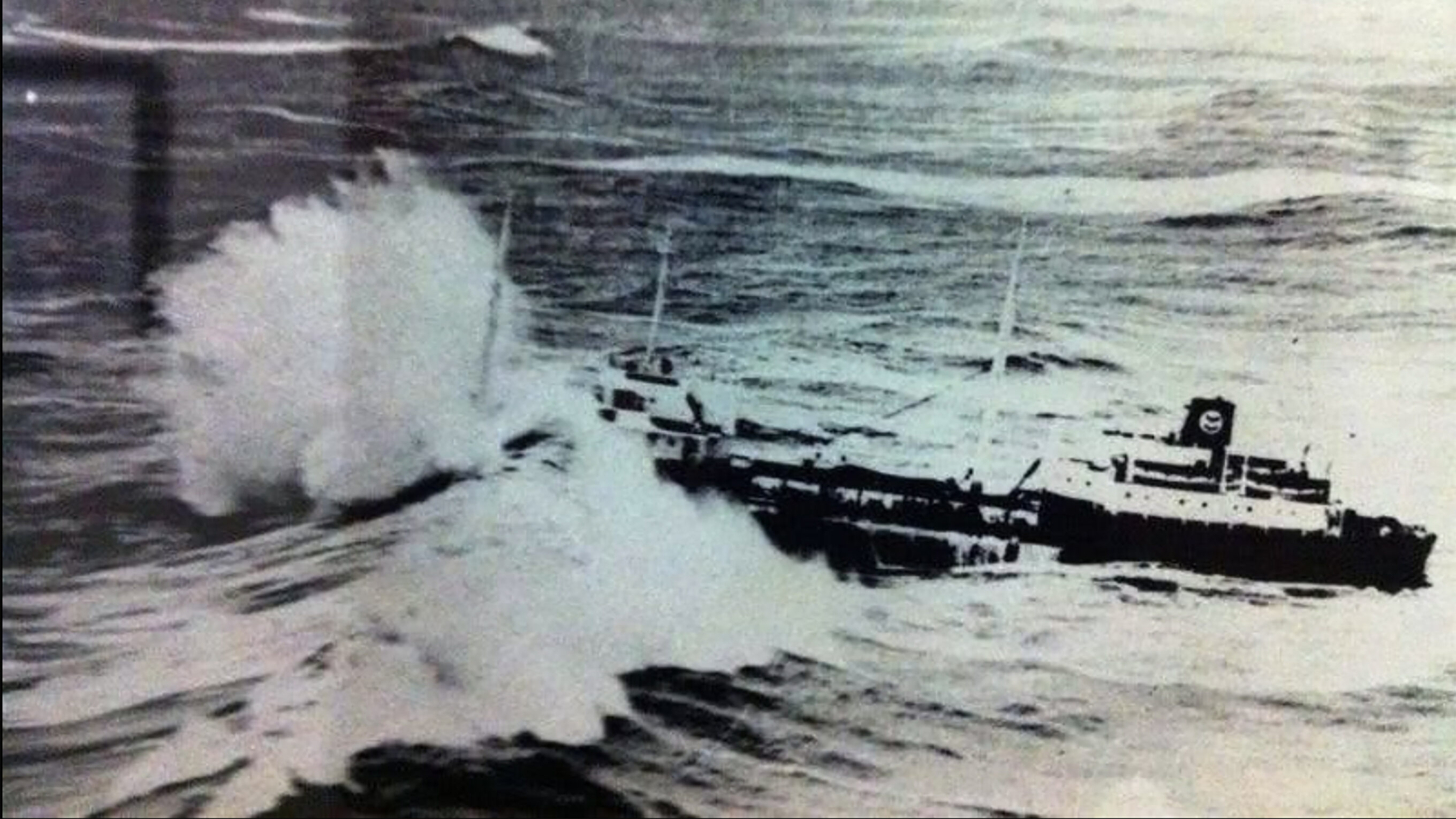
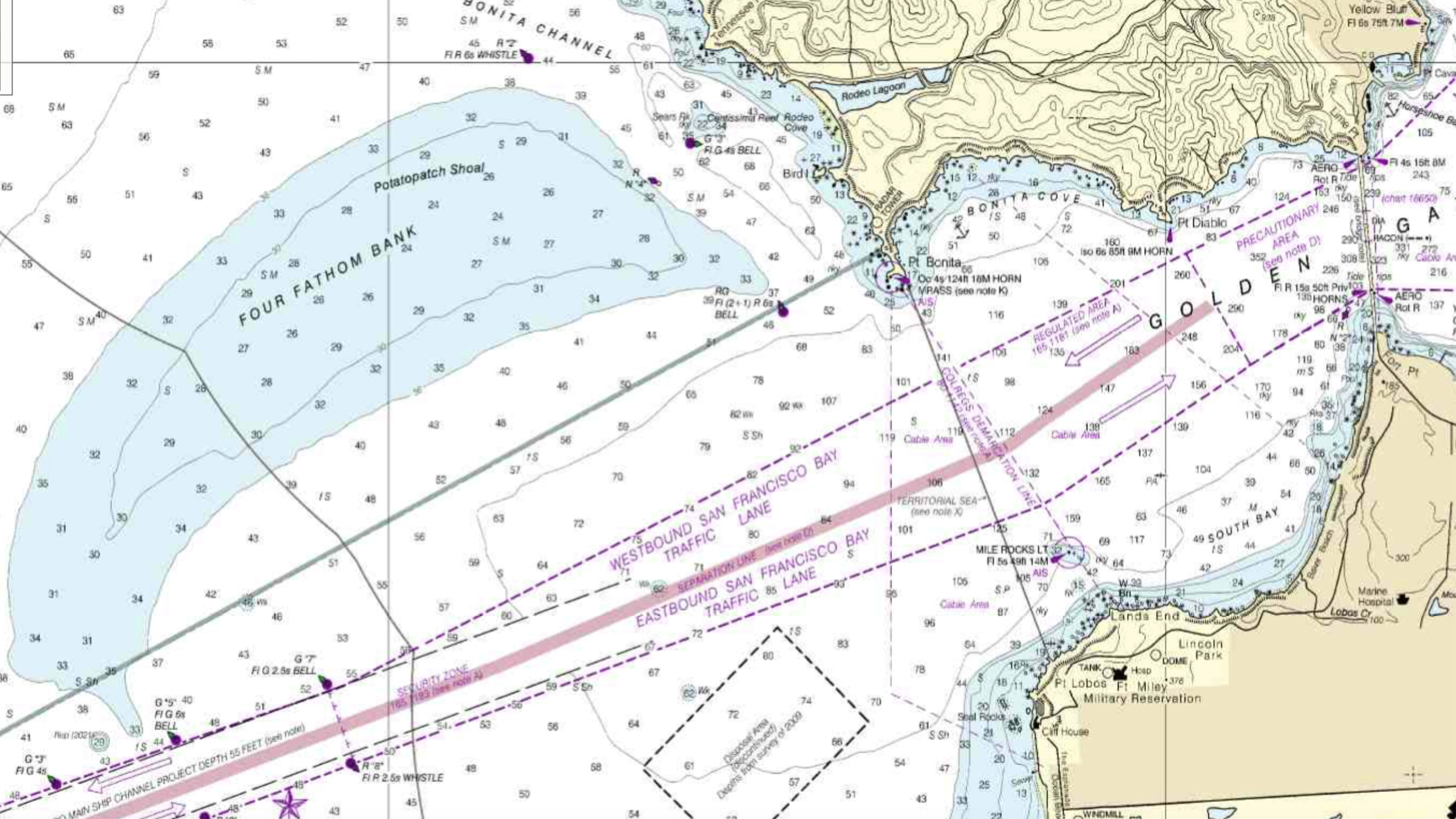
The night of February 21, 1891, was dark and dirty when the three-masted bark “Elizabeth,” with only a handful of miles left of its 13,225 nautical-mile journey from New York City to San Francisco, found itself drifting off the mouth of “The Golden Gate” at the bay’s narrow entrance. Dark, dirty and dangerous, as lashed by ferocious gale-force winds and mountainous seas, the 1,886-ton vessel found itself being inexorably swept into a treacherous shoaling ground, marked on charts as the “Four Fathom Bank,” but known colloquially as the “Potato Patch.”
The Elizabeth’s skipper, Capt. James Colcord, had shrugged off assistance from a pair of Sausalito tugboats, claiming, though in obvious peril, that he was being over-charged. But as the good ship, its sheets flying, inched closer to the shoal, where storm-driven swells crested and broke mizzen topmast-high, Colcord reluctantly agreed to the $50 fee, and accepted a tow rope. By then, however, it was already too late. Struck by a massive wave, the bark broached to starboard, and taking the following breaker full on its side summarily snapped the tow line. After somehow managing to take off Capt. Colcord’s wife and two daughters, and later fishing out of the drink three members from the ship’s crew of 29, the would-be rescuers could only watch helplessly as the Elizabeth settled on the shoal, where, relentlessly battered by breaking waves, she began to break up.
“The tugs were unable to get near the ship,” read the New York Times’ account of this chilling maritime disaster. “And later that night retired to port, leaving the vessel to its fate.”
By dawn’s first light, nothing was left of the Elizabeth, save for a few small scraps of floating wreckage. All 18 crew members left aboard the previous night, including Capt. Colcord, had perished.
On Saturday, November 14, 2026, a full 135 years after the Elizabeth was lost, a tow rope of a different sort was dropped on the Four Fathom Bank. On this day, aligned with the peak of what is now being called one of the biggest winter swells to ever bombard the U.S. coast of North America, a trio of intrepid surfers — Laird Hamilton and Benny Ferris from Kauai, along with Californian Jeff Sweet — piloted their PWCs out through the Golden Gate on a heading toward 37∞ 48’ N, 122∞ 32’ W, armed with foil boards and the intent, all these years later, of riding the massive swells sweeping across the Patch.
“Laird called me up the day before, told me about the Potato Patch, and said we had to be there,” says Sweet, a renowned L.A. County waterman, former sheriff’s detective, and longtime member of good standing in Hamilton’s “drop everything for a gnarly adventure” inner circle. “So, we loaded up the skis and headed north to the Bay Area, driving up though a heavy rainstorm.”
Basing their mission out of Coast Guard Station Golden Gate, located on Horseshoe Bay under the north side of the Golden Gate Bridge, the trio would be putting out through the same waters as did the tugboat Alert during its fruitless rescue mission almost a century-and-a-half ago. Assigned hero status, however, has changed quite a bit since those sepia-toned days of old.
“It was pretty funny,” recalls Sweet. “We were eating lunch in Sausalito, and this guy in a Thrasher magazine sweatshirt comes up, and it’s like he can’t believe his eyes. Like, “Laird Hamilton? What are you doing here?” As if he never imagined that Laird actually needs food.”
Turns out the lunchtime fan was hardly alone.
“We didn’t check in with the Coast Guard, or anything,” says Sweet, setting the stage as they mustered with their gear on the Horseshoe Bay ramp the morning of the 14th. “But they checked in with us, because they all wanted to take photos with Laird. After snapping a few, and telling them what we were up to, we just got on the skis and took off.”
Their destination, the Four Fathom Bank, isn’t a particular wave, or even a conventional surf spot, but rather a broad shoal spread over several square miles of seabed, with depths ranging from 20-to-36 feet producing a wide field of localized peaks when swells get big enough. Some claim this tumultuous acreage first earned the moniker “Potato Patch” back in the late 1800s, named for the numerous small transport vessels carrying produce down from farms along Bolinas Bay who floundered in the shoal’s treacherous, clapotis wave conditions. One in particular carrying a big load of spuds; as good as tale as any.
Located in full view of shore from either side of the Golden Gate, Potato Patch first caught San Francisco surfer’s eyes back in 1950s. Legend has it that ironmen Charlie Grimm (one of history’s coolest surfer names) and Rod Lundquist were the first to attempt paddling out to what’s known as the “South Patch,” breaking on the distal south end of the Four Fathom Bank, several miles off Ocean Beach. On heavy wooden boards and, in Grimm’s case, wearing Speedos. Just think about that for a moment.
Credit for the first try at the “North Patch,” which many consider the “real” Potato Patch, goes to longtime SF stalwart Dr. Mark Renneker, who in both 1981, and 1983, took a shot at the Patch, paddling into the lineup from a boat. Neither endeavor ended well. Chaotic, 20-to-30-foot waves proved too much to handle the first go-round; a single attempted wave on his second try ended in a brutal wipeout, and gnarly retreat back to the boat. But give major props to Doc for his impressive determination.
The first video footage of anybody actually riding waves at Potato Patch was shot on March 21, 1999, capturing NorCal tow-team Perry Miller and Doug Hansen dodging relatively modest 20-foot cap-overs, before successfully riding a few. Doing a fine, workmanlike job of it, too, considering the inherent difficulty of riding big, bumpy waves that roll along with no concave face, yet somehow lots of whitewater, while on conventional surfing equipment totally unsuitable for the task. Regardless, Miller and Hansen take first prize.
But on this past November 14th, the attempt on Potato Patch was a whole different animal. For one thing, you had Laird at the helm, the quantum-leaping surfing figure who essentially invented tow-surfing and foil-boarding, his buddy Benny, an impeccably pedigreed Hawaiian waterman and Laird’s regular tow-partner, and finally Sweet, with his background in not only extreme aquatic exploits, but emergency first response, riding safety. An ideal team to take on the Patch during a swell of this size.
“We motored out under the bridge, which was wild on skis, and headed straight out to the Four Fathom buoy,” says Sweet. “It was easy, because for some reason, maybe being in the lee of Point Reyes, but the further out we got, the glassier it got. I mean, it was crazy, with waves breaking all over the place, but perfectly smooth. And big.”
How big? From his seat on the ski Sweet estimated sets up to 50-feet. Not that this metric slowed anybody down.
“We’d hardly been out there for a minute when Laird had himself whipped into this giant wave, and all of a sudden, it was on.”
“On” was a seven-hour, 19-gallon gas session (of course the skis were outfitted with extra gas tanks) that had Laird and Benny tackling multiple monster waves that reared up and charged over the shoal, with some rides clocked at up to a mile. And from the very first drop of the rope, it was evident that the waves of Potato Patch have been waiting patiently for a foil-board to come along and do the thing right.
“These guys weren’t just going straight, but traversing back and forth, carving long lines across the face of some pretty serious waves that sometimes didn’t really break…but sometimes did. I mean, there were some steep, late drops. And with no real lineup, waves breaking all around us, you had to be on your game. I don’t think I took my hand off the throttle the whole time.”
Throttle pinned for the duration, but remarkably Sweet, although having to outrun a few five-story avalanches himself, found no need to effect a rescue the entire day. Finally, with gas gauges and energy-levels nearing “E,” the trio turned their skis east and headed back to the Golden Gate Bridge, and safe harbor.
“We didn’t see a single person all day,” reports Sweet. “And apparently nobody saw us.”
Nor will we. In sharp contrast to what was happening at the very same time a mere 25 miles down the coast, here were no cameramen, no drone-teams deployed, not even any IPhone selfies.
“Way too hectic out there for that,” says Sweet. “The whole session was a ‘both-hands-full’ situation.”
So nope, no media at all, but just three adventurous surfers who felt that on Saturday, November 14, 2026, during one of the biggest swells in years, San Francisco’s Potato Patch, this notorious graveyard of ships, was the right place to be.
“Yeah, the rest of the world was at Maverick’s,” Sweet muses. “But we weren’t.”