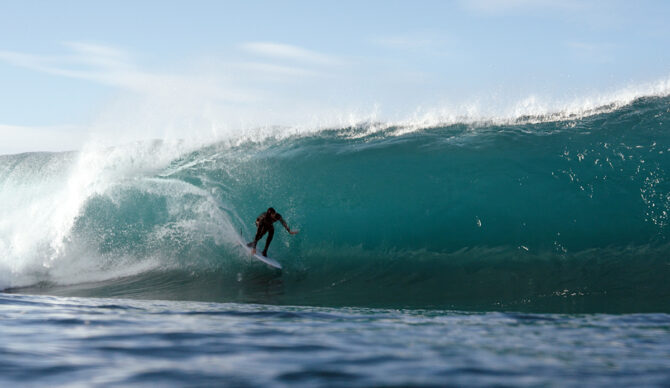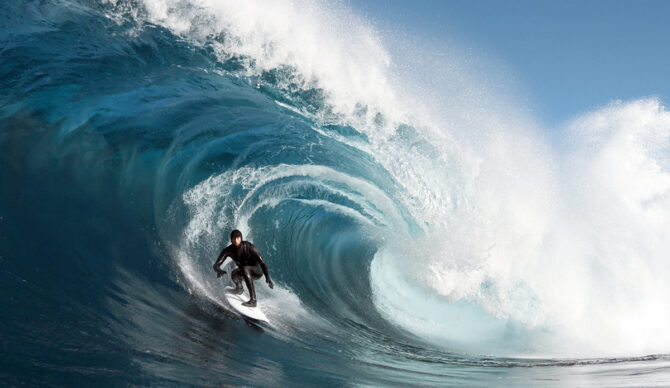
Torren says they found some fun surf, northing epic, but this doesn’t look bad. Photos: Southern Edge

Southern Edge is a new film featuring Torren Martyn and Ishka Folkwell. It’s the latest installment from the pair, whose films over the last decade have helped change the surfing cultural landscape. They started with the Lost Track series, which consisted of three films: one that circumnavigated Australia in a Land Rover, another that searched New Zealand on motorcycles, and a third that traveled in a Ford Transit from Scotland to the west coast of Africa on a surf hunt.
In 2022, Martyn and his partner, Aiyana Powell, bought a sailboat in Thailand and spent an entire year exploring surf spots in and around Indonesia, culminating in the film Calypte.
Southern Edge continues the surfing and sailing combination as the pair attempt to circumnavigate Tasmania in two 18-foot sailing kayaks on a quest to surf remote waves. All the trademarks are there: uniquely diverse landscapes, wildlife and ocean energy, mixed with Martyn’s effortless surfing style and a dedicated soundtrack from Murray Patterson and his band Headland.
We caught up with Torren at his newly built shack in Tasmania to discuss surfing Shipsterns, the trip and film, design, his late surf career and much more.
You’ve moved from your hometown of Byron to Tasmania. How’s the move been?
It’s been a big year. We moved down, bought a small piece of land, and lived in a tent for a few months. Then, we built a shed on it, which we have turned into a home for our new little family. It’s small, but it’s bigger than a caravan, which is all I’ve ever lived in, really.
And how are the waves?
It’s so different, such a different climate, there are so many more waves up north, and so much more opportunity to surf them. Down here, you work so much harder for your waves, be it loads of walking or driving, but the rewards can be far greater. I’ve never surfed less, but there have been some magical moments.
And have you been surfing Shipsterns?
Yes, it’s one of the closest waves to my place now. I’ve been loving surfing and trying to figure it out. The issue is that it is so different to every other wave you surf 98 percent of the time. So getting the right boards and approach is difficult, but again, the rewards are some of the best barrels in the world, with some of the most dramatic scenery on the planet.
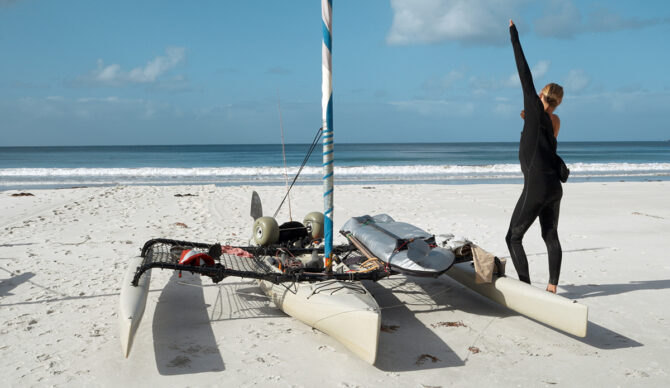
The ritual when traveling via sailing kayak.
And still on the twin fins out there, despite the steps?
Yes, I’ve never felt that a twin has been any type of hindrance in any type of waves, really. Or that I’m missing out on something. They’ve only helped me to push myself in the surfing I love to do. But it’s a new challenge for myself and my shaper, Simon Jones. I’m riding the Fiji model out there, around 6’9”, but I’m interested in seeing if a longer board out there works. The winter is coming, so we will see how we get on.
Was the move to Tasmania the inspiration for the trip and the new movie?
Yes, absolutely. This is our new home, so we wanted to learn about it and the ecosystems. We wanted to do that by connecting with the people who have spent their lives here and have them show what they know about the land and the ocean. We wanted Tasmania and the community to be the main characters in the film.
And what was the original plan, and did it change?
The original plan was to attempt to circumnavigate Tasmania in these little kayaks. We had all our food, water and camping gear to be pretty self-sufficient. We’d just chip our way around, meeting different people, um, just sort of camping our way around. We sailed all the way up the East Coast, then turned left and made our way along the North Coast until we got to the West Coast. On the way down, we were met with one of the first big storm systems of the year, and had to retreat. So in the end, we didn’t make it all the way around, but travelled about 700 nautical miles.
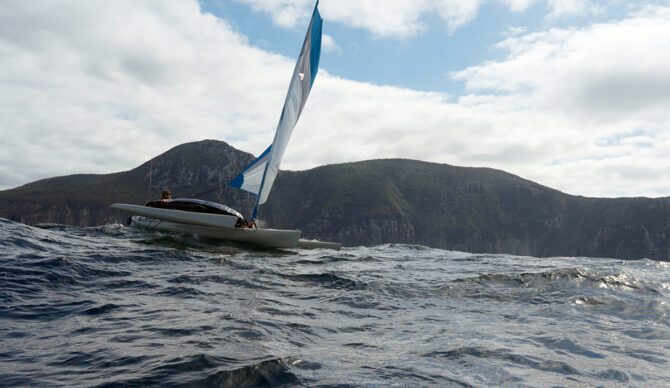
Needless to say, there was a lot more to the trip than just surfing.
Did you score any waves?
We scored fun waves, nothing epic. We discovered it was hard to surf and sail, and do both at once safely. You need to come to land on the beach to sleep for the night, and you can’t just anchor out wide, so the surfing took a little bit of a backseat. But in the end, that became a positive for me.
In what way?
We ditched the expectation that comes with scoring or finding waves. Tasmania is just dramatic. It’s beautiful, it’s wild, and just taking the landscape in, from either 500 meters out to sea, or in close was life changing. Some of the most memorable moments were when storms chased us up the rivers to get protection. It became an environmental film, rather than a pure surfing one.
Are you surprised at the cultural resonance your films have had, over such a long time? And why do you think that is?
It’s strange for me, as until my mid-twenties, I was scrounging around, just doing odd jobs. I could never have imagined having a career like this. I think it is that they are simple A-B travel adventures that are told quite well. Isa has a beautiful eye for an image and how it fits the story. And the music by Murray Patterson is absolutely integral. The other reason is that the trips always come first. We started to make the movies just to fund the adventures, never the other way around. Oh, and lastly, the support of Needessentials has been unique. They’ve invested in us, and more importantly, trusted us to tell our stories our own way. That’s pretty rare, I think.