

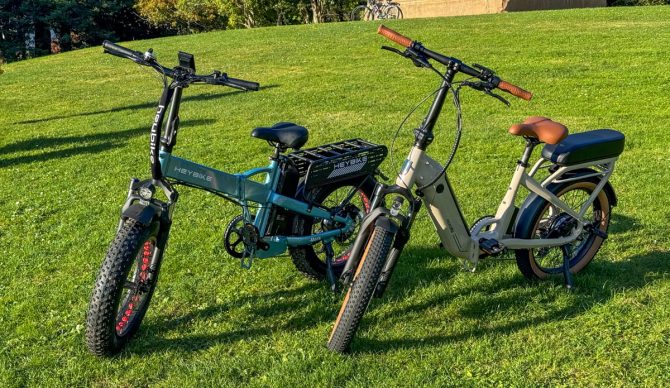
Folding ebikes are a great choice for city dwellers and space-conscious adventurers alike. Photo: Will Sileo//The Inertia

As city living grows more complex and parking spots become a hot commodity, folding electric bikes have emerged as a versatile solution for reliable, emission-free transportation that you can stash in a closet or the trunk of your car. Whether you need a bike for your daily commute or a fun weekend adventure, folding ebikes offer the perfect balance between portability and performance.
We have been testing as many folding electric bikes as we can over the past two years, resulting in the list you see here. Here are our top picks based on key criteria like speed, battery range, ease of folding, and off-road capability.
After extensive testing, we named the Velotric Fold 1 Plus as our Best Overall Folding Electric Bike, with the Lectric XP4 as our Runner-Up Best Overall/Best Value Folding Ebike.
Navigate To: Comparison Table | How We Tested | Buyer’s Guide
Related: Best Electric Bikes | Best Cargo Electric Bikes | More Electric Bike Reviews
The Best Folding Electric Bikes
Best Overall Folding Ebike: Velotric Fold 1 Plus
Runner-Up Best Overall/Best Value: Lectric XP4
Best Budget Folding Ebike: Engwe L20 2.0
Best Lightweight/Compact Folding Ebike: Tern Vektron
Best Offroad Performance: Engwe Engine Pro 2.0
Editor’s Note: Rad Power Bikes has filed for Chapter 11 bankruptcy, and the CPSC has warned consumers to stop using several Rad models due to fire risk from their batteries. The RadExpand 5 is one of the affected models and has been removed from this review. Learn more at the link above.
Best Overall Folding Electric Bike
Velotric Fold 1 Plus ($1,499)
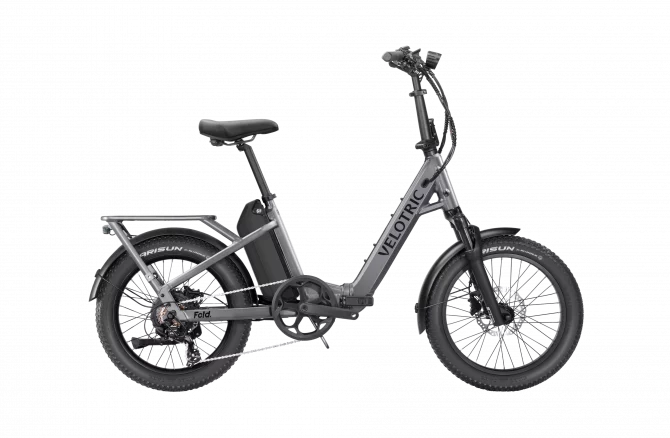
Payload: 450 lbs
Range: 68 miles
Top Speed: 28 mph
Weight: 63 lbs
Sensor: Cadence and Torque with Sensor Swap technology
Pros: Loaded with features, high-quality construction, welded rear rack capable of taking a passenger
Cons: Center folding latch required some fiddling/adjustment to close properly
Velotric just released the Fold 1 Plus, a solidly upgraded version of their already well-loved Fold 1 ebike. The Fold 1 is now being offered at $1,299, and the Fold 1 Lite with a smaller battery, less-powerful motor (500W), and without the welded rear rack, is $999.
The Fold 1 Plus features both a torque and cadence sensor with SensorSwap technology, and integration with Apple Find My, and both are massive upgrades in our books. Dual sensors and Find My integration are relatively new features that a number of ebike companies are beginning to roll out across various ebike models. A small but notable plus – the bike has a USB-C charging port located on the bottom of the controls for charging your phone or other accessories. The battery is UL-certified, and the entire bike is rated to IPX6 waterproofing.
Other standout features of the bike include the massive payload of 450 lbs and the high-quality construction, including a welded rear rack capable of taking a passenger. One small knock to the bike there – without a pad to increase the distance between your passenger’s feet and the relatively low seat height of the rear rack, riding as a passenger will feel pretty cramped. Velotric does offer a seat pad accessory that increases the height somewhat, but overall, you’ll likely want to put your larger rider in the driver’s seat, so to speak, for enhanced stability.
As far as the overall ride quality goes, we are very impressed with what Velotric has cooked up here. The torque sensor modes are smooth and intuitive, with the cadence sensor delivering the type of easy, on-demand power that you’d expect. And in both cases, the 750-Watt/75 Newton-meter motor provides an impressive level of power, more than capable of tackling the hilly streets of San Francisco, where we tested the bike. With top-tier internals and best-in-class features such as the welded rear rack, Find My integration, and SensorSwap, naming the Velotric Fold 1 Plus the Best Overall Folding Ebike was a pretty easy decision. However, those who are less focused on features and looking to save a few hundred bucks should check out the Ride1Up Portola and Lectric XP4, below. And if you’re less focused on features and more on range (and to a lesser extent, power), the Lectric XP4 750 is an offering that’s hard to ignore. Read our full review of the Velotric Fold 1 Plus here.
Check Price on Velotric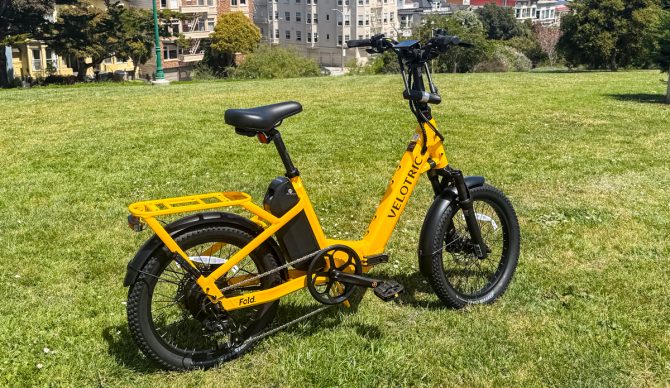
Photo: Will Sileo//The Inertia
Runner-Up Best Overall/Best Value
Lectric XP4 ($999)

Top Speed: 28 mph
Motor: 500W (750W on the XP4 750)
Battery: 10.4Ah (17.5 on the XP4 750)
Weight: 69 lbs (71 lbs for the XP4 750)
Payload: 330 lbs
Range: 50 miles (85 miles for the XP4 750)
XP4 750 Price: $1,299
Pros: Speedy, reliable, compact, tons of accessories, upgraded XP4 750 is a powerhouse of a folding ebike
Cons: Less of a premium feel compared to some other bikes in this review, but for nearly half the price, it punches far above its weight class
Lectric’s XP 3.0 was already a worthy bike on this list. Priced at $999, it provides a solid overall riding experience, with decent power and great range. The XP4, released this past May, takes things to the next level, while maintaining the same price of $999. To say that we’re impressed would be an understatement.
The biggest change over the XP 3.0 is the change from a cadence to a torque sensor. A feature that is normally found on higher-priced ebikes, Lectric designed their torque sensor in-house to keep things affordable. It’s not a showstopper, but it holds its own. Combined with the new Stealth M24 motor technology, it provides a smooth, quiet, and efficient ride with plenty of power to reach the Class 3 top speed of 28 mph. Other standout features among the laundry list of upgrades over the XP 3.0 include a redesigned frame with a sleeker, more premium feel, a detachable (for security) full-color display with better menu navigation and a USB-C charging port, turn signals, and upgraded brakes and drivetrain. The XP 3.0 requires the bike key to be inserted into the keyhole (located on the bottom of the frame) to turn the bike on. On the XP4, this is now optional, and the keyhole is more conveniently located on the side of the frame.
And as if that wasn’t already impressive enough, Lectric has also launched the XP4 750 ($1,299), an upgraded version of the bike with a 750-Watt motor and 17.5Ah battery (compared to the base model’s 500W motor and 10.4Ah battery). These are massive upgrades, giving the bike a lot more power and significantly increasing the range. With such impressive internals, the bike goes from being far-and-away the best value folding ebike on the market as the XP4, to being a true contender for the title of Best Overall as the XP4 750.
In comparison to the Velotric Fold 1 Plus, which we named the Best Overall Folding Ebike, choose the Fold 1 Plus for a slightly better ride feel and better features such as SensorSwap technology and integration with Apple FindMy, or choose the XP4 750 for a bit more power and a lot more range. The base model XP4 is also a natural comparison to the Ride1Up Portola. Compared to the XP 3.0, we gave the nod to the Portola as Runner-Up Best Overall, but the upgrades to the XP4 have us giving the nod to Lectric. That said, if you prefer a cadence sensor and don’t want to spend an extra $500 for the Velotric Fold 1 Plus, the Ride1Up Portola is likely the bike for you.
Worth mentioning, if you’re intrigued by Lectric, but are looking for a bike that’s either cheaper or lighter weight, check out the Lectric XP Lite. Read our full review of the Lectric XP4 here.
See the XP4 on Lectric See the XP4 750 on Lectric
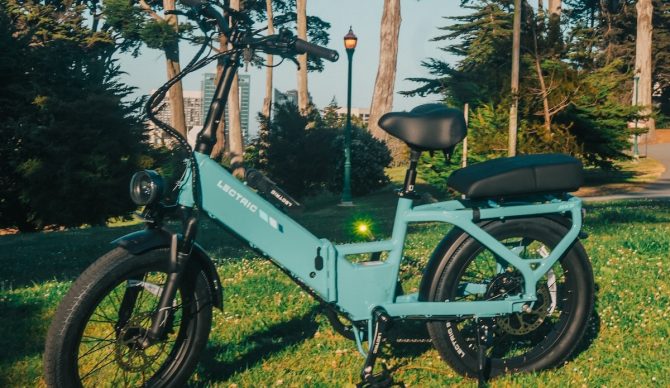
Photo: Skyler Fitzmaurice//The Inertia
Best Budget Folding Electric Bike
Engwe L20 2.0 ($799)
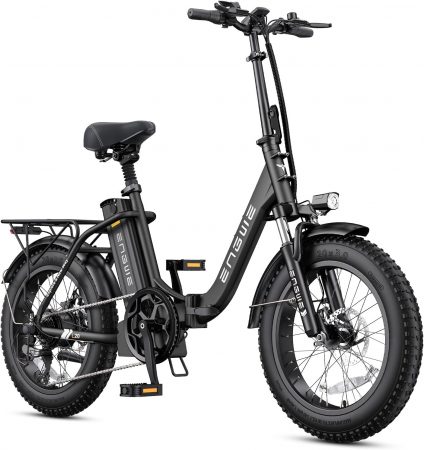
Payload: 264 lbs
Range: 60 miles
Top Speed: 28 mph
Weight: 68 lbs
Sensor: Cadence
Pros: Compact design, good range, affordable
Cons: Basic suspension, non-U.S.-based support
If you’re on a tighter budget but still want performance and range, the Engwe L20 2.0 checks a lot of boxes for what you’d want in a folding electric bike. Add in the fact that it has a price tag of $800, and you have one of the best bang-for-your-buck deals anywhere. With a top speed of 28 mph and a range of up to 60 miles, this bike has stats as good as any other we’ve listed, and on top of that, it looks pretty decent as well. Riding it is smooth and easy, and it has plenty of juice to get up steep hills. We tested it on mountain roads and found that it’s not as powerful as our top performance pick, the Engine Pro, but it’s certainly no slouch in the power department.
It sports a sleek frame, a large display, and folds up easily. It also comes with front and rear racks for extra storage. While the suspension isn’t as advanced as higher-end models, and you won’t get the build quality of higher-priced bikes like the Tern Vektron, the L20 2.0 makes up for it with affordability and functionality. Let’s be clear – this is not a “janky” ebike, but to an extent, you do get what you pay for when it comes to electric bikes, with bikes such as those from Tern and Aventon offering higher-quality components, as well as U.S.-based support in the unlikely event that something does go wrong. Read our full review of the Engwe L20 2.0 here.
CHECK PRICE ON Amazon
Photo: Steve Andrews//The Inertia
Best Lightweight/Compact Folding Electric Bike
Tern Vektron ($3,299)
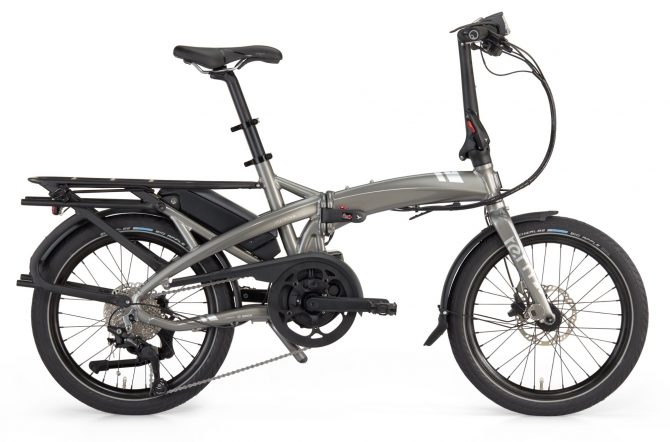
Payload: 275 lbs (rear rack rated to 60 lbs)
Range: 34-68 mi
Top Speed: 20 mph
Weight: 48.7 lbs
Sensor: Torque
Pros: Bosch mid-drive motor, solid features, compact and lighter weight than most folding ebikes, rolls when folded
Cons: No throttle, rear rack can take a kid, but not a full-sized adult passenger
The Tern Vektron clocks in with a price tag much higher than your average folding ebike. That’s because the Vektron is not your average folding ebike. Tern has a reputation for building some of the highest quality ebikes on the market, and the Vektron is no exception, with a whisper-quiet Bosch mid-drive, torque-sensing motor for an intuitive pedaling experience, a sturdy frame, integrated rear rack (rated to 60 lbs), and more. If you came here for speed, this is not the bike for you, as it is a class 1 electric bike capable of speeds up to 20mph, and with no throttle. However, it makes up for this fact with a low weight, easy portability, and great range. The lack of a throttle is a notable downside for city riding, and you’ll need to treat this ebike much more like a regular bike, downshifting as you come to a stop so you’re not struggling to get the pedals turning again, instead of being able to rely on a throttle for off-the-line juice. However, we recognize that may be a welcome difference for those who prefer an ebike that truly feels like a bike, over one that feels like a moped.
Our favorite feature of this ebike, however, is not how it performs, but how it folds. Folding ebikes are often an awkward package when folded, prone to opening up when you’d least want them to, and overall, picking up a 50-75lb package of awkward metal angles and movable parts (pedals, wheels, handlebars, etc) isn’t the easiest task. Well, with the Vektron, instead of picking up the folded bike to get it from point A to point B, you can roll it. With the bike folded (and it stays that way due to a powerful magnet on the rear hub that holds the frame together), simply tilt the bike backward onto the rear wheel, and walk it where it needs to go. Going up a hill? Turn the bike on and activate “walk mode” for a gentle assist as you push the bike forward. And with a weight of just 50 lbs (relatively low as far as ebikes go), loading the bike in and out of cars, storage spaces, etc, isn’t exactly a breeze, but after loading and unloading so many 65-75lb bikes over the course of our testing, the difference is quite noticeable.
CHECK PRICE ON REI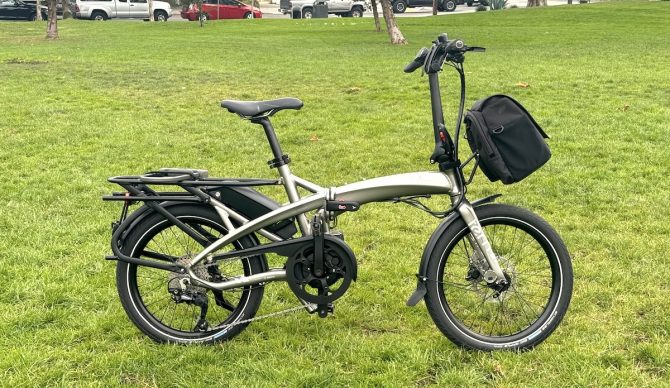
Photo: Will Sileo//The Inertia
Best Offroad Performance
Engwe Engine Pro 2.0 ($1,199)
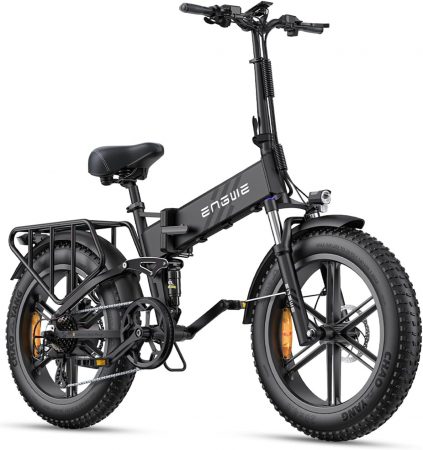
Payload: 330 lbs
Range: Up to 68 miles
Top Speed: 28 mph
Weight: 70 lbs
Sensor: Torque
Pros: Impressive power and off-road capability for a folding ebike
Cons: Heavy, folding mechanism could be smoother
The Engwe Engine Pro 2.0 offers impressive power and versatility as a folding electric bike made with off-road activities in mind. This beast of an ebike is equipped with a 750W motor, rated to 1200W peak, with 75 Nm of torque. That’s a ton of power, and far more than you’ll find on most folding electric bikes. That said, thanks to the torque-sensing motor (an upgrade from the first Engine Pro), acceleration feels smooth and easy no matter how hard or soft you’re pedaling. It wasn’t as responsive as other bikes’ higher-quality torque sensor, but as far as an intuitive and natural pedaling experience goes, it’s a huge step up over the classic cadence sensor. Adding to the smooth ride is the dual suspension and 4-inch fat tires that make it one of the best off-road folding ebikes we tested. We also found the battery to provide a great range, going close to 40 miles in our real-world tests before needing to be recharged.
The downside? At nearly 75 pounds, it’s heavier than other foldable options and isn’t the easiest to carry around once folded. And while the bike’s performance statistics are impressive, the bike’s components aren’t as high-quality as those included on bikes like the Tern Vektron. Additionally, it’s always worth mentioning with overseas manufacturers that you won’t get the same super-responsive, locally-based support that you do with ebike companies like Tern or Lectric. Nonetheless, the Engine Pro 2.0 is a great folding ebike option for those who like to get off the pavement more often than not.
CHECK PRICE ON Amazon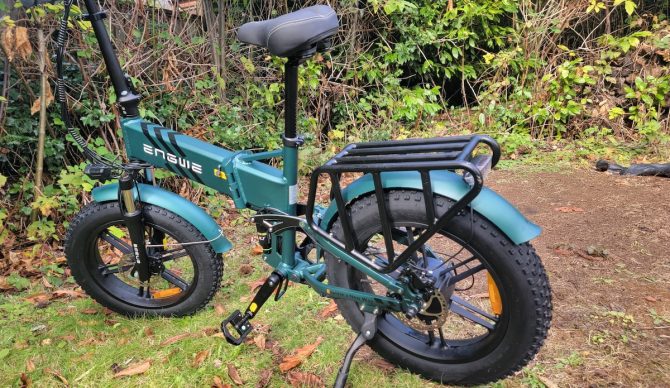
Photo: Steve Andrews//The Inertia
Best of the Rest
Most Compact and Lightweight Folding Ebike
Brompton C Line ($4,700)
Payload: 242 lbs
Range: 20-45 miles
Top Speed: 15 mph assisted
Weight: 38 lbs
Sensor: Torque
Pros: Super compact, super lightweight
Cons: Not very powerful, expensive
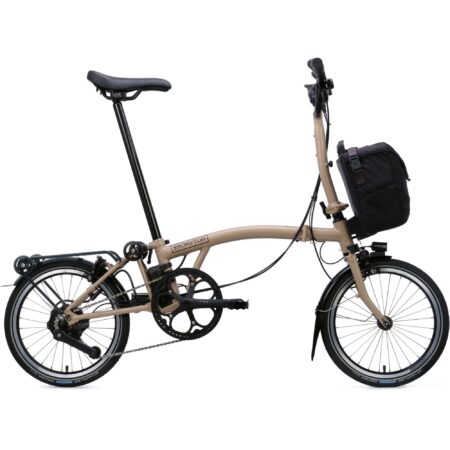
What happens when you take the idea of a portable, folding electric bike to the most lightweight, slimmed-down extreme? You get the Brompton C-Line. Brompton hails from London, and their bikes reflect that with an innovative tri-fold frame that produces the smallest-folded-size (and lightest) ebike that we’ve tested thus far. The brand has a couple of other models that sport various upgrades (larger wheels, more gears, or different frame materials), but the C-Line is the base model, and the most compact/lightweight version. The bike weighs just 38 lbs, and the 7 lb battery, mounted on the front of the bike, is easily removable, either for security or a lighter load going up stairs. That’s where this bike truly shines.
That said, when it comes to actual bike performance, we found our testing grounds, the hilly streets of San Francisco, to not be the best match for this bike’s fairly small 250-Watt motor with only 24 Nm of torque. That, combined with the small gear set (four speeds), made for quite the challenge on anything but the gentlest grades — and in SF, gentle grades are hard to come by. That said, we could see it being a great fit for those in flatter cities like New York, as the extreme lightweight and compactness are huge wins for those who live in urban environments. This is an electric bike that’s lightweight enough to carry up and down the stairs of a walk-up apartment, which is a mighty feat indeed. For shorter, lower-effort commutes with stairs, public transport, or a compact storage space at Point A or Point B, Brompton’s bikes are far and away the best choice, they’re just a little specialized for what most of us are looking for in a folding electric bike.
check Price on REI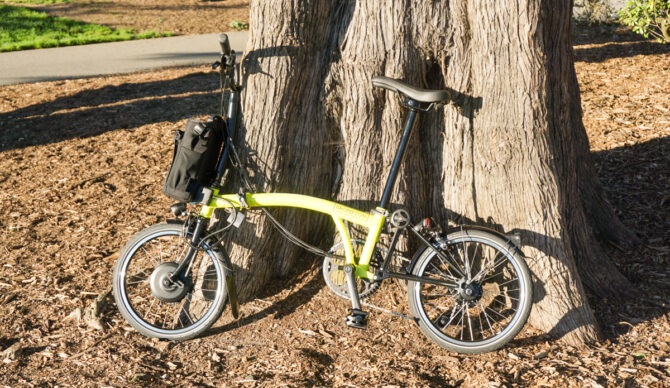
The Brompton C-Line. Photo: Will Sileo//The Inertia
Another Runner-Up Best All-Around
Ride1UP Portola ($995)
Payload: 300 lbs
Range: 20-40 miles (10Ah battery)
Top Speed: 28 mph
Weight: 59 lbs
Sensor: Cadence
Pros: Excellent value, powerful internals, welded rear rack can take a passenger
Cons: Display is fairly basic, a little small for larger riders
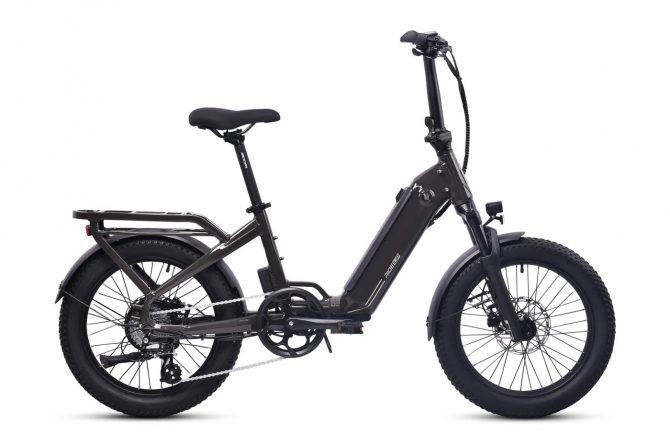
Ride1UP’s Portola offers an insane value for a foldable electric bike, proving itself to be far more capable than the price tag or the size of the bike suggests. Capable of class 3 speeds up to 28 mph, and with a 750-Watt/65-Nm motor, the bike is as fast and powerful as many top-pick non-folding ebikes. And with an integrated rear rack rated to 130 lbs, you can even take a passenger. That’s highly impressive for an ebike that weighs only 59 lbs. And let’s not forget the looks, as this is one of the better-looking folding ebikes that we’ve tested, with sleek styling and fun colors.
The tires have a good mix of ruggedness for off-roading, yet are narrow enough to handle well around the city. It’s a perfect hybrid bike that will feel comfortable on asphalt or dirt. To get to the price point, Ride1Up had to sacrifice somewhere, and that’s in the simple display that only shows the battery level as bars without a percentage, so be sure to keep it well charged and have an idea of its range before taking it on any long-distance treks. For an extra $200, you can upgrade to a 13.4 amp-hour battery instead of the 10.4 amp-hour version for an increase in range.
Our final con is that the bike frame will feel a bit small for riders over 6′ tall. If that’s you, or if you prioritize range over power, or like the idea of a bike that requires a key to turn on, it might be worth taking a closer look at our Best Value Folding Ebike, the Lectric XP 3.0, below. Overall, the value of this bike is what elevates it to the best overall folding ebike in our review, with better stats, features, and styling than some ebikes that cost nearly twice the amount. If money isn’t an issue for you in searching for the absolute best folding ebike, and you prioritize functional features over speed (and having a throttle), you should also check out the Tern Vektron, below. Read our full review of the Ride1UP Portola here.
Check Price on Ride1UP
Photo: Will Sileo//The Inertia
Sleek with Advanced Features
Aventon Sinch 2.5 ($1,799)
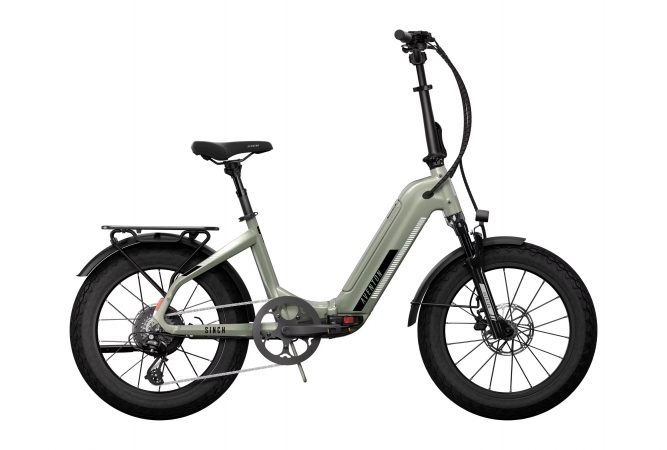
Payload: 300 lbs
Range: Up to 55 miles
Top Speed: 25 mph
Weight: 68 lbs
Sensor: Torque
Pros: Sleek design, great build quality, easy to fold
Cons: Pricey, lacks advanced tracking and security capabilities of other Aventon ebikes like the Abound and Aventure 3
We were already huge fans of the Aventon Sinch.2, the Sinch 2.5’s predecessor, but the upgrades the Sinch 2.5 provides truly knock it out of the park, namely: hydraulic disc brakes, a suspension seat post, a new display, and a more powerful motor that lets the bike hit 25mph when unlocked to class 3. The Aventon Sinch 2.5 has quality written all over it with style points, quality components, and Aventon’s reputation for top-tier customer service. The sleek step-through frame also brings an element of accessibility, making it one of the easiest bikes on this list to mount and ride.
Adding to the user-friendliness is the torque-sensing motor, which provides a smooth and intuitive pedaling experience, integrated rear turning signals, and Aventon’s smartphone app. When it comes to off-road riding, the larger 4-inch tires (most bikes on this list top out at 3 inches) provide great all-terrain potential and a smooth ride with the front suspension fork. The bike folds up fairly small, making this a great choice for van lifers who need a capable ebike to run errands and explore with.
The 500W motor (1056W peak) isn’t the most powerful out there, but it has a very high peak rating, and we are stoked to have the bike now capable of Class 3 speeds with a top speed of 25 mph. That said, this is a little lower than most class 3 ebikes, which tend to be capable of hitting 28mph, so if you’re looking for the ultimate speed and zip, there are better bikes on this list for you. However, the smooth ride of the torque-sensing motor and four-inch tires combined with the ease of use of the step-through frame, app, and Aventon’s great customer service has us seeing the Sinch 2.5 as a top-tier option for those who prioritize user-friendliness over top speed and are willing to pay a little extra for a smooth ride and top-tier build quality.
CHECK PRICE ON Aventon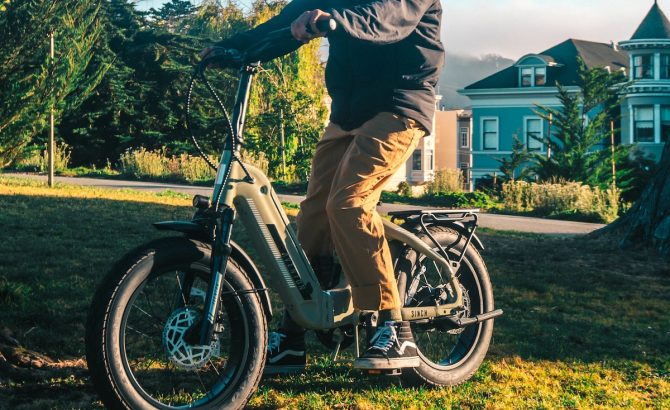
Photo: Skyler Fitzmaurice//The Inertia
Unlockable Speed
Heybike Mars 3.0 ($1,299)
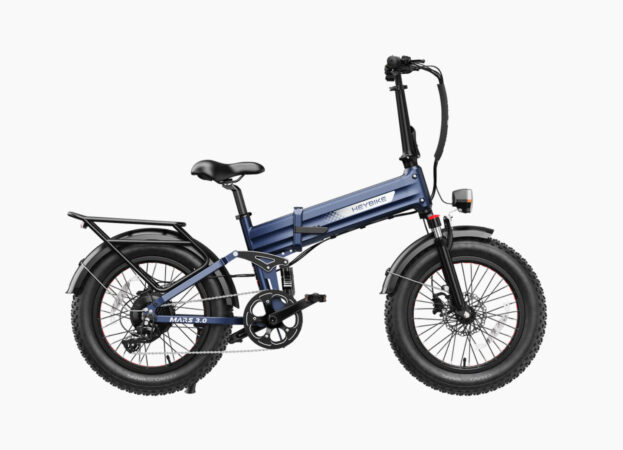
Payload: 440 lbs
Range: 65 mi
Top Speed: 28+ mph
Weight: 70 lbs
Sensor: Torque
Pros: Rugged tires, great for mixed terrain, powerful motor
Cons: Battery level fluctuates when applying power
Heybike’s new Mars 3.0 offers an interesting mix of power and features, for a great price, as the company is known to do. The bike comes packed with upgrades over the prior version. It now sports a torque, instead of a cadence sensor, and a full-suspension frame with the addition of a rear shock. The bike now has multiple security features, including a key, NFC-touch card, and passcode as options for added security, an LCD display, an internal battery, and higher cargo capacity. Finally, the bike is unlockable (for use on private roads only), and when doing so, it can reach speeds of 30mph+. Other features that carry over from the prior version include a built-in phone charging port and an app that allows some customization of the bike’s performance characteristics. Listed at $1,799, it’s often on sale for much cheaper, and at the time of publishing, it is available for $1,299.
While the bike provides a great value at the sale price for a basic fat-tire ebike with powerful internals, it didn’t end up being a top pick due to one noteworthy drawback. The bike’s battery readout can be tough to read, as the battery level is prone to fluctuation – showing lower values as power is applied to the motor during quick acceleration or when climbing hills, and then bouncing back to show higher values once the motor stops working.
This makes keeping an eye on the bike’s available power and range a bit of a guessing game. That said, the unlockable nature of the bike is something that is much rarer these days, with ebike regulations being much stricter than they used to be. With that in mind, the combo of full suspension, high speed, foldability, and a great price might be enough to overlook that issue when it comes to the battery readout. And as long as you keep the bike topped up when you’re done riding, and are willing to risk it on the first few rides as you come to learn, more intuitively, how much range the bike truly has in your specific riding conditions, the lack of an accurate battery readout shouldn’t be too much of an issue.
CHECK PRICE ON Heybike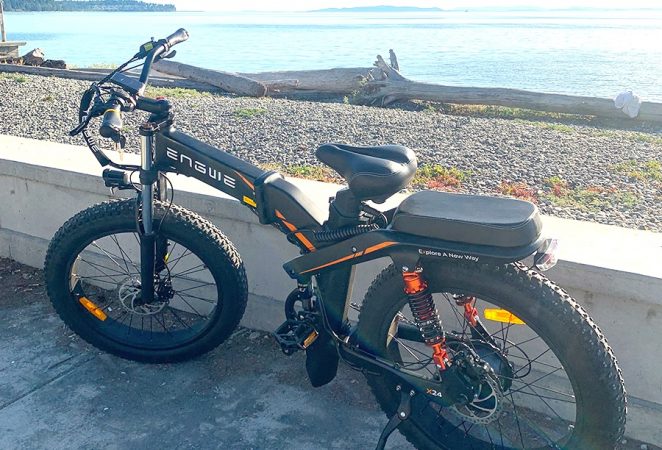
The Engwe X24 sure looks odd, but it’s a highly capable performer. Photo: Steve Andrews//The Inertia
Honorable Mentions
There are a lot of folding ebikes out there on the market, and we could only include so many without boring you, or worse, overwhelming you with options. Here are a few more top-tier folding electric bikes that came oh-so-close to making the cut.
First off, we’d love to recognize the Blix Vika series of folding ebikes. Due to low stock at the time of reviewing, we were unable to get our hands on one of these to test (Blix makes both the Vika Flex, which presents a lighter-weight build, and the Vika Plus, which adds some comfort features), but we plan on doing so at the first opportunity.
Pedego’s Latch is another ebike that we’ve recently tested, and overall, we were fairly impressed by it. The Latch takes a slightly different design approach than most folding ebikes we see on the market. Rather than the beefed-up, fat-tire folding ebikes that dominate this list, the Latch features a much more slimmed-down design with thinner tires and an aluminum-tube frame construction that feels more like a traditional bicycle. Unfortunately, the bike is currently out of stock online, but we’re in contact with Pedego and will add the bike to the review when and if it comes back into stock.
Another folding ebike worth mentioning is the Engwe x24, a strange-looking machine with larger (24-inch) tires and an integrated rear seat. The bike has been in and out of stock on the Engwe website, and wasn’t our favorite looks-wise, so we left it out of this review for the time being.
We also plan on doing some future testing of super-compact folding ebikes aimed at urban micro-mobility. More scooter than bike, with very small tires that often sit around 14 inches in diameter, we’re holding off on adding any of these to the review until we are able to get our hands on a wide enough selection to speak to.
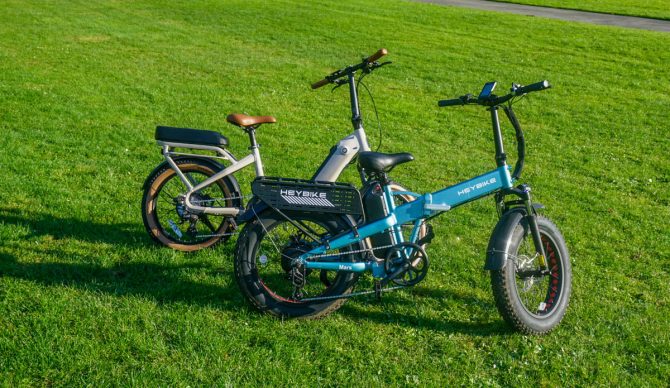
The Heybike Mars and Ride1UP Portola feature powerful motors belied by the folding frame. Photo: Will Sileo//The Inertia
Folding Electric Bikes Comparison Table
| Model | Price | Stated Range | Top Speed | Motor Power | Class | Weight |
| Velotric Fold 1 Plus | $1,499 | 68 miles | 28 mph | 750W | 2, 3 | 63 lbs |
| Lectric XP4 | $999 | 55 miles | 28 mph | 500W | 2, 3 | 69 lbs |
| Lectric XP4 750 | $1,299 | 85 miles | 28 mph | 750W | 2, 3 | 71 lbs |
| Engwe L20 2.0 | $799 | 60 miles | 28 mph | 750W | 2, 3 | 68 lbs |
| Tern Vektron | $3,299 | 34-68 miles | 20 mph | 250W | 1 | 48.7 lbs |
| Engwe Engine Pro 2.0 | $1,299 | 68 miles | 28 mph | 750W | 3 | 70 lbs |
| Brompton C Line | $4,700 | 20-45 | 15 mph | 250 W | 1 | 38 lbs |
| Ride1Up Portola | $995 | 20-40 miles | 20 mph | 750W | 2, 3 | 59 lbs |
| Aventon Sinch 2.5 | $1,799 | Up to 55 miles | 25 mph | 500W | 2, 3 | 68 lbs |
| Heybike Mars 3.0 | $1,799 | 65 miles | 28+ mph | 1400W Peak | 2, 3 | 70 lbs |
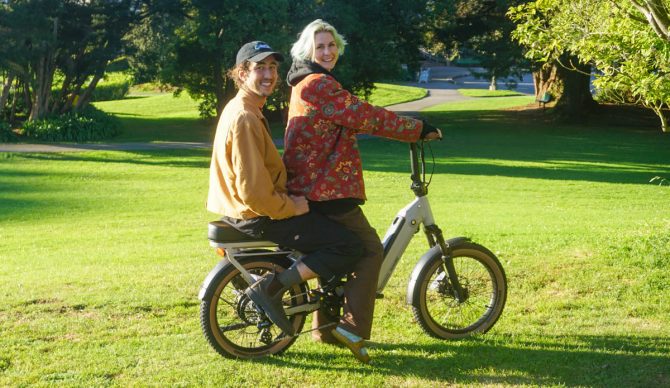
The Ride1UP Portola is a great choice for heavier loads (like a passenger) with a surprisingly powerful motor for a folding ebike. Photo: Sam Schultz//The Inertia
How We Tested The Best Folding Ebikes
As surfers and outdoors enthusiasts, The Inertia’s gear team has been aware of the incredible utility of electric bikes for years, using them to transport surfboards and ourselves to local breaks with difficult, limited, or nonexistent parking, or far-flung waves. Folding electric bikes add another element of utility to our endeavors, letting us drive to the trailhead with a bike and boards in the back of the car, or road trip with the perfect wave-scouting machine tucked into a corner of the van.
Our lead testers for this review are Will Sileo and Steve Andrews. Based in San Francisco, California, and the wilds of British Columbia, respectively, they have a diverse and challenging landscape to test these bikes. San Francisco’s notorious hills provide challenging urban riding, and mountain towns in BC offer a great mix of conditions from trail to pavement to put these ebikes to the test. We put this review together to highlight some of the industry’s best folding electric bikes and provide our real-world testing experience with them, to help you make an informed purchasing decision. When testing folding electric bikes, we wanted to provide an in-depth look at each model’s real-world performance. Here’s how we evaluated each bike:
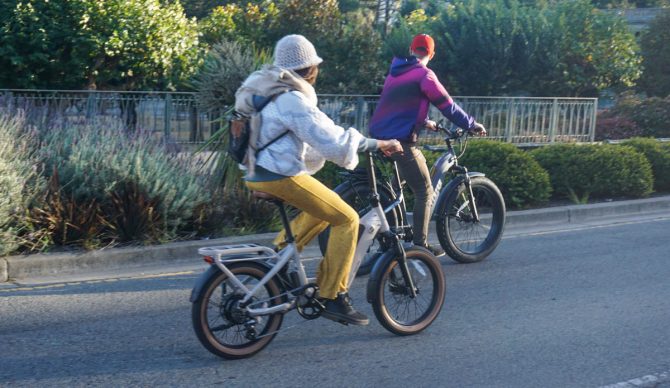
Testing the Ride1UP Portola in San Francisco. Photo: Will Sileo//The Inertia
Range Testing: To assess battery life, we conducted multiple rides across different terrains, including city streets, trails, and hills. We measured how far each bike could go on a full charge and how the battery held up under varying speeds and conditions.
Folding Mechanism: Each bike’s folding mechanism was tested multiple times to see how quickly and easily it collapses and reassembles. We also looked at how compact the bikes became when folded and how easily they could be carried or stowed away.
Speed and Motor Power: We tested the speed limits on flat roads, hills, and mixed terrain. Bikes with higher wattage motors were taken off-road and subjected to hill climbs to gauge their power and torque.
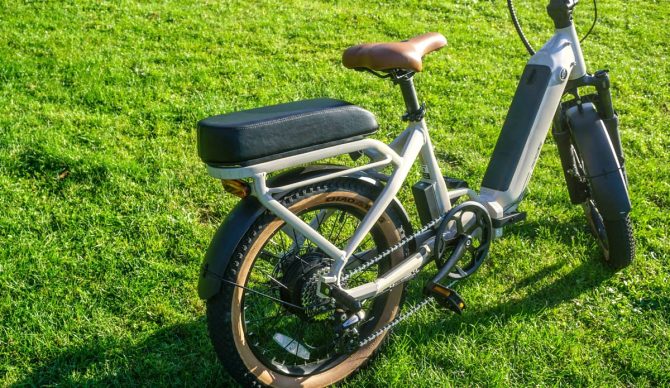
The Ride1Up Portola comes with an integrated rear rack that’s capable of carrying a passenger. Shown with the passenger kit attached (not included). Photo: Will Sileo//The Inertia
Comfort and Handling: Riding comfort was assessed over long and short trips. We paid attention to saddle comfort, shock absorption, and handlebar ergonomics. Suspension systems were also evaluated on rough surfaces to see how much they enhanced ride comfort.
Weight and Portability: Each bike’s weight was measured against its portability. We carried the bikes up stairs, stowed them in car trunks, and transported them on public transport to get a sense of how easily they fit into daily life.
By combining real-world use with structured testing, we were able to get a clear picture of how these bikes perform under different conditions and who they’re best suited for.
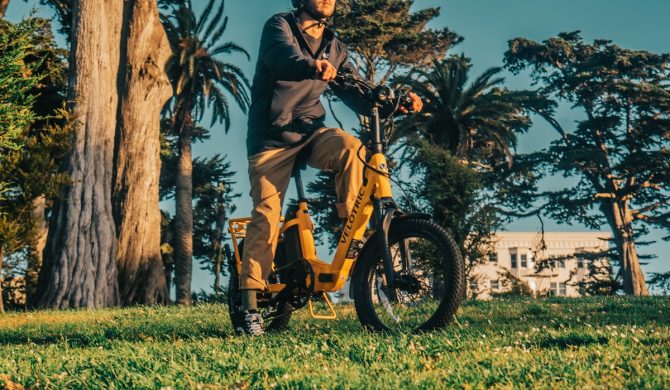
The Velotric Fold 1 Plus. Photo: Skyler Fitzmaurice//The Inertia
Folding Electric Bikes Buyer’s Guide
When shopping for a folding electric bike, there are several key factors to consider. Whether you’re planning to use the bike for daily commuting, weekend adventures, or both, it’s essential to find one that suits your specific needs. Below, we break down the most important things to look for when selecting the best folding ebike for you.
Motor Power and Speed
The motor power of an electric bike is one of the main factors determining how fast and how easily it can handle different terrains. Folding electric bikes typically range from 250W to 750W motors. If you’re planning to ride mostly on flat, paved roads, a 250W motor will suffice (note: the bikes we tested all have a minimum 500W motor). However, if you’re looking for more speed, plan to tackle hills or off-road trails, or take a passenger with you, a more powerful motor (like 500W or 750W) is a better option. The Heybike Mars even has a 1000W version if you really need to tackle the hills, but it chews through the battery very quickly. Some of the models on this list reach class 3 top speeds of 28 mph (such as the Ride1UP Portola, Velotric Fold 1 Plus, and Engwe Engine Pro 2.0), while others are limited to 20 mph to comply with Class 2 ebike regulations. The Aventon Sinch 2.5 has a top speed of 25 mph.
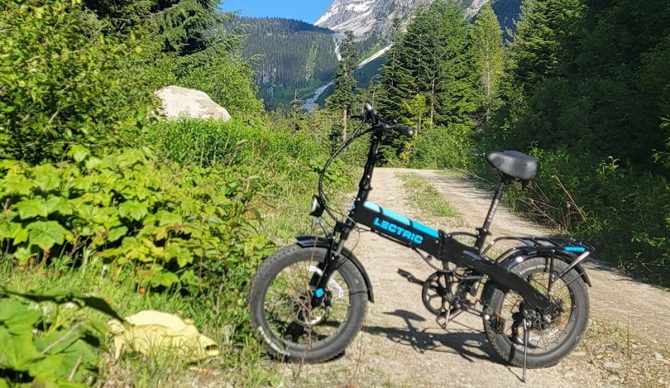
The Lectric XP 3.0 is available with two different battery sizes. Choose the larger battery for $200 extra if range is a concern for you. Photo: Steve Andrews//The Inertia
Battery Life and Range
The range of an electric bike refers to how far you can travel on a single charge. Folding ebikes generally offer between 20 and 60 miles of range, depending on the battery size and motor power. The key is finding the right balance for your needs — if you plan to use your ebike for short trips around town, a smaller battery like the 10.4 AH one in the base-model Portola will do the job, and it’ll also keep the bike lighter. However, if you’re planning longer rides or weekend getaways, a bike with a longer-range battery (Like the Lectric XP4 750) will help ensure you don’t run out of juice halfway through your ride. The XP4 is also a torque-sensing ebike like the Sinch 2.5 and Fold 1 Plus, which will have longer ranges due to their more efficient motors.
Keep in mind that the more you weigh, the more hills you ride on, the faster the battery will drain, regardless of the brand. It’s just physics. You will also drain the battery faster on a higher pedal assist setting, so if conservation is key, the more energy you supply from your legs, and the slower you accelerate, the longer the battery will last.

The Engwe L20 2.0 folds up nicely to easily fit in the back of a 4Runner with room to spare. Photo: Steve Andrews//The Inertia
Weight and Portability
One of the main reasons to opt for a folding electric bike is the convenience of portability. And when it comes to how portable a folding ebike is, the true determinant is the weight. All of the bikes here fold up into relatively similar-sized packages, but not all of them weigh the same. And what’s the point of having a foldable ebike if it’s too heavy to move around?
Most folding ebikes weigh between 45 and 75 pounds. While heavier bikes may offer better stability and performance, they can be cumbersome to carry. Consider how often you’ll need to lift the bike — whether it’s up the stairs to your apartment or onto public transport — and weigh that against the performance characteristics, such as speed and range, that you might be sacrificing to go with a lighter bike.
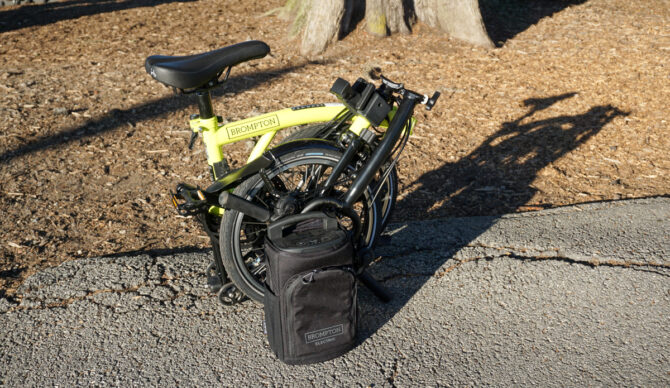
All folded up, the Brompton C-Line makes for a very compact package. Photo: Will Sileo//The Inertia
For example, the lightest bike we tested was the Brompton C-Line, which weighed 38 lbs. That sounds like a lot, but knowing ebikes can reach up to 100 lbs, staying under 50 while maintaining solid speed and range is no easy feat. However, with the Brompton, you do sacrifice some features like a throttle and higher class 3 top speeds to make the smaller battery last long enough, a common trade-off with lighter-weight ebikes. One top-tier feature of some folding ebikes that adds to their portability is the fact that they can be rolled while folded up.
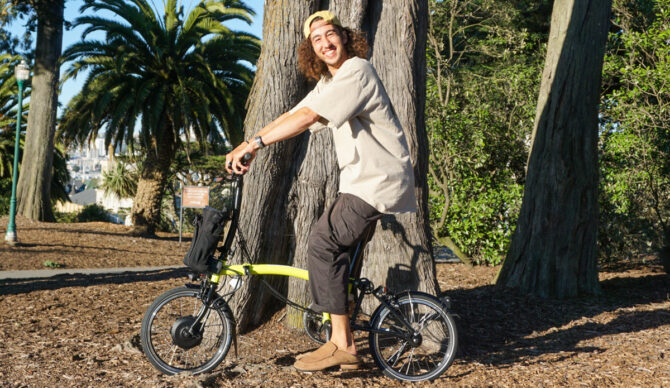
The Brompton C-Line folds in three places to make a very compact package indeed. Photo: Andrew Wasilewski//The Inertia
Ease of Folding
Not all folding mechanisms are created equal. Some bikes fold in half with a simple latch, while others require multiple steps and adjustments. If you’ll be folding and unfolding your bike frequently, you’ll want a model that’s quick and easy to manage. Bikes that fold down to a compact size can also save space, especially if you plan to store them in a small apartment, car trunk, or office. We found the Tern Vektron to be the most compact when folded.
When looking at ease of folding, pay attention to how secure the latches are and whether the bike stays securely folded during transport. Many folding ebikes also feature an integrated strap to keep the bike from opening up when folded, and the Pedego Latch and Tern Vektron use magnets and small latches to keep things folded while being a bit more convenient to open and close.
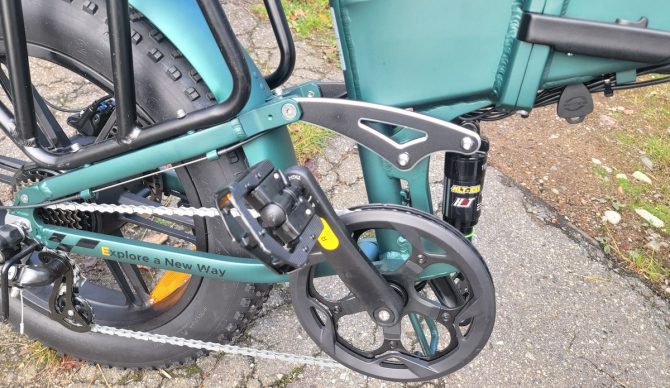
The Engwe Engine Pro 2.0 features rear suspension, a rarity on folding ebikes. Photo: Steve Andrews//The Inertia
Comfort and Suspension
Comfort is often overlooked but plays a big role in your riding experience. Folding ebikes come with a range of comfort features, including padded seats, ergonomic handlebars, and adjustable heights. For those riding on rougher roads or light trails, suspension systems can make a big difference.
Dual suspension (front and rear) provides better shock absorption on bumpy roads as found on the Engine Pro 2.0, while a rigid frame is more suitable for smooth, urban riding, like the one found on the Tern Vektron. Keep in mind that while suspension adds to comfort, it can also add weight and complexity to the bike.
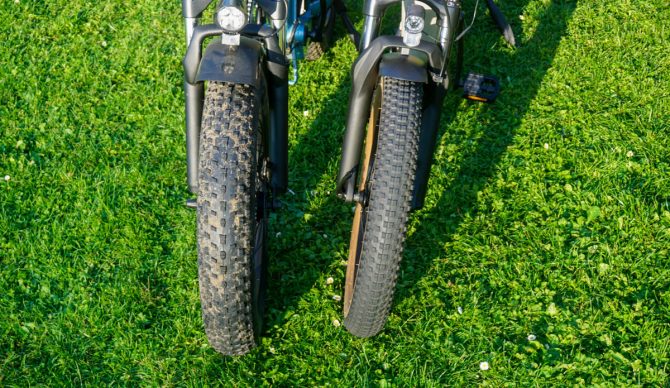
The Heybike Mars’s larger tires (left) provide better off-road performance than the Portola’s (right), and a bit less efficiency on paved roads. Photo: Will Sileo//The Inertia
Tires and Terrain Capability
The type of tires on a folding electric bike influences its versatility. Wide, fat tires are ideal for off-road or mixed-terrain adventures, as they offer better grip and stability. If you’re mostly sticking to paved roads or bike lanes, thinner tires may offer better speed and maneuverability.
Make sure the bike you choose is well-suited to the types of surfaces you’ll be riding on regularly. The Ride1Up Portola’s rugged 3-inch tires hit a sweet spot for both off-road capability and urban maneuverability, while the Engwe Engine Pro 2.0 and Aventon Sinch 2.5 have burly 4-inch tires for better off-road capability.
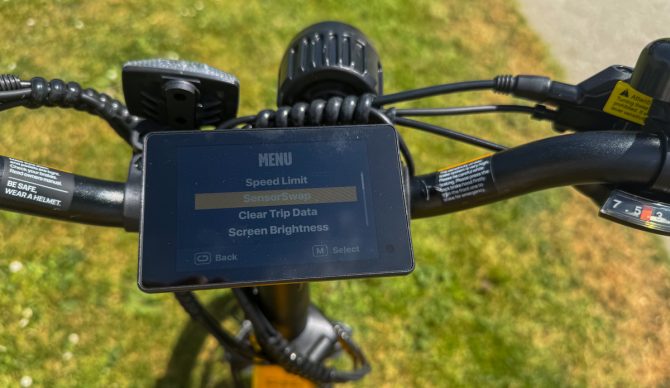
Swapping from cadence to torque sensor on the Velotric Fold 1 Plus is as easy as pushing a few buttons. Photo: Will Sileo//The Inertia
Hot New Features
Ebikes are already a pretty high-tech piece of equipment. But there’s more coming. Over the past six months to a year, there have been a couple of new features that many ebike brands are starting to integrate into their lineups – namely, dual-sensor technology and enhanced security and tracking features. Both of these are standout features of our top-pick folding ebike, the Velotric Fold 1 Plus.
Dual Sensor tech is pretty self-explanatory. Whereas it used to be a big decision whether you wanted the easy pedaling and lower price of a cadence sensor, or would rather spend a bit more to get the more natural pedaling feel of a torque sensor, nowadays, you can have both!
The Fold 1 Plus features Velotric’s SensorSwap technology that integrates both a torque and cadence sensor into the bike, and lets you choose which one to use based on your preferences and riding conditions. As riders who appreciate the benefits of both types of ebike sensors, we’re stoked to be able to choose and dial in our riding preferences based on the day, or even mid-ride.
Enhanced Security (Tracking): Ebikes present a fairly sticky security problem. Expensive, but fairly easy to steal (let’s be honest: bike locks are really just a deterrent, not a guaranteed theft-prevention method), if you want to use it as you would a car, you have to be able to lock your bike up and go about your business without constantly looking over your shoulder.
That’s why a number of ebike manufacturers are integrating tracking features into their bikes. On the Velotric Fold 1 Plus, that’s an integration with Apple’s Find My network. If someone steals your bike, you’ll be able to track them down (though we recommend getting in touch with law enforcement rather than knocking on doors yourself).

The Velotric Fold 1 Plus uses integrated Find My technology so you know where your bike is at all times. Photo: Will Sileo//The Inertia
Final Thoughts
Overall, you can’t go wrong with any of the ebikes we have included in this guide. But if you’re looking for the most versatility and enhanced new features, the Velotric Fold 1 Plus is our top pick. If you don’t care about those latest and greatest features, but would prefer a bit more power and a much improved range, the Lectric XP4 750 is likely the bike for you.
If you’re here on a budget, the Engwe L20 2.0 is a great pick, but you’ll get a more refined ride-feel and better customer service (thanks to US-based support) with value-based bikes like the Ride1UP Portola and Lectric XP4, which only cost a couple of hundred bucks more. For the smallest folded size and lowest weight, check out the Tern Vektron. If the smoothest ride is your priority, and absolute best top speed (as well as price) isn’t, check out the Aventon Sinch 2.5. Happy riding!
Return To: Top Picks | Comparison Table
Editor’s Note: For more top ebike picks, check out our guides to the Best Ebikes, Best Fat Tire EBikes, and the Best Cargo Ebikes. For more gear reviews and features on The Inertia, click here.

