
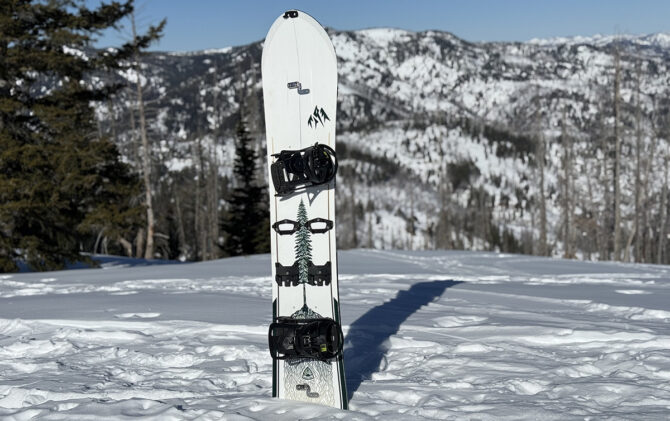
The Jones Frontier 2.0: a board for all of us. Photo: JC

Splitboarding is one of the finest ways to traverse wild snow. The climb, cleansing, even meditative as you slide, one foot in front of the other, uphill. The reward? Thousands of feet of untouched snow to surf, expressing yourself in any way you see fit on your snowboard: quick, tight turns in the trees, long, drawn out lines on open faces, snaps in little pockets of snow you find clinging to boulders, butters, big airs – even little airs of any variety. The mountain is your canvas. And with a snowboard, the conditions are less of an issue – heavy or light, as long as it’s consistent, it’s fun to rip.
Splitboarding remains a niche in the backcountry world. But it’s a growing one. The equipment is fantastic. And at the forefront of splitboard innovation is Jones Snowboards. The brand’s Solution came out in 2011. The stiffer, big-mountain freeride offering has been one of the premier splitboards on the market for 15 years. Not to mention a plethora of other Jones split models for any riding style. So I was stoked to test out Jones’ newest addition: the Jones Frontier 2.0 Splitboard ($850).
Bottom line: The Frontier 2.0 is a completely redesigned splitboard from Jones, a brand that boasts some of the most well-rounded offerings in the industry. It’s a directional split with a soft flex – amazing in powder, and works for beginner or smaller riders who don’t want to be overpowered. It’s also the most affordable split in the Jones’ line.
Check Price on evo Check Price on Jones
Related: Best Snowboards | Best Snowboard Boots | More Snow Gear Reviews
Testing the Jones Frontier 2.0 Split
I’ve now got at least 10 days on the Frontier, and the setup is dialed. For bindings, I’m using the Burton Step On touring binding (a fantastic option we’ll have more on later). I’m using G3 splitboard skins, a solid staple in the industry. You can also choose the Jones splitboard skins with the proprietary latch system that’s fitted into the Frontier tail (you’ll notice the notch).
As everyone west of Colorado knows, it’s been a down year. But the backcountry has still provided. Holiday storms subsided, but cooler temperatures remained. So I was able to test out the Frontier in really good terrain and conditions in January, from steep gulleys to open trees. This thing is a joy to ride in good snow. Problem: As many of you found out, if the exit to your tour is south-facing, things get bushy quick. So I did beat the board up, and that was a good thing. The high-quality build held up splendidly, featuring the wood core and a sturdy bio-resin top sheet (the tree graphic is A+ too).
Jones Frontier 2.0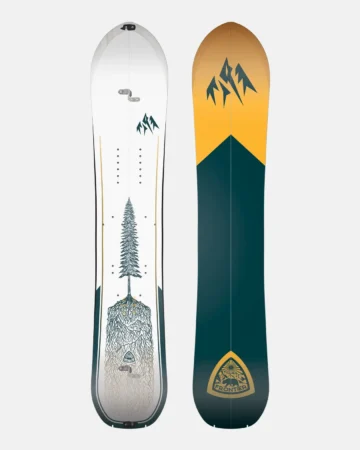
Sizing: 156, 158W, 159, 161W, 162, 164W
Riding Style: Backcountry Freeride
Profile: Rocker/Camber/Rocker
Shape: Directional
Flex: 3-4/10
Pros: From experienced backcountry riders to newbies, this board’s fun-meter is through the roof.
Cons: The softness might scare away bigger, heavier riders.
Best For Riders Who: Love getting creative in powder from high speed carves to quick slashes with a fun, playful feeling.
What I Loved About the Jones Frontier 2.0
In the backcountry, weight matters. The Frontier 2.0 Splitboard is light and user-friendly. In ski mode, it feels gentle on the body and is easy on the uphill (relatively). Karakoram hooks allow for a rock-solid connection, keeping the board super tight in downhill mode.
In snowboard mode, the Frontier 2.0 rips! It’s so fun in easy-going terrain and light snow. Carving turns is a joy, and they really feel full-railed on this board. There’s no need to rush. The nose and tail rocker (3D Contour Base) make initiating turns so fun. I’m 6’0″, 200 pounds, and I am riding the 156 (Jones recommends I size up), but I was really able to push into this thing. Yet when things got steeper, and I needed to hold an edge at high speed, it didn’t falter either. Unless you have your hand to the wall on rock-hard snow, you’re gonna love this thing. It is an absolute joy to play with in the backcountry.
From The Legend Himself…
I once heard a quote from designer Jeremy Jones that you should use the softest snowboard possible for the conditions. I asked Jones about that quote: “True,” he told me. “Unless you’re doing Freeride World Tour stuff and going mega big and fast, you want a board that flexes but doesn’t fold. Flex gives you snap and playfulness. The key with the Frontier is that it is soft in the right spots as well as stiff where it needs to be. It’s a fine balance.”
Indeed, and I feel like Jones hit this one on the head. Newbie splitters and experienced backcountry aficionados alike seem to love where this board fits. And it’s affordable for a new splitboard in this market.
Tech That Works
There is a technical aspect to the Frontier 2.0 that can’t go unmentioned. First is the brand’s Traction Tech. It’s a theory that a straight edge creates less traction in steeper icy terrain than a wavy edge. The inside edge of the Frontier 2.0 features that wavy edge, which becomes your outside edge in ski mode. This actually does help. The wavy edge matches the unpredictable contour of the mountain better. As anyone who splits knows, hard crust can be a nightmare and cause extreme slippage in the skin track. Traction Tech did actually help with grip. Yes, you’re gonna slip, but I felt like there was a slight difference in side bite.
Next is the Boltless Bridge. No one wants exposed bolts and hardware on the base of their snowboard when they’re riding – extra hardware that could create friction. The Karakorum Clips are part of that boltless tech.
Third is the 3D Contour Base. Think surfboard rocker. Jones calls it a spoon on the nose as it’s lifted to allow for easy turn entry. There is also a subtle lift in the tail, which just makes the entire turn feel more fun. And you can really feel it on the Frontier 2.0. (Here’s more info on the 3D Contour Base.)
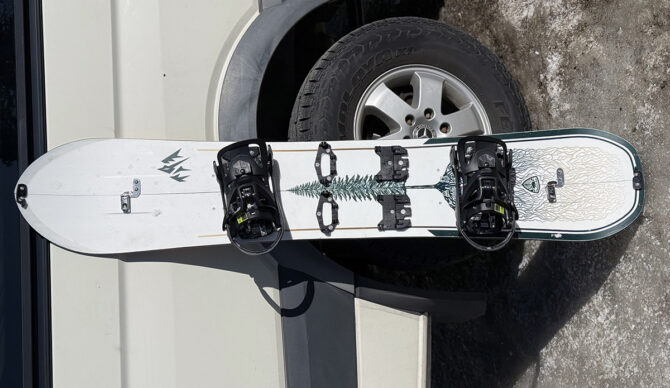
A closer look and you can see the “spoon” action in the nose, part of Jones’ 3D Contour base tech. Photo: JC
What I Looked Closer At on the Jones Frontier 2.0
Soft is good… in good snow. But there is a time and place where a more sturdy flex is needed. Namely, hard snow needs to be met with stiffness. If you’re exiting a tour and the trail is tracked out and those old turns have turned to cement, heavier riders might feel the flex on this board too much (not enough hold in junk). Or, if you’re riding a 45-degree chute in spring conditions with an ice axe in your hand, the flex might not be so fun. But the latter is a very specific situation that most of us won’t find ourselves in (or could use another board in the quiver).
Again, at 6’0″, 200 pounds, I was above the recommended weight for the 156 Frontier. I was still able to make tight, decisive turns when needed. If you’re worried about the flex, size up a little….or not. The Frontier 2.0 definitely has the right flex at the right points.
Other Boards To Consider
It’s a little tough to find other comparable boards on the splitboard market that have this much flex to them. Some of the fish designs out there are similar, and even the Family Tree line from Burton, but the FT line is still a little stiffer. The closest is probably in the Jones line itself with the Stratos or the Mind Expander, both lightweight boards on the flexier side.
Final Thoughts
The Jones team put a ton of thought into developing the Frontier 2.0 Splitboard. And it paid off. This board could really fit a lot of riders, from beginners to experts, and both men and women. It’s a light option for the uphill…and it absolutely rips in powder.
Check Price on evo Check Price on Jones
Related: Best Snowboards | Best Snowboard Boots | More Snow Gear Reviews

The Best Snowboards of 2026


