
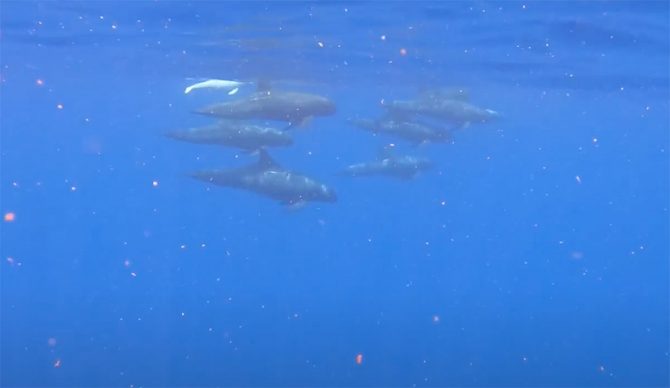
The elusive white whale in real life. Photo: KHON2//Screenshot

Divers off Makaha on Oahu were treated to an incredibly rare sight on March 28 when they saw a potential pygmy albino blackfish whale, known outside of Hawaii as either false killer whales or short-finned pilot whales.
“[The Blackfish is] one of four species that we call Blackfish because they’re all kind of black in color and hard to distinguish,” said Dr. Jessica Jacob, assistant professor at Hawaii Pacific University. “Based on the shape of the fin and the white lips, I would say it’s a pygmy killer whale.”
Although the false killer whales have skull shapes that closely resemble that of an orca, they aren’t closely related. Like orcas, though, they are a toothed species. They’re normally dark grey or black, which is why seeing a white one in a pod was so surprising.
“We noticed there was a white baby with them,” Travis Woo, a safety diver with Iruka Hawaii Dolphin Snorkeling Tours, told KHON2 News. “My initial reaction was euphoria.”
According to KHON2, an albino whale of any species has never been seen off Hawaii. It’s possible that this calf is leucistic, which is a genetic condition where some or all of the whale’s cells don’t produce melanin. It’s different than pure albinism, where there is a complete absence of melanin. Albino animals generally have white or pink eyes.
“It is potentially an albino individual, but there’s really only two ways to confirm that,” Pacific Whale Foundation Chief Scientist Jens Currie explained. “One is to do genetic sampling and look for that mutation that would cause a lack of pigmentation and lack of melanin production, which produces the color of individuals. Or, sometimes, you can examine the eyes of those individuals and the lack of color in their eyes makes them appear pink.”
According to The Cascadia Research Institute, white whale calves would have a hard time reaching adulthood. They said that this particular calf looks to have sunburns and blistering, and due to its coloring, they stand out to predators.
“Usually these dolphins, they go and hunt kind of far off shore and we don’t see them that often, but we’re seeing them hanging in closer to shore trying to guard this calf,” Woo said. “So, they’re sticking with it. We’re all rooting for it and hopefully it makes it. It’s unlikely, but it is possible.”

