
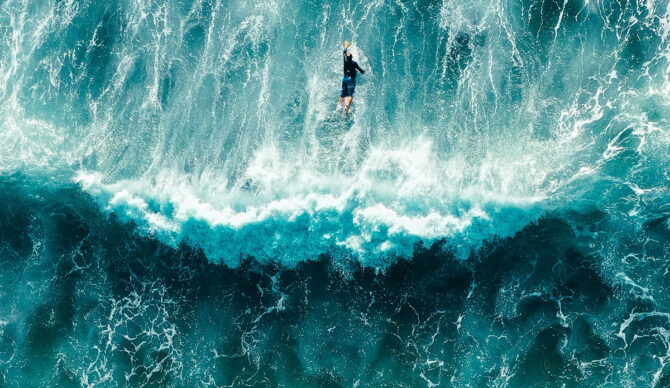
Microscopic particles are able to “surf” their way around in order to save energy. Does that mean they can duck dive? Photo: Unsplash

If you’re teeny tiny, like microscopic or even nanoscopic in size, existence can be hard. One example of a difficulty a particle of that size might face is how to transport the necessary nutrients around its constantly fluctuating environment. As it turns out, they do something like surfing in order to make it happen.
Physicists at Heinrich Heine University Düsseldorf (HHU) and Tel Aviv University in Israel were interested in finding out more about how things work at the smallest scales, so they used model calculations to do it. Their results have just been published in the journal Nature Communications, and they are interesting, to say the least.
Pretend for a second that you’re downwind foiling. Sure, you could pump your way around the ocean, but it sure is easier if you’re able to hitchhike on the energy of the waves. But in doing so, you need to be able to react to the changes in the the wind and the currents, and those things need to be taken into consideration when figuring out the amount of energy you need to expend to go from point A to point B. Biological cells need to use as little energy as possible to move things around, and surfing is a good way to do it.
“The conditions are much rougher in the highly dynamic environment of a living organism and the fluctuations to which the microtransporters need to respond are significantly larger,” Arne Claussen of Heinrich-Heine University Duesseldorf wrote. “Large deterministic forces such as the periodicity of the heartbeat can however be harvested to realize optimum movement strategies; particles can surf on the waves of the microcosm, so to speak.”
Of course, “surfing” here is a metaphor. It should be fairly obvious that nanoparticles aren’t riding tiny surfboards on actual tiny waves, but it is fascinating to realize the similarities between microscopic worlds and our own.
“The second law of thermodynamics defines how heat is converted into work in the macroscopic world,” said Dr. Kristian Stølevik Olsen, Humboldt postdoctoral fellow at HHU and lead author of the study. “In the microscopic world, however, things can look very different and therefore cannot be described properly by the macroscopic theory.”
When things get small enough, they’re affected by the tiniest of things, like thermal motion or repeating biological rhythms, such as a heartbeat. But much like a downwind foiler, the particles are able to ride these fluctuations in such a way that they use less energy.
The researchers were able to use their big brains and deep understanding of math to figure out exactly how much energy is necessary to move a particle from one place to another within a certain time frame. In order to do so, they used simulations of tiny beads floating in a fluid. Those simulated beads could be moved around using light to push them or pull them. It’s much more complicated, of course, but the calculations used could answer many unanswered questions in nanoscience and biology.
In short, the study found that these tiny particles actually ride the environmental fluctuations in such a way that they’re able to get from one place to another while expending the least amount of energy — much like a surfer riding a wave.

