
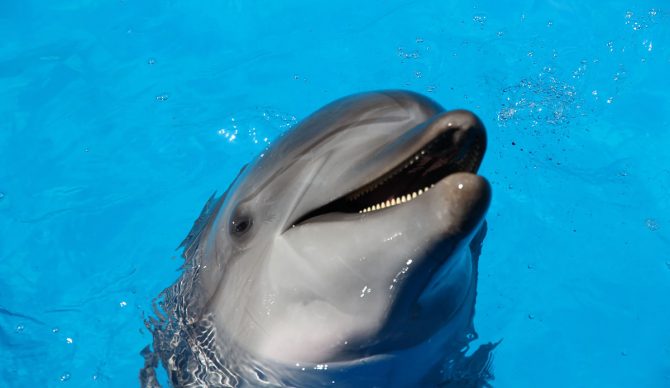
Even bottlenose dolphins that live in close proximity to each other can communicate with something like an accent. Photo: Unsplash

Accents aren’t just a human thing. Bottlenose dolphins have them too, and a newly released study found that even dolphins that spend most of their time reasonably close to each other can “speak” in different accents.
Researchers listening to the whistles of bottlenose dolphins at Great Barrier Island (GBI) off New Zealand Aotearoa’s north coast and the sounds of another population at Doubtful Sound (DS) near the southern tip of the South Island heard something that surprised them.
“Whistles from DS were longer in duration and had more inflection points than whistles from GBI,” the authors of the study said. “At a global scale, the acoustic parameters of the whistles from the New Zealand populations clustered with populations found in the Northern Hemisphere, rather than to those in the Southern Hemisphere.”
Dolphins aren’t quiet animals, not in the slightest, and it’s been known for a while now that dolphins that live across the world from each other communicate differently. They use their voices to find food and communicate with others in their pods, whistling in frequencies between 3,000 and 36,000 Hz. They don’t just whistle; clicking sounds are a big part of their vocalization, too. One of the most interesting theories scientists have is that dolphins have “signature whistles,” which are thought to be akin to names for themselves. It appears that they use these particular whistles to let other members of their group know who they are.
“It’s already been established that dolphins use whistles to coordinate behavior, recognize each other, and generally maintain harmony,” The Independent wrote. “All that depends on being able to understand what a particular whistle means. If populations become isolated from each other for long enough, it makes sense their languages would drift, as human speech does.”
Although we do know that bottlenose dolphins have different accents — for lack of a better word — we don’t know how long those accents take to develop. The GBI and DS dolphins are genetically distinct, which means they haven’t been mixing for a long, long time.
The whistles produced by the two groups are different in many ways. The most common whistle contour is ascending/descending frequencies, but the duration and frequency are also dissimilar. The team of researchers used computer programs built to identify which population the sounds they picked up came from, and they claim the accuracy is around 90 percent.
One of the stranger findings is that although the GBI dolphins live in a shallower area than the DS dolphins, the GBI group uses lower frequencies on average, which are generally reserved for the deeper depths. Scientists think this is likely because they need to be heard over the ever-increasing sound of boats zipping around above them, since where they spend most of their time is a bit of a tourist hot-spot.

