
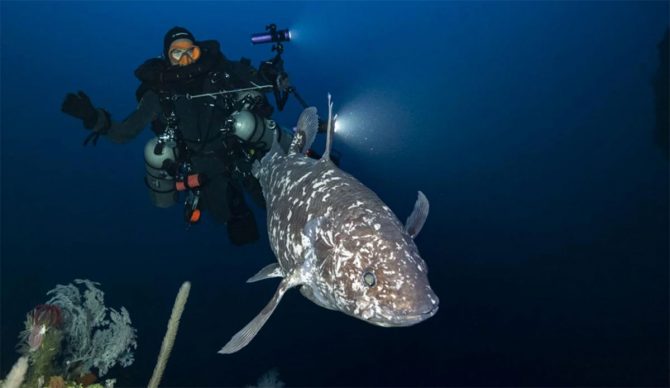
A deep diver about a meter behind the coelacanth discovered at a depth of -144 m in North Maluku, Indonesia. Photo: Creative Commons CC-BY-NC-ND//Alexis Chappuis

There are only two species of coelacanth that we know of, and there are barely any of them left. So few, in fact, that they were thought to be extinct until one was pulled up by a fishing trawler in 1938. And divers recently took the very first photos of a live Sulawesi coelacanth off the coast of Indonesia.
“One of the world’s most famous ‘living fossils,’ coelacanths (seel-a-canths) were once thought to have gone extinct approximately 65 million years ago, during the great extinction in which the dinosaurs disappeared,” The Smithsonian writes. “It wasn’t until 1938 when a live coelacanth was caught in a fishing trawl that we realized they were still alive… The earliest coelacanth fossils date back as far as the Devonian period, approximately 420 mya. At one time coelacanths were a large group comprising about 90 valid species that were distributed worldwide in both marine and freshwaters.”
The exact place where the divers took the photos is being held tightly to researchers’ chests because they worry that tourists will flock to the area to see if they can spot one of these incredibly rare creatures with their own eyes.
“Today, all known coelacanth populations are under anthropogenic pressure globally, and new threats may well arise in the near future with the development of potentially lucrative and unregulated coelacanth tourism activities,” the authors of a study on the find wrote. “Therefore, to protect a potential new population of the vulnerable L. menadoensis from disturbance, the exact locality of this discovery has been withheld until further studies are conducted and better protections are in place.”
This particular species, the Sulawesi coelacanth, wasn’t even discovered until the mid-’90s, when scientists found one in a fish market by researchers Arnaz and Mark Erdmann in Manado, in North Sulawesi. Two years later, it officially was recognized as a new species.
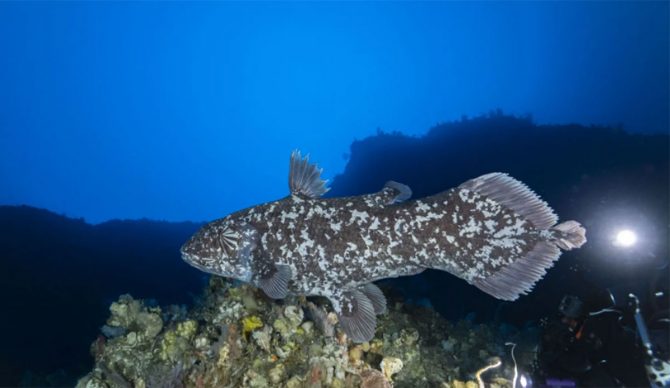
Left profile of the coelacanth, with its unique pattern of white dots. Photo: Creative Commons CC-BY-NC-ND//Alexis Chappuis
It was dead, as most fish in fish markets are, but it was proof that there were indeed coelacanths swimming around. Since then, there have been a few possible sightings from remotely operated submarines, but no one has ever taken a picture of one.
It was back in October of 2024 when the authors of the recently-published study detailing the fish were diving in the North Maluku province of Indonesia. They were very deep — nearly 500 feet down, where closed-circuit rebreathers and trimix breathing gases are necessary — when they ran into one.
“Interestingly, it was out in the open, not inside a cave or under an overhang, which have long been considered coelacanths’ diurnal hides,” writes the researchers in the study. “When the observation was made, the animal already had its dorsal fin completely erect and kept it like this all the time, which could be associated with an active state or potentially a natural defensive behavior.”
The next day, they returned to the same site and found the exact same fish. It’s an interesting creature, and not just because of its rarity. Most of the fish we see today have ray-finned ancestors. Coelacanths, however, are in an exceedingly rare group of lobe-finned fish. That means that their fins are full of bones, resembling something akin to limbs.

