
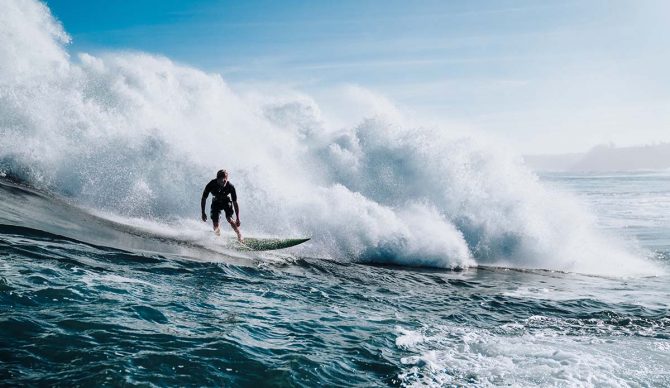
If you don’t surf to get better than why do you do it? Photo: Guille Pozzi//Unsplash

Recently, I found myself seated in a mosquito-y warung at the end of a long table of traveling surfers. The topic of discussion turned to surfing (somewhat surprisingly, considering most surfers hate talking surf outside of the water). A surfer named Sam, who I’d come to respect through a couple of philosophical conversations and his highbrow taste in equipment (he brought a Joel Fitzgerald twin), surprised me with the line, “I don’t surf to get better.”
I was completely floored. Here we all were, thousands of miles from home, spending our hard-earned money to come to some place that didn’t even have proper coffee or hot showers, and one of these people wanted to tell me there was no desire to improve at the thing behind the whole trip.
“Why do you surf, then?”
“Cause it’s fun.”
It was a fair answer; far better than whatever I could have offered up. But somehow, I’d never heard someone put it that simply, and frankly, I couldn’t believe it. In college, I lived about 40 minutes away from the closest break, and I distinctly remember a guy I was friends with turning down a ride to the beach because, in his words, “if I can’t go every day, I’m just going to get worse, and it’s not even worth it.” Which, at the time, also seemed sort of fair.
So, which one was it? Was surfing just for fun, something not to take too seriously? Or was surfing a competitive, athletic pursuit? Sure, surfing is pleasurable, and it’s one of the best things in my life, but it also doesn’t make me happy every single time. Surfing is like meditating, or drawing, or lifting, or doing yoga. It feels good and it relieves stress, but would I describe it as fun? I’m not sure. I usually have to convince myself to paddle out (especially if it’s early in the morning or there’s a lot of people out). Once I’m out, I don’t want to come in. But that mentality reminds me more of learning self discipline than letting loose and “having fun.”
But I’m a serious person in general (I read Hume and Sun Tzu in my free time), so maybe I’m not the one to ask about fun. Which is why the question, “why do we surf?” interests me so much.
Looking first to a couple answers from surfing’s history, on the fun side we have Kemp Aaberg, who says, “it’s so much fun to do. And it makes you feel so good. I always wonder how people inland really exist. What can they do? Do they really feel refreshed after a game of football? Not unless they take an awfully long shower.” And of course, the iconic quote from Mark Richards answering the question of “what makes you happy?” to which he replied, “sex and tube rides!”
On the competitive side, we have Larry Bertlemann, who, when asked if he would “rather be out surfing than doing all that promotional stuff,” responds, “sure. I’d rather surf than anything, but I get off on doing promos too. Your fans are what make you, so I try to keep them happy and in return they’ll keep me in business. I like to sign autographs and do all that stuff.” Of course, Bertlemann’s answer is a reminder that competing (and the bonuses that come with succeeding as an athlete) is fun for a lot of people. It may not be an either/or situation.
Then, there are those who surf for reasons unrelated to surfing altogether. For one, surfing provides the perfect itinerary on which to see the world. Wayne Bartholomew said that one of his big influences was “Lord of the Rings… I wanted to be the Hobbit. I wanted all that adventure. Hawaii, to me, meant dragons and goblins and treasure. I had to venture off and steal the treasure and find my way back home.”
Still others surf to immerse themselves in nature and experience the power of the ocean. One of my personal surf heroes, Marge Calhoun, recounts “getting wiped out and rolling around in the water, laughing to myself. I always knew who was the boss. The ocean doesn’t care whether or not you ride waves. There is no ‘conquering,’ other than yourself.” There is something humbling and gratifying (I’ll admit, maybe even… fun?) about letting yourself get thrashed and come back.
Flash forward to today, and the answers are more or less the same. Some people surf for fame, money, and achievement, and others surf for themselves and their pleasure alone. Griffin Colapinto had no interest in surfing until his younger brother, Crosby, picked it up, and then Griffin explains that he also had to give it a shot. When he found he was skilled, he thought he would try contests, and look at him now. Carissa Moore says she works out on land every single day in addition to surfing. Other surfers like Alex Knost surf for simpler reasons: to create, to express, to enjoy.
It would be easy for me to end it here, to say, well, I don’t know why you should or shouldn’t surf. Clearly, people surf for all sorts of reasons, and we can all have our own different reasons! The end. But, treating this as seriously as any other ethical question, I’ll offer one potential answer. The way we approach anything is the way we approach everything, right?
Philosopher Robin Attfield even claims that reflecting on decisions can offer us better insight into ourselves. In other words, maybe the reason you surf has parallels to decisions you make in other areas of your life. And if surfing is a decision, you can apply the same morals and values you have about anything else in your life to your choice to paddle out. Is it affecting people in your life positively or negatively? Is it affecting you positively or negatively? Do the benefits outweigh the costs?
The last thought to consider relates to the definition of the word “improvement.” When paired with surfing, we tend to think of improvement as being physical: better cutbacks, learning airs, walking back from the nose, that kind of thing. But improvement can happen in all kinds of ways: cultivating a stillness of mind, working on having a positive mindset, better relating to others. For someone like me, maybe learning to let go of the curse of consciousness and enjoy the moment is something to work on? And surfing definitely helps me get better at that.

