
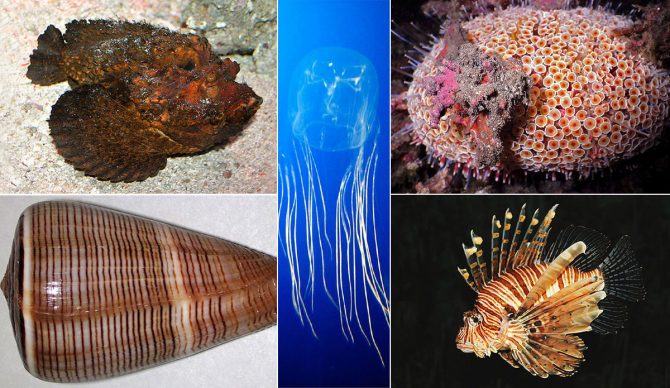
See those? Don’t touch those. Ever. Photos: Wikimedia Commons

The ocean is a wonderful place. It’s full of amazing things and stunningly beautiful creatures. It’s where waves come from, after all, and waves are just about the best thing the planet has to offer. But in that wonderful place that is the ocean, there are also a lot of things that you don’t want to interact with. Big things, sure, like sharks (although you really don’t need to be worried about that), but it’s generally the little things that you really want to avoid. Depending on where you live (looking at you, Australia), there are more dangerous things hiding in the sand and the nooks and crannies than the other places. So here are five sea creatures that you definitely don’t want to step on when you’re stomping around in the sea.
1. Cone Snail
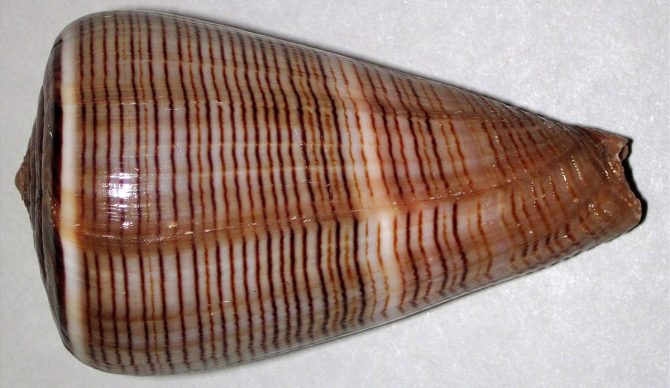
See that? Don’t grab that. Photo: Wikimedia Commons//cc-by-2.0.
Cone snails are weird. One generally doesn’t think of a snail as being predatory, but those in the Conus genus are just that. We, of course, are not their prey, but the venom they hide under that pretty little shell packs one hell of a punch.
“The handful of humans that are stung by a cone snail is often subject to a venom potent enough to immediately paralyze and eventually kill its prey,” the National Library of Medicine wrote. “The venom from one cone snail has a hypothesized potential of killing up to 700 people.”
Cone snails live in warm, tropical seas, where snorkelers and divers like to frequent, and the more naive and curious of them might be tempted to pick up a pretty little snail shell they spot. But if that shell belongs to a cone snail… well, watch out. If you are stung by one, you can expect intense, pain, numbness, and tingling. Severe cases can lead to muscle paralysis, including respiratory paralysis, which can lead to death.
2. Stonefish
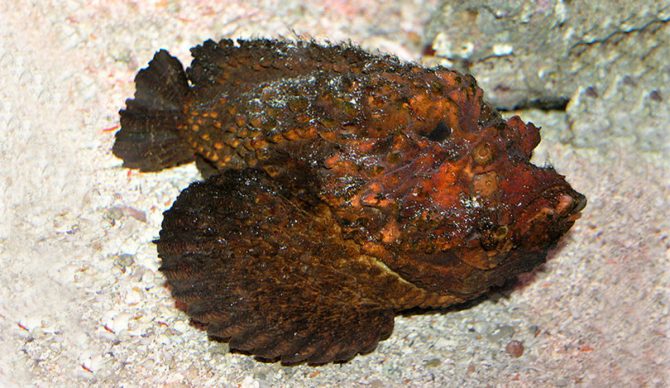
Don’t tread on me. Seriously, don’t. Photo: Wikimedia Commons// CC BY 2.5
Stonefish are incredibly good at blending in. To the casual viewer — or even the viewer looking for one — they’re hard to spot. True to their name, they look an awful lot like a stone, so you’d be forgiven for accidentally stepping on one with your big, clumsy feet. But should you accidentally step on one, you will know it.
“Stonefish have 13 spines lining its back that release venom under pressure,” writes The Ocean Conservancy. “If you inadvertently step on a stonefish thinking it’s a harmless rock, it will pop up its dorsal spines and release venom from two sacs at the base of each spine. Unsurprisingly, the more venom that is injected, the worse it is for you.”
Living mostly in tropical waters, the stonefish has a venom with a chemical in it called verrucotoxin. Within seconds of getting that venom in your body, you can expect severe pain and swelling at the site of the sting. According to Mt. Sinai Hospital, that swelling rapidly spreads with the venom, and as it hits different parts of the body, everything from your heartbeat to your breathing can be severely affected. Your blood pressure can plummet, you can be struck with horrible abdominal pain, diarrhea, and vomiting, and you might become delirious, full of anxiety, experience tremors, or even develop seizures. Or, God forbid, all of the above.
If you want to see a guy get stung with a stonefish on purpose, click here.
3. Lionfish
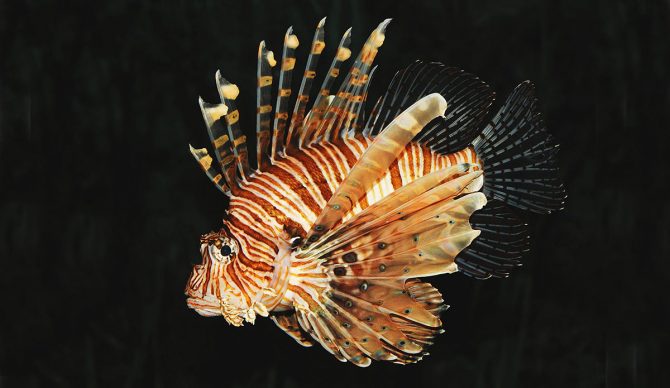
The lionfish will shoot a pile of venom into you through those spinal spines. Photo: Wikimedia Commons//CC BY 3.0
The lionfish, like the stonefish, injects its venom into would-be predators through spines that line its back. It is found throughout the Atlantic Ocean, Gulf of Mexico, and the Caribbean Sea, and luckily, they’re fairly obvious. They have thick brown, red, and sometimes white stripes covering their body, as well as fan-like fins. They’re an objectively very pretty fish, but that prettiness is matched by the toxicity of their poison.
“The venom consists of a neuromuscular toxin that’s similar to cobra venom in toxicity,” Healthline wrote. “A lionfish delivers the venom when its spine penetrates the skin of predators, or in some cases, an unsuspecting human.”
The good news is that if you’re stung by a lionfish, you probably won’t die. You will, however, experience some of the worst pain in your life, depending on how deep the spine went in and how much venom got into your body. Throbbing pain, massive swelling, bleeding, bruising, and numbness all come along with it. Be aware that excessive swelling can lead to decreased blood flow, which can in turn lead to tissue death. You can be allergic to lionfish venom as well, which leads to a host of other problems, like anaphylactic shock.
4. Australian box jellyfish
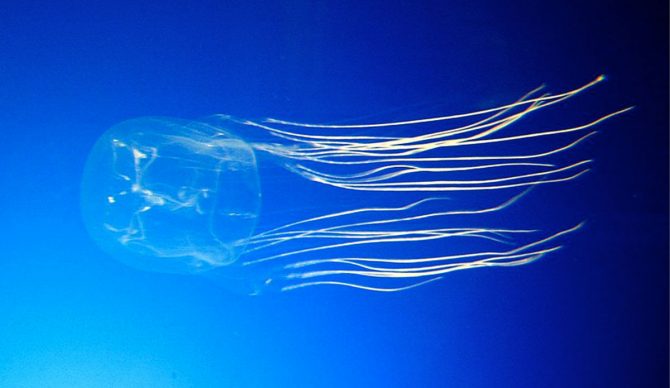
The Australian box jellyfish, aka the Sea Wasp. Photo: Wikimedia Commons//CC BY-SA 2.0
The Australian box jellyfish is an unassuming gelatinous blob of potential pain, and they have a sting that can kill you. Named for the shape of their body, they have tentacles that are loaded with things called nematocysts, which are basically tiny little darts that are crammed full of a potent toxin. As the name suggests, they’re found mostly in the waters around northern Australia, and they can actually get terrifyingly large. According to NOAA, they have “body sizes reaching up to one foot in diameter and thick, bootlace-like tentacles up to long.”
Not all box jellies can kill you, though. There are around 50 different kinds of them, but only a few will put you in an early grave. Interestingly, some researchers think that box jellyfish, unlike most kinds of jellyfish, actively hunt for prey.
“Box jellyfish have traits that set them apart from other jellyfish. Most notably, box jellyfish can swim — at maximum speeds approaching 4.6 miles per hour, or four knots — whereas most species of jellyfish float wherever the current takes them, with little control over their direction,” NOAA writes. “Box jellyfish can also see. They have clusters of eyes on each side of the box. Some of these eyes are surprisingly sophisticated, with a lens and cornea, an iris that can contract in bright light, and a retina.”
The severity of the sting depends on the size of the box jellyfish that stings you. While most any size will lead to burning pain and welts on the skin, the bigger ones can lead to stomach and chest pain, muscle spasms, severe sweating, nausea, and vomiting.
“If the length of the welts on the skin measure over 70 centimeters altogether, or around two feet, seek medical attention immediately,” NOAA warns, “because unconsciousness and death are likely to follow.”
5. Flower Urchin
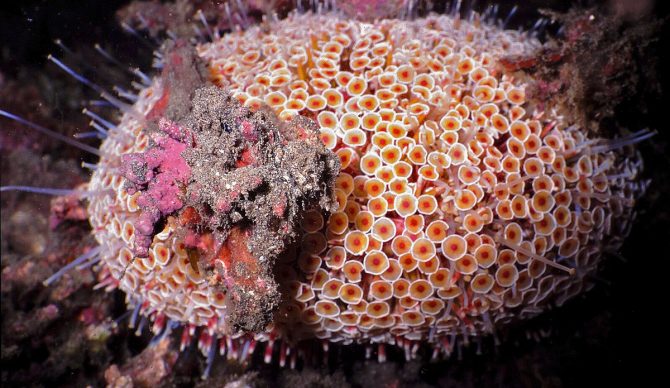
A flower urchin in the Lembeh Strait, Sulawesi. Photo: Wikimedia Commons//CC BY-SA 2.0
If you’re a surfer, you’ve likely had the pleasure of stepping on an urchin. It’s pretty horrible no matter what kind of urchin jams those little spikes into your body — and then, of course, the inevitable attempt at stabbing at them with a blunt, dirty knife to remove them on some desolate beach — but if you happen to be unlucky enough to land on a flower urchin, you’re in for a far worse time.
The flower urchin can be found on coral reefs, on rocks, in sand, in seagrass beds from Japan to Tasmania, in the Red Sea, along the east coast of Africa, and in the Cook Islands. The toxin they carry in their pedicellariae (little stalked appendages found on the body of the urchin) is absolutely brutal.
Those pedicellariae are more like claws than spines, and they have trigger hairs on them that grab onto something when touched, which then injects the venom into whatever is unfortunate enough to be on the receiving end.
That venom has something in it called Contractin A, which causes contractions in the smooth muscles in your body’s organs, like the heart. You will be alerted to the fact that you’ve done something horribly wrong by immediate, intense pain. That’s followed by muscle paralysis, difficulty breathing, and numbness.
Back in 1930, a marine biologist named Tsutomu Fujiwara grabbed a flower urchin while he was working on a fishing boat. He described what happened next in a paper published five years later.
“Instantly, I felt a severe pain resembling that caused by the cnidoblast of Coelenterata, and I felt as if the toxin were beginning to move rapidly to the blood vessel from the stung area towards my heart,” he wrote. “After a while, I experienced a faint giddiness, difficulty of respiration, paralysis of the lips, tongue and eyelids, relaxation of muscles in the limbs, was hardly able to speak or control my facial expression, and felt almost as if I were going to die. About 15 minutes afterwards, I felt the pains gradually diminish and after about an hour they disappeared completely. But the facial paralysis like that caused by cocainization continued for about six hours.”
All in all, you’d be best to avoid stepping on, or grabbing any of the creatures you see above. If you do, you can call the National Poison Control Center at 1-800-222-1222.

