
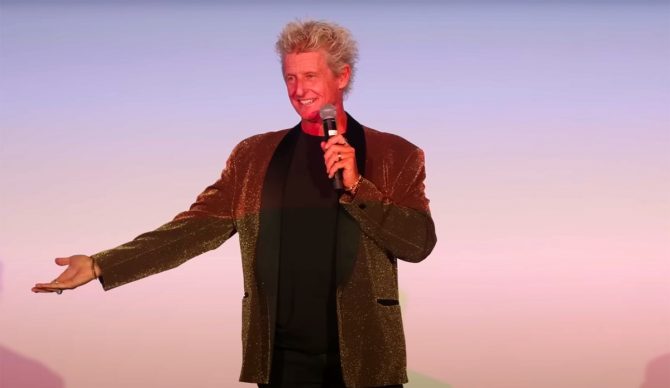
Bill Sharp, also the event director for the Big Wave Challenge Awards. Photo: Big Wave Challenge

On the evening of September 14, during a glitzy gala in downtown Los Angeles, when HBO’s hit series 100 Foot Wave earned two Emmy Awards, it was a big night for surfing. Not simply because its production team, resplendent in their sartorial finery, got to heft those garish golden statuettes. In fact, a trio of surf projects have proceeded them in receiving this coveted honor from the National Academy of Television Arts and Sciences (ABC’s American Sportsman in 1980, 2014’s Hawaiian: The Legend of Eddie Aikau from ESPN, and the 2018 film Momentum Generation.)
There’s a difference, however, between these award-winning productions and HBO’s recent triumph, and it lies in the location — in this case, the heart of Hollywood. Because while each of those aforementioned surfing productions earned “Sports Emmys” in ceremonies typically held in New York City, this was Hollywood, baby, and the 100-Foot Wave took home a Primetime Emmy. A distinction that co-producer Bill Sharp has more than earned the right to make. While working with an eminently talented team of directors, producers, cinematographers and technical wizards, when it comes to championing the riding of 100-foot waves, or anything even close to that mark, none can boast the breadth of experience as Sharp. As the founder of both the K2 Big Wave Challenge way back in 1998, and the XXL Big Wave Awards in 2000, he’s been the driving force behind big wave surfing’s popularity for almost 30 years. Consider the two Emmy Award trophies he took home last week recognition long overdue.
So, Bill, now that all the excitement and applause has died down a bit, tell us what surfing’s big night in Hollywood was like.
Being in the Peacock Theater while the Emmy Awards were going on was truly magical. It’s just like it looks like on TV. The bright lights, and cameras, the TV stars, and everyone’s wearing tuxedos. I’ve never seen so many tuxedos in my life.
Did you even have a tuxedo?
I actually have many flamboyant tuxedo jackets, but I wanted to go with something classy for a change. So naturally, I had to rent mine at Friar Tux. But it was unbelievable, because there are all these people whose entire lives are in entertainment, and, of course, we were right there in the HBO section. I was sitting on the aisle and the Saturday Night Live section was next to us, and so when each category is called up, cinematography or make up, or whatever, and someone in our row would win, we’d all be cheering for each other. Okay, we were kind of glomming onto the Saturday Night Live crew because they were winning in all these categories, but we’re right there cheering along with everyone else. It was insane.
Tuxedo’d or not, did anyone ask how you got in?
Funny thing was, no. The best part was that a lot of people seemed to know who I was, and were coming up to me, even before we’d won, to say how amazing they thought 100 Foot Wave was. Sometimes coming up to me and asking all sorts of technical questions, like, “How did you shoot that,” or “What sort of sound equipment did you use for that segment?” These are people working on these giant shows, these great producers and directors, and they’re coming up to me with technical questions.
Did you feel like that was because you were one of the faces of the show?
Well, my face was familiar. I was the guy who called Garrett McNamara a dick. But on the back end, having put together the whole Cortes Bank mission, I didn’t have to explain my presence there to anyone. There was only minimal imposter syndrome happening.
No condescension, “Hey, pretty good work for a bunch of surfer dudes” vibe?
Not at all. The whole team was regarded as, not just part of the gang, but…well, you win outstanding documentary and cinematography awards, and it’s no joke. As for myself, while we certainly had our share of Spicoli’s on the show, I felt I came across as well-spoken and able to articulate in a professional manner.
Did 100 Foot Wave have an appropriately-sized entourage?
I mean, we had seven cinematographers nominated, along with all the executive producers, all the HBO executives, the sound design team…we had a pretty significant entourage. At least 25 people. A pretty solid gang.
I doubt very few at that gala had any idea how long you’ve been in the big wave game. Did holding that Emmy trophy feel like a culmination of all those years of tireless effort?
It’s been a long, long slog. But with this project, I really was just pulled along in the slipstream of Chris Smith and Joe Lewis, who initially knew nothing about surfing, but knew how to make incredible entertainment. They were really committed to making this show different, building out characters and storylines that we in the surf world couldn’t see in the same way. We’re too close to it all. Think about it, they built out 17 hours of programming over three seasons, certainly the best surfing content that has ever been seen, by a mile. I just got pulled in to provide access to some of the core experiences, like the Cortes segment. And then be on camera as an “explainer,” putting what was going on in context. But it still took 40 years to become qualified to do all that.
While on the topic of qualified, you’re rarely recognized for your role as a Cortes Bank pioneer.
The Cortes Bank project got its start back in the late 1980s, and being in the SURFING magazine photo room with legendary photo editor Larry “Flame” Moore. I remember just killing time between photo picks, thumbing through Flame’s Southern California nautical charts, and seeing this spot 100 miles out from the coast with a depth of a half a fathom. Thinking, waves have to be breaking on this spot. This evolved into taking a plane out there and actually seeing waves, and then going out there in a boat. It continued, so that by the time we got to 2001…
Hang on, Bill. You skipped over the best part of that story.
Yeah, yeah. So, in 1990 we went out there on a small, mid-winter day in a 29-foot sport-fisher, with Flame at the helm, and a crew manifest that included myself, George Hulse and one Sam George. We get out there and find 15-foot, lovely, soft right-handers. So, we suited up and paddled out into the unknown. George caught the first wave, making history, I caught the second, and Sam, well, he was unable to participate in the way I know he would’ve liked.
So generous. But what was the longer voyage like, from that first trip to Cortes, all the way to the Peacock Theater?
I had it in my mind after watching the first season of 100-Foot Wave. I figured, okay, they’ve done Nazaré, told the Garrett story, not much more to do with that. So, I went to them with my pitch. Let’s go out to Cortes Bank and do it right.
Which in your mind meant…?
2001’s Project Neptune expedition blew minds, with the revelation that there were rideable 60-to-70-foot waves breaking out there. And there were probably 15 missions after that, right up until 2012, when on a big day Greg Long almost died. Not many surfers wanted a piece of it after that. Even so, it had never been documented well, everything shot with shaky, sea-sick camera angles off rocking boats. So basically, I went to the HBO people and said, “We’re gonna need a bigger boat.” And they said, “OK, let’s do it.”
And you got your bigger boat?
I did. And then we had a year-and-a-half to train and get everything in place, waiting for the conditions to fall into place. Until they finally did, in December of 2003.
When you obviously got it right. Thanks, in part, to the incredible conditions you encountered: giant, glassy, five-story waves. But other than great surf and gutsy performances, what distinguished this segment to make it Emmy-worthy?
What [director] Chris Smith is so good at, is going deep into the psyche of the series’ 10 main characters, mostly probing what’s messed up about them, profiling their personal problems and family turmoil, following their journeys in a way we never get to see in typical surf porn. And we also had a couple redemption stories. Garrett, overcoming the thought that he might’ve been the one who almost got Greg Long killed in 2012 [a claim that Long consistently denies], and Andrew “Cotty” Cotton, who in the previous episodes never seemed to get the best wave, constantly being yelled at by Garrett for doing things wrong, then getting the best wave of the trip — the best wave of his life. In the end, the segment included all of this, but it also, I think, captured the pure joy of going on a surf trip with your friends and having this incredible experience.
As incredible as a surfer attending the after-Emmy soiree at the Governor’s Ball?
Forty years later, sweet justice is served.
And to wrap up, the most important question: Now that you have an Emmy trophy on your mantle, do you get more waves at your local spot?
There hasn’t been a solid swell since I returned my tux. So, we’ll see.

