
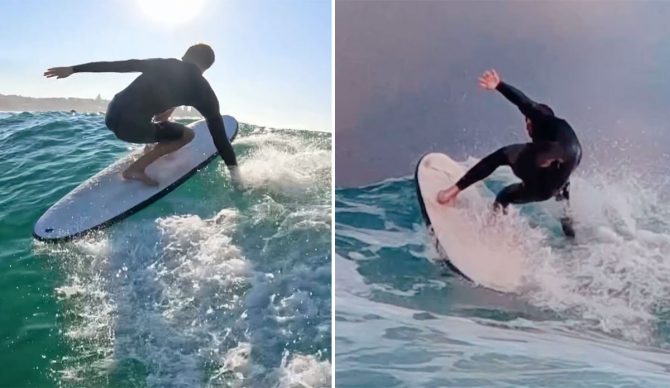
Cam Scott is fins and fancy free. Photos: Instagram

A few years ago, a friend of mine had a finless surfboard in his quiver. It was around the time when alaias were having a resurgence, and I thought, from seeing videos alone, that it looked fun. It wasn’t a traditional alia — it was a Tuna made by Tom Wegener. As it turned out, I could not surf on a surfboard with no fins. I couldn’t even come close to doing what I was supposed to be doing, and I gave up in no time at all. Some people, however, didn’t give up. One of those people is Cam Scott, who rides a finless surfboard so well it makes me think that maybe, just maybe, I could do it too.
Scott, who spent much of his time in the water on a bodyboard, was already pretty used to friction-free surfing before he got on a finless surfboard. “Because it looked that fun!” he laughed when I asked why he started. “Also, I spent more than a decade bodyboarding so it was really satisfying to translate that rail-only approach from prone to standing up.”
Alaias have been around for a long, long time. The first Hawaiian surfers surfed them, and according to Wegener, standing up wasn’t all that important. The simple act of riding a wave was. “To the ancient Hawaiians, there wasn’t a big distinction between standing on a board and belly riding,” he said in 2010. “Great surfers don’t mind belly boarding.”
There is something to be said for attempting to connect with the very beginnings of surfing, and to Scott, that’s a part of why he loves finless surfing so much. I asked him what he likes most about riding a finless board. The first is a simple reason.
“Taking surfing back to its roots,” he said. “Doing it the same way as the very first surfers feels pretty awesome. Like you’re a part of some kind of surfing renaissance rediscovering ancient texts.”
A big part of the allure of surfing is exploration. Surfing isn’t just riding waves — it’s everything that goes into riding them, from exploring the places they exist to learning when they work best and even simply just bobbing around as you wait for them. On a finless surfboard, there are more unknowns to be known.
“It’s exploring uncharted territory,” Scott continued. “Whether it’s through big waves, new combos, untested spots or finless tubes, it’s a special kind of fizz that comes from kicking out and wondering if anyone’s ever done it like that before.”
Scott, who is originally from New York, is an interesting guy outside of the water, too. He’s an artist, not only on waves but in the real sense of the word. His mediums are ever-changing, just like waves. He works in both street and gallery art, using digital mediums as well as tangible ones. Recycled materials, paint, stencils, screen printing… it’s all fair game for Scott. He’s worked with the Museum of Contemporary Art Australia, the Venice Biennale, and the Guggenheim Museum, and his efforts have been awarded with numerous accolades such as the William Fletcher Foundation Tertiary Grant, The Art Scene Award and TEDx artist talks.
That unique way of looking at the world and creating things from what he sees carries over into a unique approach to surfing. So unique that it requires him to create his own sleds on occasion. After searching for a finless board that did what he wanted it to do and realizing it didn’t exist, he decided to just make one.
View this post on Instagram
“After my favorite flat-bottomed soft boards started to be made with too much rocker for finless, I decided to make my own dead flat finless,” he explained. “No channels, no contours, and almost no drag as a result. The endless glide you get in any direction by having a completely flat bottom is wild and I find it offers much more traction on the wave face. I think the back half of a flat rail actually slices into the face and projects you forward rather than curving up the face and feeling more likely to slide out when you don’t want it to. I used a super light, low-density EPS blank that I had to get custom-made to accommodate the dead flat rocker but had it glassed very heavy as I’ve snapped way too many foamies struggling to explore the limits of finless.”
Finless surfing is a delicate thing. Even the best are constantly walking the finest of lines, and that’s a feeling that Scott enjoys. He still likes surfing on a surfboard with fins, but it’s a vastly different experience.
“It’s dancing on the edge of control and disaster,” he told me. “That same joy you felt from your first skid on a bike… Effortless early chip-ins, glorious glide through completely flat sections, the ability to enjoy otherwise inaccessible parts of the wave. I love mixing it up with finned boards, but they can feel pretty draggy in comparison.”

