
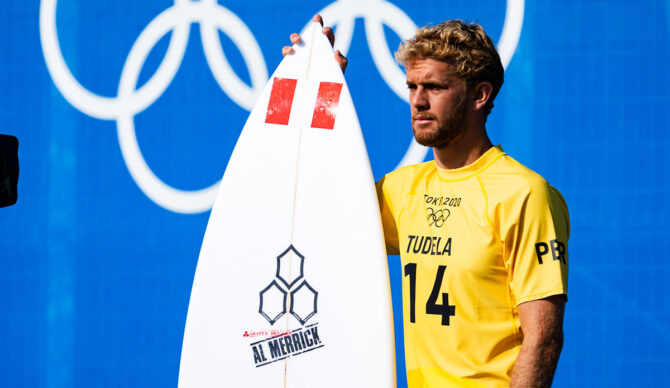
Miguel Tuleda at the 2020 Tokyo Games. Photo: Ben Reed//ISA

The International Testing Agency (ITA) has published an acknowledgment of a court decision suspending Peruvian Tokyo 2020 Olympic surfer Miguel Tudela for 16 months following a positive test for steroids. Tudela maintains the prohibited substance was administered to him mistakenly during a medical procedure. He has not appealed the ruling, and the suspension has already been fully served, retroactive to January 6, 2024.
According to the report, Tudela, 31, was selected for out-of-competition testing conducted by the ITA on behalf of the International Surfing Association (ISA), surfing’s Olympic governing authority. These tests are conducted year-round to monitor athletes outside of competition windows.
A sample collected in 2024 tested positive for metenolone, a steroid on the prohibited substances list. The ITA subsequently referred the case to the Court of Arbitration for Sport’s Anti-Doping Division, which held proceedings on August 27, 2025. The panel imposed a 16-month sanction retroactive to the date the sample was collected, ending on August 16, 2025. Any results recorded by Tudela during that period are disqualified, with the exception of the 2024 ISA World Surfing Games — which he was permitted to compete in by the ISA and ITA — where he finished 37th. Tudela did not compete in the 2025 edition of the event.
When reached for clarification, Tudela told The Inertia that the steroid was mistakenly administered as part of a plasma therapy treatment for a knee injury he suffered at the 2023 Pan American Games.
Tudela said that following a preliminary investigation, the suspension was initially lifted and he was allowed to compete at the 2024 World Surfing Games in Puerto Rico. Then, he said, the decision was later reversed, the suspension reinstated, and the case sent to the court.
“During the proceedings, we presented all the evidence demonstrating a medical error in the plasma treatment I received, which resulted in unintentional contamination,” Tudela said. “The judge concluded that there was no intent or malicious conduct on my part and considered the evidence presented credible and sufficient.”
“However, according to current anti-doping regulations, even when an athlete is deemed not to have doped intentionally, they can still be sanctioned with a suspension,” he added. “Under this regulatory criteria, the panel imposed a 16-month sanction, which had already been fully served at the time of the final ruling.”
The ISA declined to comment on the ruling.
Anti-doping cases allow for interpretation, with panels weighing factors such as the severity of the violation, whether additional samples tested positive, and whether the substance use was deemed intentional. Penalties for a first positive test can range from a warning to a two-year suspension, while a second violation can carry sanctions ranging from two years to a lifetime ban.
Tudela, who previously served on the ISA’s athlete commission, described the process as a difficult period.
“I have always fought for fair play and will continue to do so,” Tudela said. “I am deeply grateful to everyone who stood by me and believed in me during this process, especially my sponsors and brands, whose support was fundamental in moving forward and reaffirming that I never doped intentionally nor sought to gain any advantage.”
Tudela’s case is not surfing’s first run in with doping controls. In 2024, Portuguese surfer Vasco Ribeiro was handed a three-year ban from professional surfing after refusing to submit to an out-of-competition test at his home.

