
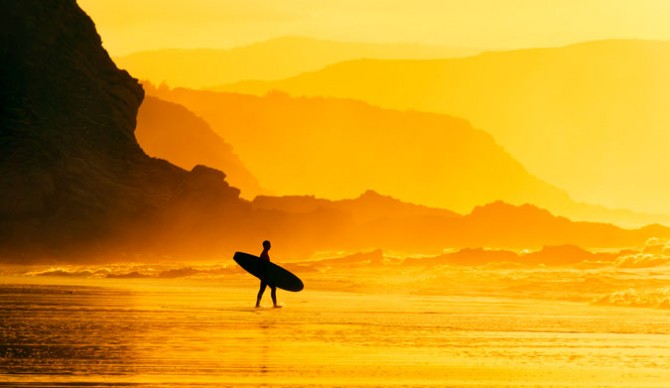
There’s something irrefutably revitalizing about the ocean. Photo: Shutterstock

Baptized and wiping out in gnarly Florida waters, as if floating, the strange lights moved slowly down the beach.
With only a beach towel wrapped around my hips, the night air sultry and warm, I awoke, padded along the boardwalk to where it descends to the sand and suddenly drew up short, startled at what I saw. It was 3:15 am. Surely no one else in their right mind could be up at this hour. But there they were, the lights. They halted, bright beams flickering over the deserted lifeguard stand. Then, as if in a ghostly dance, pairs of disembodied legs swung back and forth, feet carving messages in the damp sand. I soon realized I was watching a trio of young people pulling an all-night ramble. I tried to avoid being caught in the beams of their lamps, hunkering down in the tall sea oats not wanting to be discovered. Shortly, the dark figures danced on up the beach, the shore alive with this phantom nocturnal revel and all the while, the surf roaring as it always does, like a distant train. I walked into the shallowest shore breakers, the darkened sea less restless than the day before.
Scanning the ocean is something you do a lot if you surf. Crouching by their boards, surfers study the swells, as novelist Tom Wolfe writes, “like Phrygian sacristans looking for a sign.” As a “kook”, new to the sport, I desperately wanted the fierce northeast winds of the past few days and the pummeling shore break to calm down. At the time, however, forecasts about approaching Hurricane Isaac didn’t bode too well. I remained hopeful.
October, and I was making my second trip to Cocoa Beach, a favored spot on a barrier island, just south of Cape Canaveral, on Florida’s east-central coast, home of the famous Ron Jon Surf Shop and top-notch pro surfer Kelly Slater. It’s an hour’s ride by expressway from Orlando. Waves here pale in comparison to California’s due to the east’s low, shallow continental shelf, so swells way out in the Atlantic lose energy and speed before reaching shore. They’re perfect, however, for beginners.
I had just turned seventy and decided to honor the transition with a thousand-mile trip down from my Rochester home. I had taken my eleven-year old grandson with me a couple months earlier and, impressed by how well he had done with a basic surf lesson, I myself was determined to go from spectator to participant.
As an anthropologist, I was eager to plunge into this rarefied surfing culture, its rich lingo, technology, its varied techniques, movies, glossy surf magazines, its exotic, “outsider” mystique; even the surging popularity of surfing’s fashion industry and tourism spinoffs. As a frequent swimmer and springboard diver, I consider myself, even at seventy, physically limber and surefooted. As surfers say, I was “stoked.” The ghostly nighttime dance I saw, even now, an image that continues to burn brightly.
Within walking distance of my hotel, I rented a 9’ longboard, a “foamie” tri-fin, for a week, promising myself that, having watched dozens of YouTube videos, (including the inspirational web site www.surfersover50.com), and the remarkable award-winning documentary, “Surfing for Life,” I would “wing it” on my own for three days Then, if frustration set in, I would sign up for a private surf lesson.
It was to be, as surfing author Daniel Duane puts it, a thrilling megadose of “dermal salination therapy.”
Here, at least for this “kook, is how I worked it.
Even before entering the water several considerations surface. I looked upon these priority items as a kind of checklist. Have I practiced the all-important “pop-up” movement? Have I determined whether I’m “goofy-footed” or “regular-footed”, favoring either my right foot forward with the leash Velcroed to my rear left ankle or left foot forward, leash strapped to my right ankle. And do I know how to properly carry my board into the water, the leash cord tidily wrapped just-so around the board’s fins so as not to drag in the sand? I will also have made the key decision while at the surfboard rental shop that, because I’m a “grom,” a beginner, that I need a longboard for stability and it’s quite a bit heavier than a short board,

