
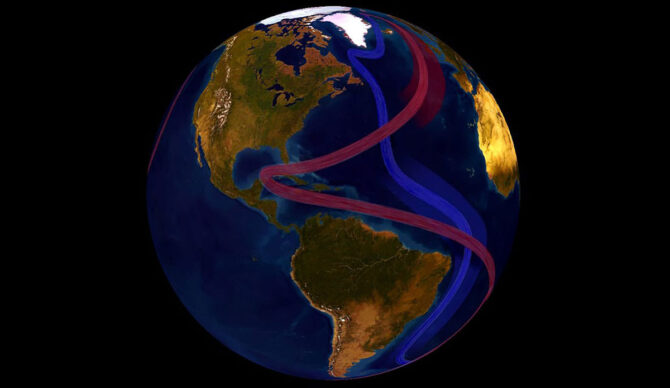
The global conveyor belt, shown in part here, circulates cool, subsurface water and warm surface water throughout the world. The Atlantic Meridional Overturning Circulation is part of this complex system of global ocean currents. Image: NASA

If you’re a believer in what the vast majority of the world’s scientists say, the ocean is warming. If you’re a believer of a small but loud minority made up of YouTubers and snake-oil salesmen, then ocean warming is fake news. The issue, though, is that reality doesn’t care about how loudly those YouTubers might scream or how many times your boomer uncle reposts Facebook memes blaming it on Obama, or whatever. The science is there and it’s proof enough — but there’s one part of the ocean that’s cooling down. And that’s bad.
The “cold blob” is in the North Atlantic, and although it’s only cooled down but about 1 degree Celsius since the 19th century, that’s enough to have global implication. Researchers think that the colder water is there because a current that traditionally has moved warmer water around isn’t doing it as effectively anymore.
The Atlantic Meridional Overturning Circulation, or AMOC, is huge and incredibly important to how the world’s climate — and in the shorter term, weather — behaves.
“AMOC plays a key role in shaping Earth’s climate by moving heat, freshwater, and nutrients around the Atlantic Ocean,” explained the Gulf of Maine Research Institute. “One of its most visible effects is on regional temperature: by transporting warm water northward, the AMOC helps keep parts of Europe and the North Atlantic milder than they would otherwise be.”
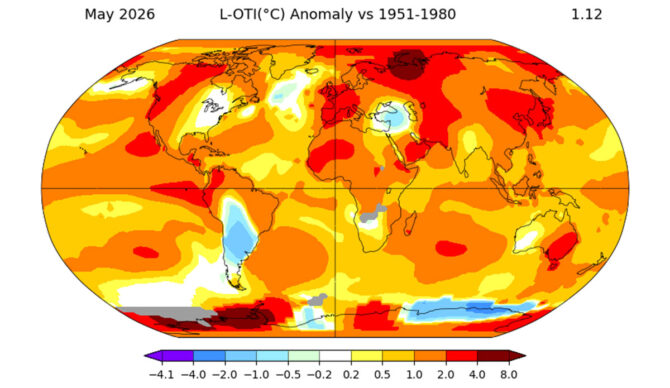
Hot spots and cold spots, but one cold spot is colder than the rest. Image: NASA
Now, the science world has known for quite some time that the AMOC appeared to be slowing down, but they didn’t know exactly why. They thought, perhaps, that there was simply less warm water moving through the AMOC, which would’ve explained the cold blob. They also thought that maybe that particular area was losing heat into the atmosphere, but they wanted to pin it down for certain.
“To sort this out, physical oceanographer Stefan Rahmstorf and his colleagues reanalyzed decades of North Atlantic temperature and heat flux data,” wrote Science News. “Temperature records there go as far back as 1870, with satellite records kicking in around 1993. If the AMOC was holding steady, and the surface was the source of the heat loss, the data should show an uptick in heat flux to the atmosphere over time.”
When they pored over the immense amount of data, however, that’s not what they found. When diving deeper, they found that in the last 50 years alone — especially from 1993 onward — the largest drop in heat was from the top 3,000-or-so feet of the North Atlantic Ocean, which (not coincidentally) is where the AMOC runs. That means, at least to the researchers’ eyes, that “the AMOC’s heat supply to this region has been declining over the last few decades.”
If the AMOC simply collapses, which isn’t entirely out of the realm of possibility, we could expect some seriously disastrous weather patterns.
“Such a collapse would be what scientists call a ‘climate tipping point’ —an event that would lead to sudden, wide-reaching impacts that are difficult if not impossible to reverse,” wrote the MIT Climate Portal team. “Changing currents would cause sea levels to rise swiftly in areas like the U.S. East Coast, storms would grow more severe, the rainy and dry seasons in the Amazon may flip, and the ice age pattern of a cooling north and warming south would play out once again.”

