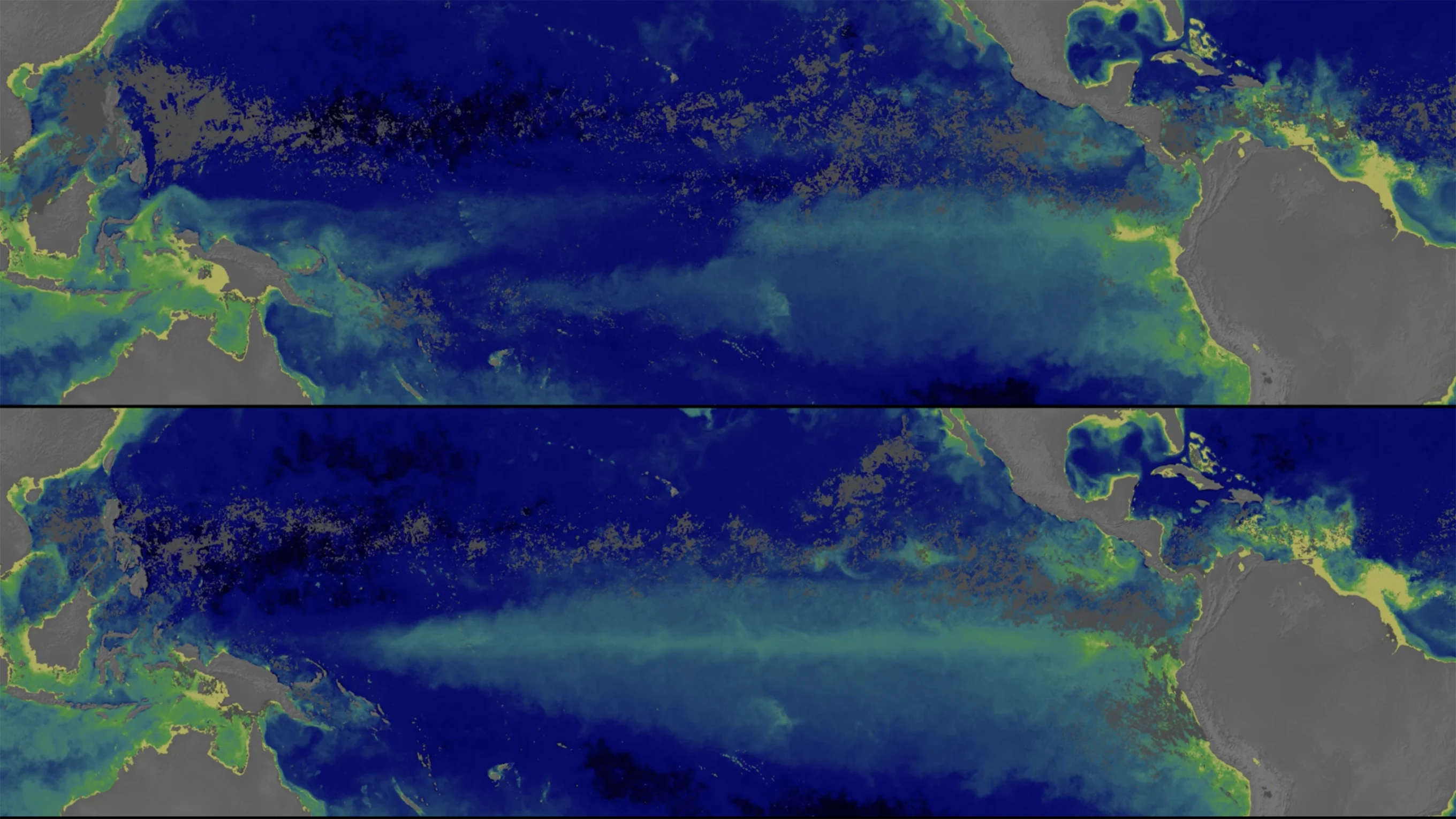
Data from a NASA satellites shows something beautiful but alarming: the Pacific Ocean has changed colors over the last year or so, going from its usual greenish blue to a much deeper shade of blue. The reason? El Niño. The color change is due to phytoplankton populations, which are affected by water temperatures.
“This is an expected effect of El Niño,” NASA researchers wrote. “Phytoplankton thrive in cool, nutrient-rich waters, but during an El Niño, the weakening trade winds reduce the upwelling of nutrient-rich deep water to the ocean surface. With limited food supply, phytoplankton abundance drops. This decline can trigger cascading effects across the marine food web, forcing other marine life to relocate to new feeding grounds.”
As El Niño gathers strength, the warm waters of the Pacific are killing off vast numbers of phytoplankton. That sounds bad, obviously, but when you learn how important phytoplankton is, it’s even worse.
“Phytoplankton are mostly microscopic, single-celled photosynthetic organisms that live suspended in water,” wrote the Woods Hole Oceanographic Institution (WHOI). “Like land plants, they take up carbon dioxide, make carbohydrates using light energy, and release oxygen. They are what is known as primary producers of the ocean — the organisms that form the base of the food chain.”
Phytoplankton is a varied species. They run the gamut in terms of colors — from green and blue to red and brown. In the equatorial region of the Pacific, it’s generally the green pigments that rule the day.
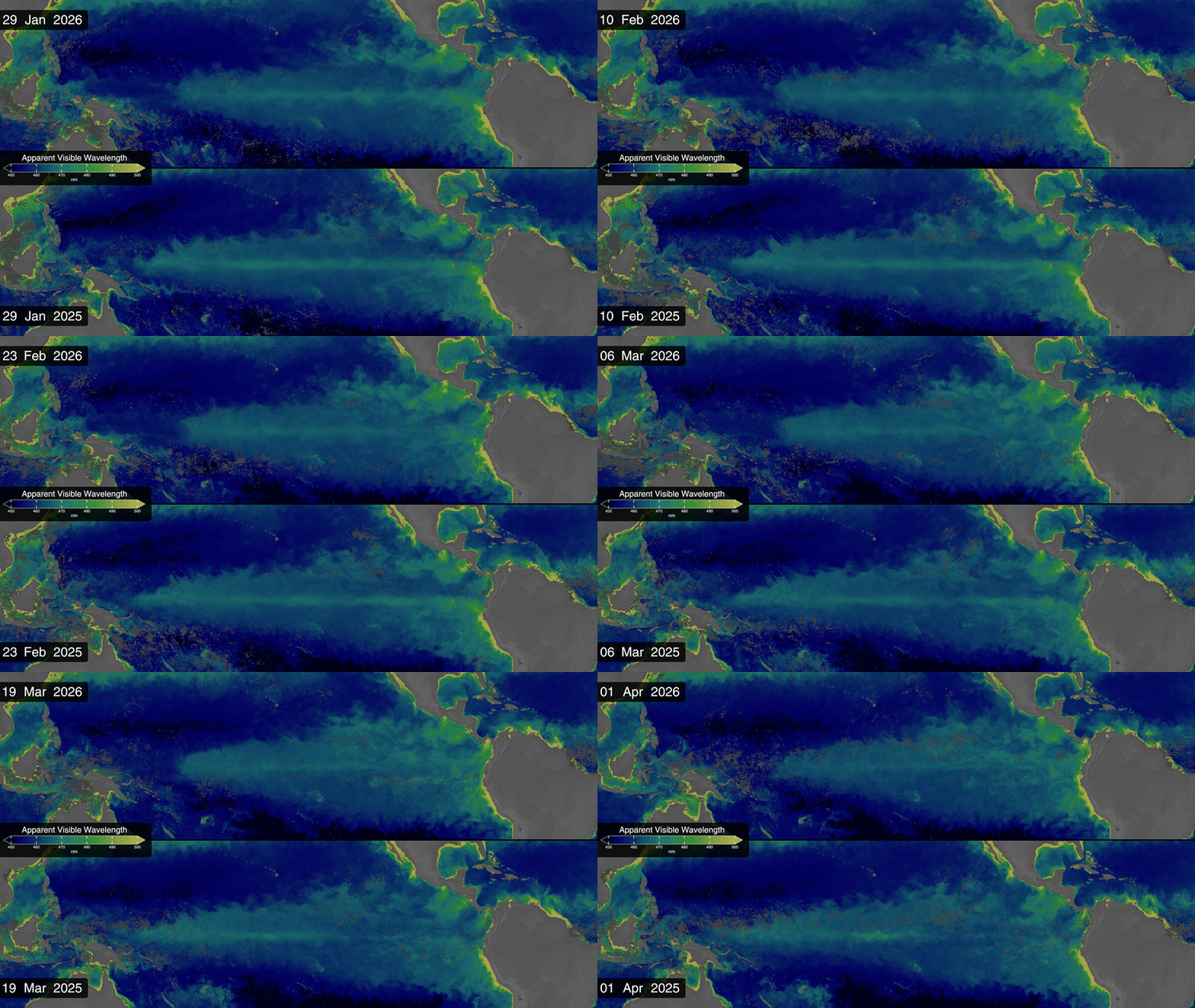
“Since these photosynthesising organisms prefer cooler, nutrient-rich waters,” wrote IFLScience, “they’ve suffered during this year’s super-strong El Niño event, which has brought warmer temperatures to the Pacific Ocean and reduced the upwelling of nutrient-rich waters from the deep.”
The color change was seen from space by a NASA satellite called the PACE that floats around up there staring down at the seas in an effort to track the blooms and die offs of phytoplankton.
When researchers compared the data between 2025 and 2026, they couldn’t help but notice that the ocean was markedly bluer. That usually means less phytoplankton in the equatorial Pacific.
“Through much of 2025, a ribbon of greenish phytoplankton bridged the Pacific’s waistband, stretching from Latin America to Southeast Asia,” IFLScience continued. “In the midst of 2026’s El Niño, however, that verdant line isn’t nearly as robust, especially in the Central and Western Pacific.”
So what, exactly, does that mean for marine ecosystems? As you’d expect when “the base of the food chain” is disrupted, it’s not great. Things like krill eat phytoplankton, which are then eaten by much larger animals like whales. If the phytoplankton supply drops, animals will begin to starve from the bottom of the food chain to the top.