
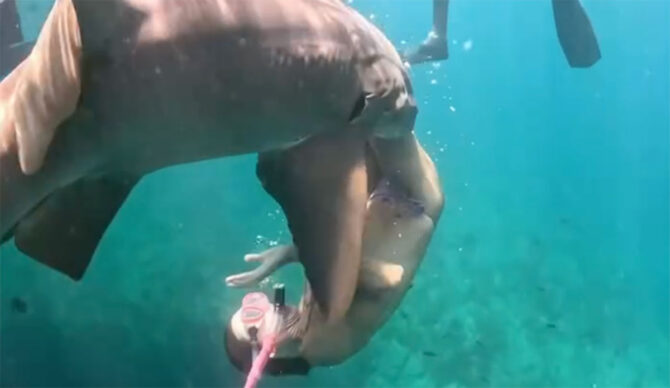
Tayane Dalazen, mid-bite. Photo: Instagram//Screenshot

Social media influencers will do a lot to get the clip – an embarrassing number of things, many of them stupid or just downright dangerous. Researchers are becoming increasingly alarmed about the rise in social media videos that feature people swimming with, touching, or even riding on sharks… all for the sake of the ‘gram.
“I’m seeing these videos every single week now and it’s way more than it ever used to be,” shark scientist Kristian Parton told the BBC. “We’re going to see people ending up in really serious incidents with sharks.”
In one particularly egregious example, a 37-year-old Brazilian lawyer named Tayane Dalazen, who has nearly 50,000 followers on Instagram and more on other forms of social media, was swimming with sharks on a tour when she was bitten on the leg by a seven-foot nurse shark. After a few terrifying seconds where Dalazen found herself being held underwater, she was released with a few lacerations on her thigh.
She posted the video to her social media and sat back as her watch count skyrocketed. At the time of this writing, over half a million people have liked the video and it’s been viewed tens of millions of times. As a result of the attack and her relatively large following, she took part in a Discovery Channel documentary (Shark Week), where the case was analyzed by experts to better understand the circumstances of what happened. Although Dalazen denies being in the water with sharks for clicks, she does admit that she was too close to the animal.
View this post on Instagram
That’s just one of many examples, and thankfully, it wasn’t worse. Sometimes, it is worse, and sharks can inflict some serious damage, even when they’re simply test biting.
The International Shark Attack File, a widely-used resource that tracks shark interactions with humans around the world, told the BBC that it has seen a large increase of people being bitten by sharks while trying to film themselves.
You may remember the woman who had her hands bitten off last year in the Caribbean after she tried to take a picture of a bull shark. Or the content creator from China who was bitten in the Maldives. Or the snorkeler in Israel who was killed by sharks while holding a selfie-stick. There are countless examples, and the numbers of those examples are only expected to rise.
In a recent study of expeditions that had influencers swimming with wildlife, it was found that influencers and photographers were the most likely to ignore safety instructions. While the risk of being attacked by a shark are still very, very low, the uptick in people purposely getting close for the shot are increasing the risk.

